European natural gas reached a three-year peak around the same time, with the European Central Bank (ECB) expected to raise its deposit rate on Thursday. The currency pair has yet to price in either development. What keeps the Euro constrained is a bill due before winter, a issue that no interest rate differential can resolve.
Front-month Dutch gas rose up to 3.4% on Tuesday, hitting its highest level since January 2023 and trading near €75.00 per megawatt-hour—nearly 128% above its level from one year ago. European storage stands at 67% capacity, compared to the seasonal norm of 83%, with less than a month remaining before the heating season begins. The Strait of Hormuz has remained closed since February 28, and Qatar has extended force majeure on shipments bound for Europe and Asia into the autumn.
The ECB is widely expected to lift the deposit rate to 2.5% from 2.25% on Thursday, while the main refinancing rate is set to rise to 2.65%. That adjustment represents a quarter-point of additional annual yield on Euros parked in Frankfurt. However, the energy the monetary union cannot produce internally must be acquired abroad at whatever price the next bidder demands, a purchase process that repeats weekly until storage tanks are filled.
Eurozone inflation accelerated to 3.3% in August from 2.9% in July, primarily driven by surging energy costs. Because the rate increase is largely priced in, the Euro's reaction may depend heavily on remarks from President Christine Lagarde and the ECB's updated economic projections. Traders will monitor signals on whether policymakers are considering another rate hike past September or planning a pause.
Meanwhile, the Bank of Canada (BoC) kept its benchmark interest rate unchanged at 2.25%, a decision fully anticipated by markets. However, the central bank adopted a more cautious tone, noting that inflation risks have tilted upward and assessing the economic recovery has become increasingly complex.
Governor Tiff Macklem stated that multiple rate hikes could become necessary if inflation remains a persistent challenge. Nevertheless, he emphasized that upcoming decisions will depend entirely on how the inflation outlook and surrounding risks evolve. Echoing this view, Senior Deputy Governor Carolyn Rogers stressed that monetary policy cannot react to a single data point or isolated risk, but must rely on a comprehensive assessment of the broader economy.
The central bank's statement also highlighted a challenging mix of macroeconomic factors, including softening labor demand, persistent excess supply, and growing uncertainty surrounding the sustainability of the recovery. Additionally, new U.S. tariffs and potential future trade measures continue to weigh on the growth outlook, while ongoing conflict in the Middle East keeps energy prices elevated, amplifying upside risks to inflation.
Technical Analysis
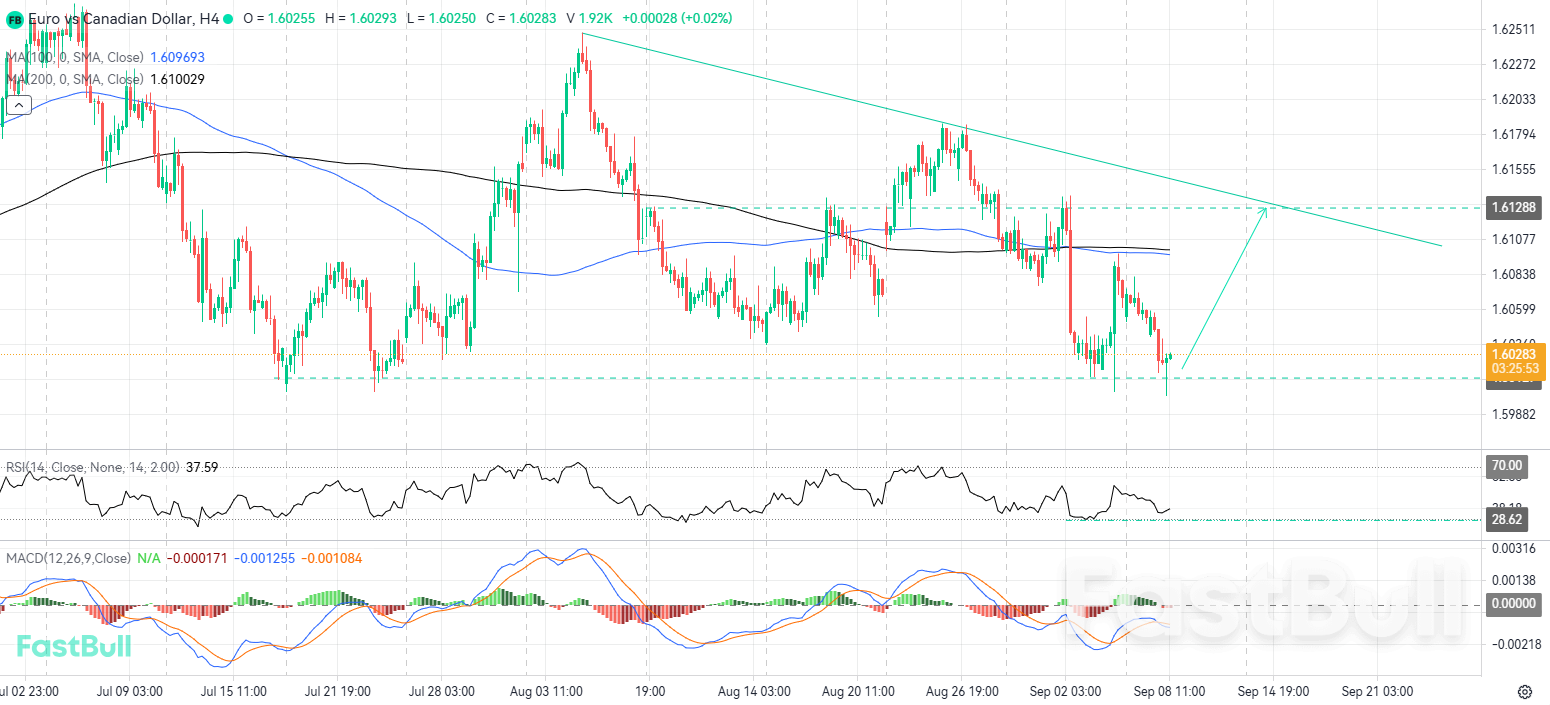
EURCAD has established solid support around the 1.6013 level, a region from which price has bounced upward on multiple occasions. Most recently, the pair briefly tested this zone before rebounding sharply, opening buying opportunities toward the descending trendline and key resistance at 1.6128. Meanwhile, the 100-period and 200-period moving averages are clustered closely at 1.6096 and 1.6100, indicating that local average price sits in this area and reinforcing the view that an upward retracement appears to be the logical next move.
On the oscillator side, the RSI previously reached an oversold reading of 28 during the prior test of support and currently sits near 36, giving buyers room to regain control from these lower strength levels. Concurrently, the MACD histogram shows minimal bearish depth, suggesting an impending bullish crossover, while the signal lines remain just below the neutral zone. A crossover into positive territory would further confirm that the path of least resistance points upward.
Trading Recommendations
Trading direction: Buy
Entry price: 1.6026
Target price: 1.6128
Stop loss: 1.5970
Validity: Sep 18, 2026 15:00:00


