Data published last week showed a significant recovery in the U.S. labor market. Nonfarm Payrolls (NFP) increased by 162,000 jobs during August, easily topping both the revised 21,000 figure from the prior month and market expectations of 56,000. At the same time, the unemployment rate held steady at 4.1%, reflecting a labor market that continues to show resilience despite signs of moderation observed in earlier months.
Following the release of this data, market participants raised their expectations for another interest rate hike by the Federal Reserve (Fed). According to the CME FedWatch tool, the implied probability of a rate increase at next week's monetary policy meeting rose to 60%, up from 50% recorded prior to the jobs report.
On the geopolitical front, tensions in the Middle East intensified once again. Over the weekend, the United States launched strikes against three Iranian oil tankers in response to a previous ballistic missile attack by Iran's Islamic Revolutionary Guard Corps (IRGC) against U.S. Navy vessels. Meanwhile, the Iranian Navy claimed to have targeted oil tankers transiting unauthorized routes in the Strait of Hormuz, alongside three other U.S.-flagged vessels in different locations. These developments keep risks to global energy supply elevated and continue to support oil prices.
Meanwhile, U.S. President Donald Trump stepped up pressure on the Federal Reserve by publicly reiterating the need to lower interest rates. Trump asserted that if the Fed does not cut rates, the United States could rethink its commercial relationships with countries with which it maintains trade deficits, introducing an additional political dimension to the monetary policy debate.
Looking ahead to this week, market attention will focus on a series of key U.S. economic indicators, including the Producer Price Index (PPI), the Consumer Price Index (CPI), initial jobless claims, the monthly budget statement, and the University of Michigan consumer sentiment survey. These data points will be decisive in assessing the inflation trajectory and shaping expectations surrounding the Federal Reserve's upcoming policy decisions.
In Switzerland, trade data continues to reflect a gradual loss of competitiveness across one of the economy's most crucial sectors. Since 2019, the country has surrendered market share in its main export category—pharmaceutical products—recording double-digit declines in select international markets. Although China has expanded its global footprint, most of the market share lost by Swiss firms has been captured by other international competitors.
On the other hand, comments from Swiss National Bank (SNB) Governing Council member Petra Tschudin were interpreted as dovish from a monetary policy perspective. In an interview with Finanz und Wirtschaft, Tschudin stated that the central bank remains prepared to push interest rates back into negative territory if necessary to keep inflation within its target range of 0% to 2% over the medium term.
Headline inflation currently stands at its highest level since September 2024, coming in above the SNB's third-quarter forecast of 0.6% year-over-year. Core CPI inflation also surprised to the upside at 0.4% year-over-year (versus the 0.3% consensus), following four consecutive readings of 0.3%.
Technical Analysis
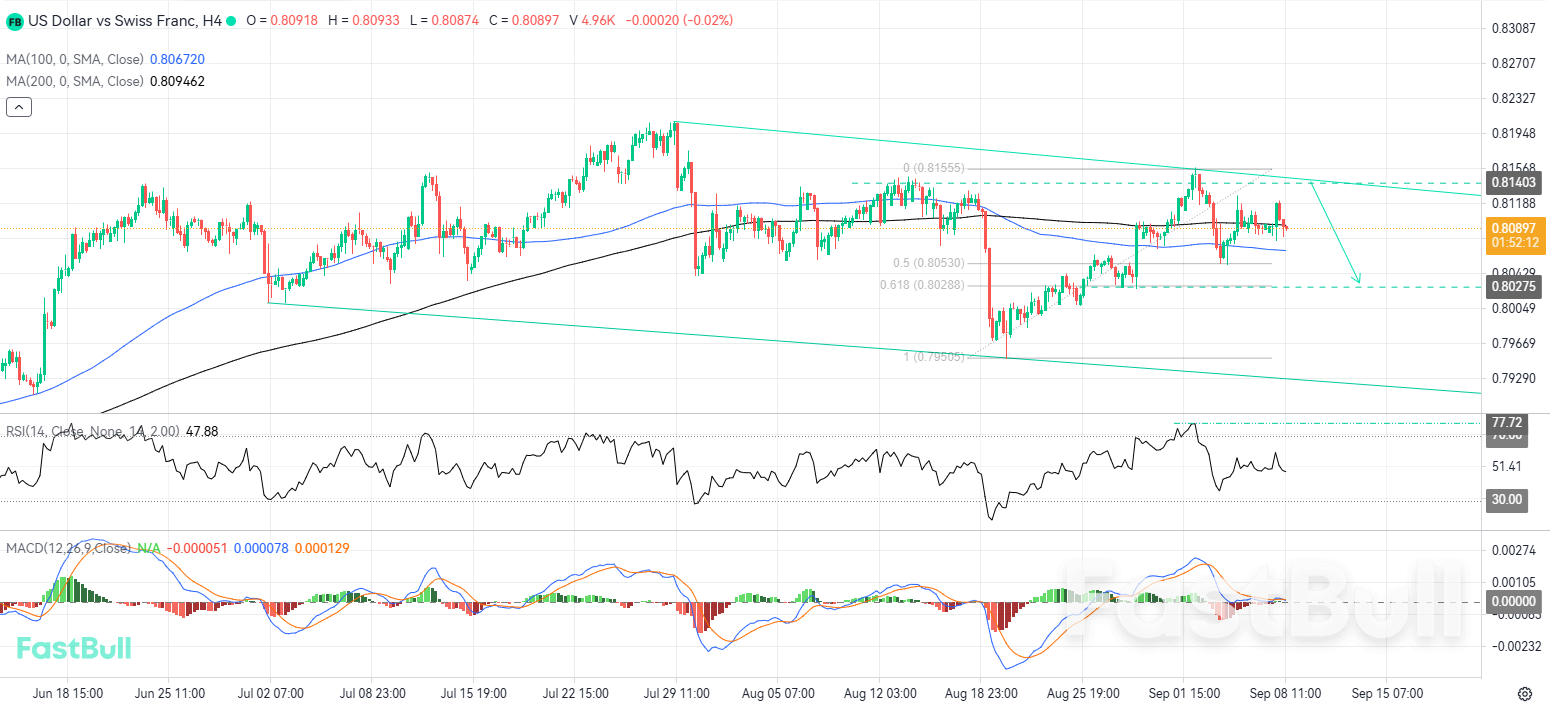
USDCHF is moving within a downside channel, having recently bounced lower from the 0.8155 level. For now, price action is consolidating as it attempts to close lower through the 100-period and 200-period moving averages, positioned at 0.8067 and 0.8094, respectively. A clean close below these levels could accelerate downside momentum toward local support at 0.8027, where the 0.618 Fibonacci retracement level is also located, making this zone a key downside target.
Turning to the oscillators, the RSI recently reached 77 in clear overbought territory and currently sits at 47, re-entering negative territory where downside momentum could accelerate. Meanwhile, the MACD presents a shallow bearish histogram; if momentum builds, the histogram could regain depth. With the signal lines sitting very close to the neutral threshold, a quick cross lower could align indicators to support an extended downside move.
Trading Recommendations
Trading direction: Buy
Entry price: 0.8140
Target price: 0.8027
Stop loss: 0.8190
Validity: Sep 18, 2026 15:00:00


