Eurozone industrial production grew by a minor 0.1% month-over-month in April, according to data published by Eurostat, landing below the 0.3% increase expected by the market. On a positive note, the figures for March were revised upward, showing a 0.4% gain compared to the 0.2% originally published a month ago. On a year-over-year basis, the indicator showed a growth rate of 0.3% after dropping by 2.8% in the previous month, a figure that was revised downward from the initially reported positive reading. Alongside industrial production, the Eurozone released its trade balance statistics, showing a deficit of one billion euros in April, which disappointed market expectations of a 7.8 billion surplus. The data for March was also revised lower, with the surplus shrinking to 4.9 billion euros against the 7.8 billion previously published. In response to these conditions, ECB Governing Council member Martins Kazaks stated that the central bank still sees upside risks for inflation and remains prepared to act again if necessary. Similarly, ECB policymaker Joachim Nagel noted that policy conditions are still largely neutral and warned that second-round effects coming from energy costs cannot be excluded. Nagel also mentioned that the ECB keeps all options open for its upcoming July meeting.
This environment follows recent actions where the European Central Bank (ECB) met market expectations by raising its key interest rates by 25 basis points on Thursday, positioning the deposit facility rate at 2.25%. With this decision, the institution ended a period of seven consecutive meetings with an unchanged monetary policy, inside an economic backdrop marked by growing inflationary pressures coming from rising energy costs. In its official statement, the ECB highlighted that the ongoing conflict in the Middle East is contributing to higher inflation risks, noting that the rate adjustment is appropriate under various scenarios that evaluate the potential development of the energy shock and its medium-term impact on the Eurozone economic outlook. During the subsequent press conference, ECB President Christine Lagarde repeated that future policy choices will remain strictly dependent on incoming economic data and dismissed the idea of a pre-set path for interest rates.
On the geopolitical stage, the proposed agreement between the United States and Iran would end the conflict, reopen the strategic Strait of Hormuz, and start 60 days of negotiations over Tehran's nuclear program. Regarding uranium, the U.S. agreed that Iran will dilute its highly enriched stockpile inside the country, with the exact mechanism to be discussed during the 60-day talks. On the economic front, U.S. inflation data showed that producer prices increased by 6.5% year-over-year in May, coming in higher than the 5.7% recorded in April and beating the market forecast of 6.4%. Meanwhile, the core Producer Price Index (PPI), which excludes volatile energy and food components, grew by 4.9% year-over-year, landing below the consensus market expectation of 5.4% and remaining unchanged compared to the previous month.
Recent U.S. inflation figures, covering both consumer and producer prices, remained above the Federal Reserve's 2% target, which could prompt the central bank to take policy action. However, the potential end of the war might lead policymakers to keep current interest rates steady for the rest of the year, contrasting with investor expectations from last week that anticipated a rate hike. On Wednesday, the Fed will announce its interest rate decision, marking the first policy meeting under the leadership of Kevin Warsh, followed by his official press conference. Financial markets will be monitoring how he communicates, his specific approach to the central bank's balance sheet, and the overall policy stance he adopts as he begins his four-year term.
Technical Analysis
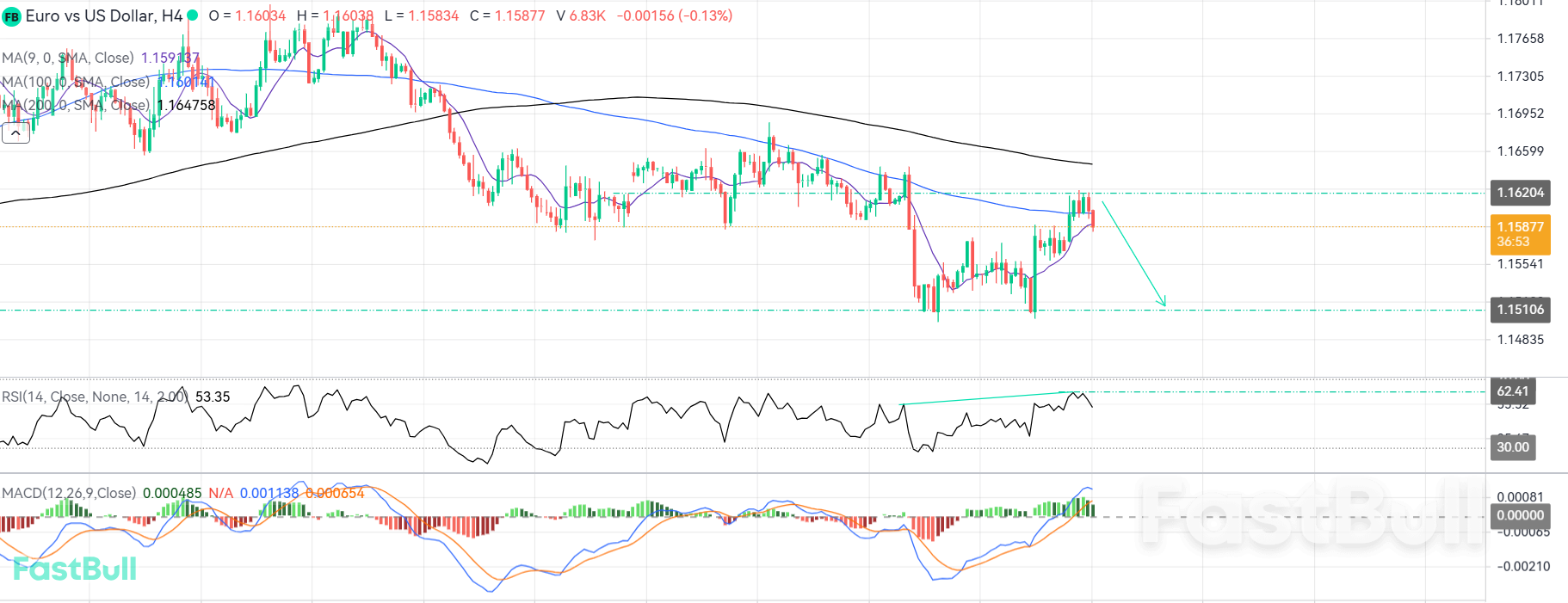
From a chart perspective, EUR/USD has faced a downward rejection at the horizontal resistance level of 1.1620, a zone marked by a visible price gap where the market has shown a clear reaction before. This turn from the ceiling could serve as an early sign of a renewed downward move from this area. This price action is currently developing very close to the 100-period Moving Average tracking at 1.1601, while the 200-period Moving Average follows slightly above at 1.1647, offering another potential layer of dynamic resistance for buyers. If this downward momentum is maintained over the near term, the price could expand its move toward the lower objective at 1.1510, which represents the local support floor reached during recent sessions.
A review of the oscillator section provides secondary confirmation for this potential downward path. The Relative Strength Index (RSI) is currently tracking at the 53 level after briefly hitting a local peak near 62. While it is not trading inside oversold boundaries, a hidden bearish divergence is starting to emerge on the chart, indicating that the recent upward strength is fading away quite quickly.
At the same time, the MACD indicator is showing a positive histogram that has begun to decrease in size. A clean transition into a negative histogram would add more technical weight to the broader downward trend. Furthermore, since the signal lines recently crossed just above the neutral zero line, a quick return back underneath this threshold would provide more confirmation for the downward movement, keeping short positions favored on intermediate price bounces.
Trading Recommendations
Trading direction: Sell
Entry price: 1.1587
Target price: 1.1510
Stop loss: 1.1660
Validity: Jun 26, 2026 15:00:00


