Fundamentals
The Bank of Japan (BOJ) recently refrained from signing a joint statement by multiple central banks supporting Federal Reserve Chair Powell, drawing market attention. This decision is widely interpreted as continuing its long-standing tradition of avoiding political and controversial issues, while also being closely tied to Japan's current domestic political environment. Multiple government sources revealed that the BOJ informally sought the government's opinion on whether to sign the statement, but failed to obtain clear support amid time constraints and sensitivity in Japan-U.S. relations. Relevant officials worried that a public stance might trigger unnecessary friction with the U.S. as Japan faces an early general election. Although BOJ Governor Ueda Kazuo has repeatedly emphasized the importance of central bank independence, he has not publicly responded to remarks by the Trump administration attacking the Fed. Analysts noted that this cautious attitude aligns with the BOJ's consistent style and reflects that it is not entirely immune to political influence. Affected by the Japanese government's deep historical involvement in monetary policy, the BOJ is particularly restrained when dealing with overseas political disputes. Former BOJ Policy Board member Takahide Kiuchi believes that in the current environment, maintaining silence externally is seen as the safest option, especially to avoid additional pressure on the Japanese government from the Trump camp. With Prime Minister Takaichi Sanae's trade policies still in effect, the yen's recovery momentum is expected to be limited. Market experts have already priced in expectations of Takaichi Sanae winning the early general election. Takaichi Sanae is expected to announce the election results after dissolving the House of Representatives next week. Her victory will help secure support for her budget proposal, which is expected to include higher spending plans—beneficial for Japanese stocks but unfavorable for the yen.
On the U.S. side, November retail sales rose more than expected, indicating robust growth momentum in the fourth quarter, driven mainly by a rebound in auto sales and increased household spending across multiple sectors. However, economists pointed out that consumption growth shows a clear "K-shaped divergence": high-income groups supported the overall data, while low-income households faced greater pressure from rising prices of necessities like food, closely linked to the Trump administration's comprehensive tariff policies. Meanwhile, the U.S. Producer Price Index (PPI) recovered moderately, with rising energy costs as the main driver. However, companies absorbed some costs by compressing profit margins, curbing further inflation. Financial markets reacted relatively mildly to these data: the dollar failed to extend its previous rally, U.S. Treasury yields retreated, and traders continued to weigh prospects for Fed policy and geopolitical risks. Although the market generally expects the Fed to keep interest rates unchanged in the coming months, political pressure on Powell still casts a shadow over the dollar's outlook. Concerns about potential damage to Fed independence once intensified but have recently eased.
Technical Analysis
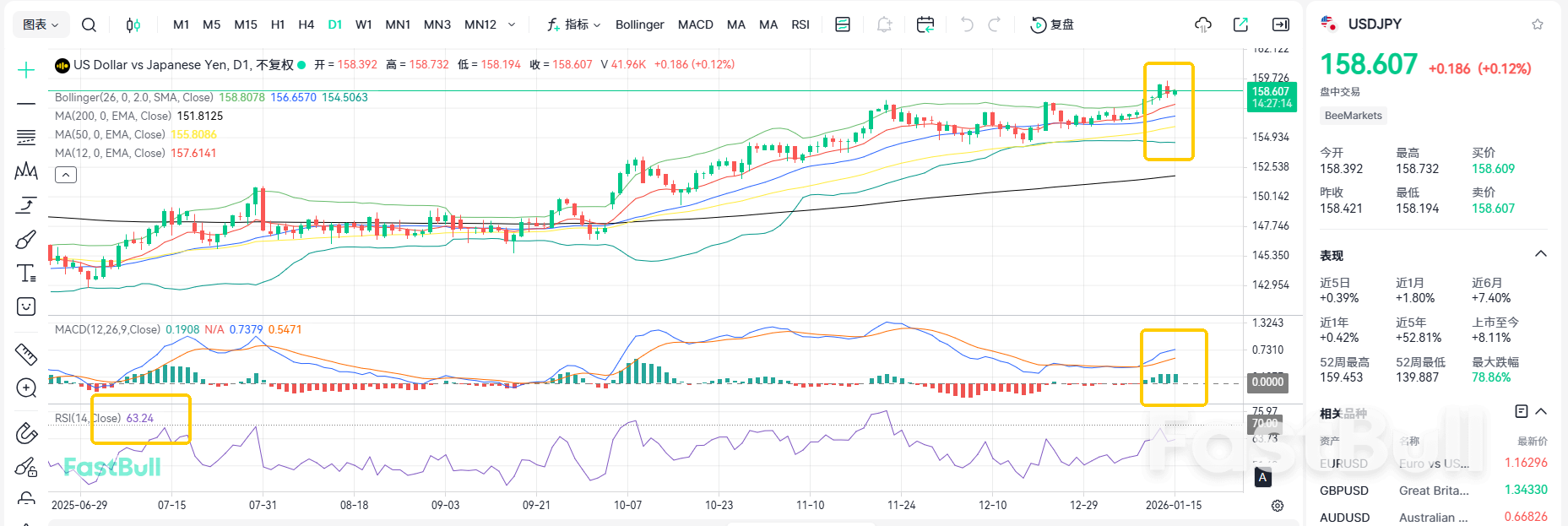
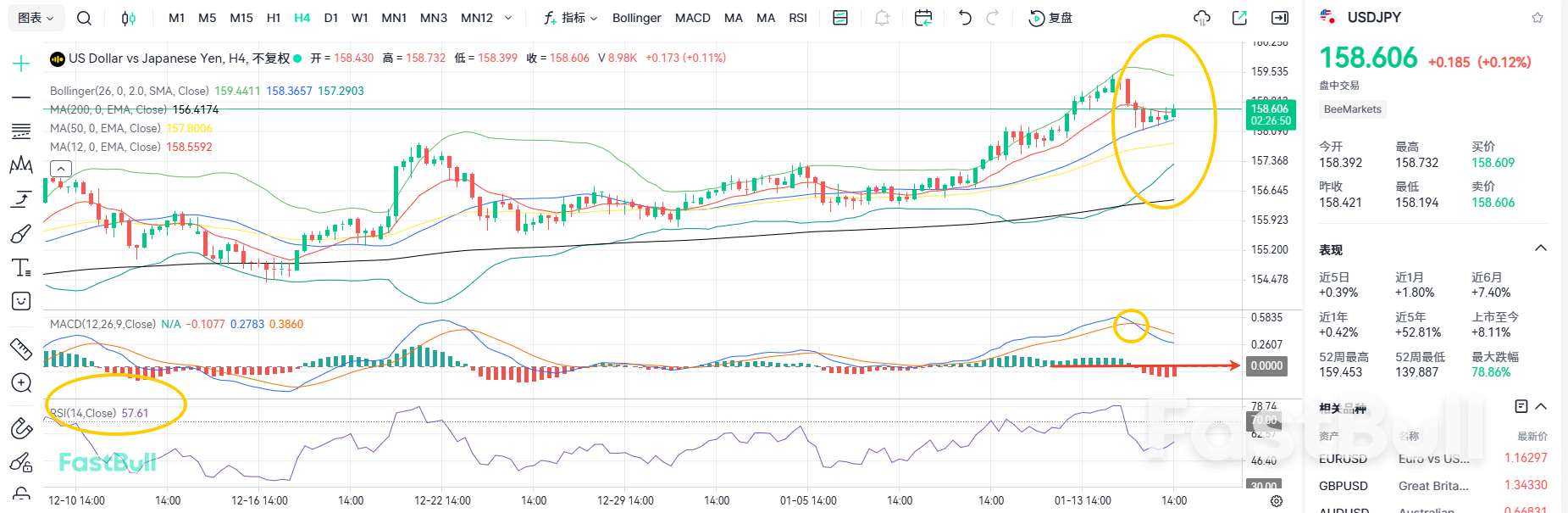
Regarding the daily chart, the Bollinger Bands are expanding upward, the moving averages are diverging higher, and prices are rising strongly along the Bollinger Upper Band. After the golden cross, upward momentum remains intact. Overall, there is a high probability of testing 160 and 162. The RSI stands at 63, with lows gradually rising, indicating investors are predominantly buying. Based on the 4-hour chart, prices fluctuate upward along the Bollinger Upper and Middle Bands, remaining within an upward trend channel. As long as prices fail to break below the Bollinger Middle Band effectively, they are expected to test 160. After forming a death cross, the MACD and signal lines are pulling back toward the 0-axis but remain some distance away, suggesting adjustments are incomplete. Support levels are at 158 and 157.8. The RSI is at 57, placing the market in a wait-and-see zone. Buying at lows is recommended.
Trading Recommendations:
Trading direction: Buy
Entry Price: 158.6
Target Price: 162
Stop Loss: 156.5
Support: 157.5/156.5/155
Resistance: 160/161/162