Fundamentals
The Canadian economy faces dual challenges from both domestic and external sources: on the one hand, the manufacturing and small business sectors are under pressure, with investment and entrepreneurial activity weakening; on the other hand, the external trade environment and geopolitical risks continue to create uncertainty. Although financial markets have reacted positively in the short term due to improved risk sentiment, the recovery of economic fundamentals remains dependent on greater policy stability and further clarification of the external environment. Canada’s manufacturing sector saw a marked rebound in February, with sales rising by 3.1% month-on-month, reversing the decline of the same magnitude recorded in January. However, this recovery was largely driven by short-term factors rather than an improvement in fundamentals. Previously, some automotive manufacturers in Ontario had experienced longer-than-expected production stoppages due to planned refurbishment and maintenance, resulting in an unusually low output in January; the resumption of production in February led to a significant increase in sales of motor vehicles and parts. Although sales of transport equipment showed strong month-on-month growth, they were still down 10.2% year-on-year, whilst overall manufacturing sales also fell by 4.6% year-on-year. Analysts point out that US trade policy, particularly tariff measures, continues to exert pressure on the Canadian manufacturing sector. Against this backdrop, corporate investment sentiment remains subdued, and the forthcoming review of the USMCA has also become a significant source of uncertainty affecting the sector’s outlook.
The number of people claiming unemployment benefits in the US fell last week, indicating that labour market conditions remain stable, although employers remain cautious about hiring new staff and the conflict in the Middle East is casting a shadow over the economy. Data released by the US Department of Labour on Thursday showed that seasonally adjusted initial claims for state unemployment benefits fell by 11,000 to 207,000 in the week ending 11 April. Economists polled by Reuters had forecast a figure of 215,000. Since the start of the year, initial claims have remained within the range of 201,000 to 230,000. Although redundancies remain at low levels, the oil price shock triggered by the US-Israel war against Iran may be hampering recruitment. The Federal Reserve’s Beige Book, released on Wednesday, noted that “several districts observed increased demand for temporary or contract workers, as businesses remained cautious about committing to permanent employment.” The report, based on information gathered in early April, also noted that the conflict in the Middle East “was viewed as a major source of uncertainty, complicating business decisions regarding hiring, pricing and capital investment, with many firms adopting a wait-and-see approach.” Since the war broke out in late February, oil prices have surged by more than 35%. Government data shows that the rise in oil prices in March pushed up both consumer and producer prices. President Trump has imposed a blockade on the Strait of Hormuz, blocking Iran’s maritime trade in and out. Economists say the labour market had already been stagnant prior to the war, attributing this to the uncertainty caused by Trump’s sweeping import tariffs and mass deportation policies. The conflict in the Middle East has merely added another layer of uncertainty for businesses. Data shows that for the week ending 4 April, the number of people continuing to claim unemployment benefits after their initial week (known as continuing claims, a proxy for hiring) rose by 31,000 to a seasonally adjusted 1.818 million. Continuing claims have fallen from last year’s peak, which may be partly because people have exhausted their eligibility for benefits (limited to 26 weeks in most states). This figure does not include young workers on partial unemployment, who typically have limited or no work experience. The labour market remains challenging for this group.
Technical Analysis
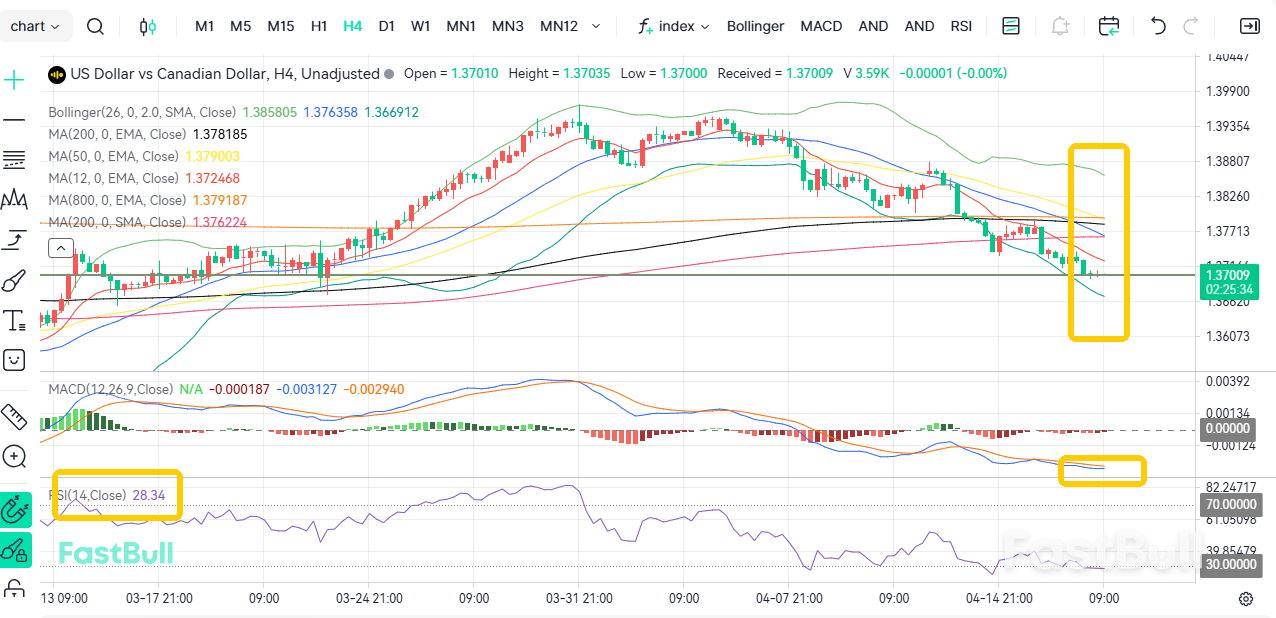
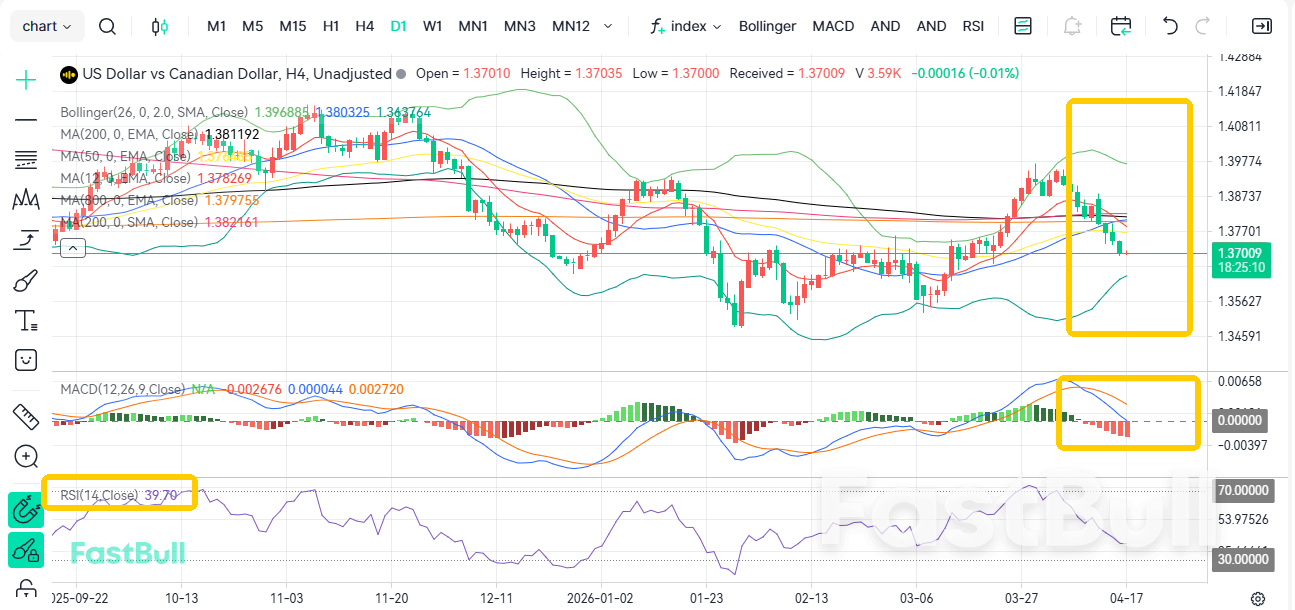
Looking at the USD/CAD on the four-hour chart, the Bollinger Bands are widening downwards and the moving averages are diverging downwards. The price is oscillating lower between the lower Bollinger Band and the 12-period EMA, with the short-term downtrend remaining intact. However, the MACD fast and slow lines are on the verge of a golden cross, and the candlesticks have formed consecutive doji patterns, suggesting a rebound could occur at any moment. Resistance lies near the middle Bollinger Band and the 50-period EMA, at 1.376 and 1.38 respectively. The RSI stands at 280, indicating that market sentiment is predominantly bearish. On the daily chart, the Bollinger Bands are narrowing and the moving averages are flattening out. The price has reached a key psychological support level in the short term, making a rebound highly likely. The RSI stands at 39, indicating that the market has entered oversold territory. Therefore, the recommended strategy is to buy on dips.
Trading Recommendation
Trading Direction: Buy
Entry Price: 1.37
Target Price: 1.41
Stop-loss: 1.35
Support Levels: 1.35, 1.325, 1.28
Resistance Levels: 1.4, 1.41, 1.42


