The Canadian labor market showed unexpected strength during the month of May. Statistics Canada reported that the national unemployment rate fell to 6.6%, landing below general market expectations and indicating a visible improvement in broader hiring conditions. Net employment additions also delivered a positive surprise, increasing by 87,800 positions, which stands in sharp contrast to the loss of 17,700 jobs recorded back in April. At the same time, the labor participation rate held steady at the 65% mark, while annual wage growth cooled down to 3.2% from the 4.8% pace observed in the previous month. Before the release of these figures, market analysts had anticipated a much more moderate scenario, as the consensus forecast projected the unemployment rate to remain stuck at 6.9% for May and estimated a net addition of just 10,000 new jobs following the contractive trend seen in April.
Despite the solid nature of this employment report, the threshold remains quite high for the Bank of Canada (BoC) to shift its active monetary policy path. Financial markets continue to price in that the institution will maintain its benchmark interest rates unchanged at its upcoming June 10 meeting, a decision that would mark its fifth consecutive policy pause. In its most recent communications, the central bank shared a relatively optimistic perspective regarding medium-term economic growth, while simultaneously revising its inflation forecasts upward for the year. Furthermore, during his press conference, Governor Tiff Macklem kept a cautious tone and repeated a data-dependent stance, leaving open the door to maintain a restrictive policy posture for longer if elevated energy costs keep generating upward price pressures.
Across the Atlantic, Eurozone industrial production grew by a minor 0.1% month-over-month in April, according to data published by Eurostat, landing below the 0.3% increase expected by the market. On a positive note, the figures for March were revised upward, showing a 0.4% gain compared to the 0.2% originally published a month ago. On a year-over-year basis, the indicator showed a growth rate of 0.3% after dropping by 2.8% in the previous month, a figure that was revised downward from the initially reported positive reading. Alongside industrial production, the Eurozone released its trade balance statistics, showing a deficit of one billion euros in April, which disappointed market expectations of a 7.8 billion surplus.
The data for March was also revised lower, with the surplus shrinking to 4.9 billion euros against the 7.8 billion previously published. In response to these conditions, ECB Governing Council member Martins Kazaks stated that the central bank still sees upside risks for inflation and remains prepared to act again if necessary. Similarly, ECB policymaker Joachim Nagel noted that policy conditions are still largely neutral and warned that second-round effects coming from energy costs cannot be excluded. Nagel also mentioned that the ECB keeps all options open for its upcoming July meeting. This environment follows recent actions where the European Central Bank (ECB) met market expectations by raising its key interest rates by 25 basis points on Thursday, positioning the deposit facility rate at 2.25%. With this decision, the institution ended a period of seven consecutive meetings with an unchanged monetary policy, inside an economic backdrop marked by growing inflationary pressures coming from rising energy costs. In its official statement, the ECB highlighted that the ongoing conflict in the Middle East is contributing to higher inflation risks, noting that the rate adjustment is appropriate under various scenarios that evaluate the potential development of the energy shock and its medium-term impact on the Eurozone economic outlook. During the subsequent press conference, ECB President Christine Lagarde repeated that future policy choices will remain strictly dependent on incoming economic data and dismissed the idea of a pre-set path for interest rates.
Technical Analysis
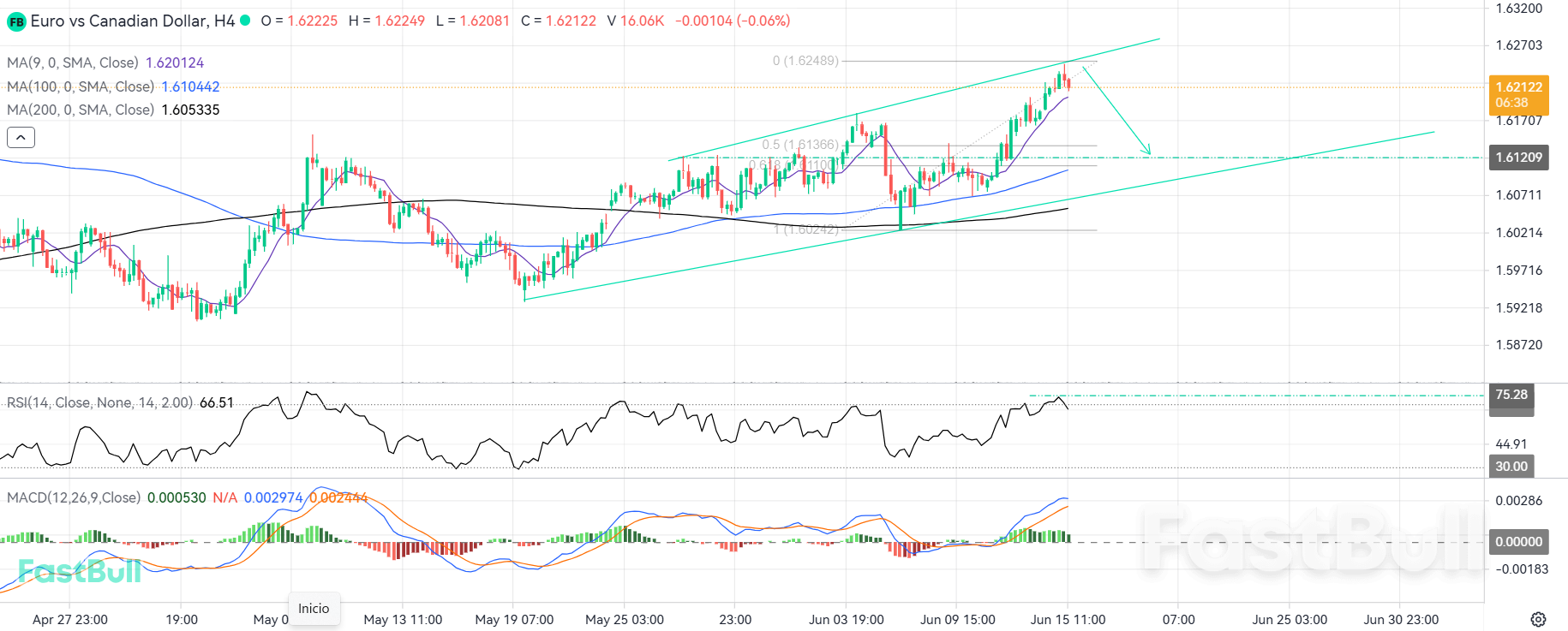
From a chart perspective, EUR/CAD has been moving within a well-defined ascending channel and recently attempted to test the upper boundary of the pattern, turning downward quickly from that level. If this rejection is maintained over the coming sessions, we could see a downward correction develop toward the 1.6120 area. This target would bring the price closer to the channel floor, where it would also meet the 100 and 200-period Moving Averages currently tracking at 1.6104 and 1.6053, respectively. These moving lines have recently offered reliable dynamic support to the broader EUR/CAD movement. Furthermore, a Fibonacci retracement plotted over the most recent upward expansion shows that this 1.6120 support zone rests right midway through the main corrective Fibonacci ratios, suggesting these overlapping levels could act as a strong magnet for price action.
A review of the oscillator section provides secondary cross-verification for this potential downward path. The Relative Strength Index (RSI) recently reached the 75 level, showing that the indicator had climbed deep into overbought territory, which indicates that a downward correction could follow.
At the same time, the MACD indicator is showing a positive histogram, but the bars are printing with increasingly less depth. This pattern suggests that a bearish crossover can be expected if the corrective pullback keeps developing on the chart. However, because the signal lines remain deeply embedded inside positive territory well above the neutral zero line, any near-term downward movement should be categorized as a temporary technical retracement rather than a long-term trend reversal, leaving the underlying structure under the control of long-term buyers.
Trading Recommendations
Trading direction: Sell
Entry price: 1.6211
Target price: 1.6120
Stop loss: 1.6280
Validity: Jun 26, 2026 15:00:00


