The British Pound is under palpable pressure across the London forex desks this morning, trading firmly in the red against a basket of major currency rivals. This pre-emptive sell-off reflects a market bracing not for a surprise, but for a tone. All focus is laser-locked on Threadneedle Street, where the Bank of England’s Monetary Policy Committee (MPC) will deliver its latest interest rate decision and, more critically, the contours of its future path.
Consensus is near-unanimous: the BoE will hold its Bank Rate steady at 3.75%. This follows the historic shift in December, which saw the central bank, after a prolonged and aggressive tightening cycle, finally pivot to a 25-basis-point cut. The narrative today hinges on the vote split and the accompanying communication. Market economists largely anticipate a 7-2 division, with members Swati Dhingra and Alan Taylor expected to renew their dovish stance by advocating for an immediate follow-up cut of another 25 basis points. Their dissension will be a key barometer of the Committee's internal pressure to act.
However, the true volatility catalyst—and the source of the Sterling’s current malaise—will not be the decision itself, but the subsequent Monetary Policy Report and the press conference led by Governor Andrew Bailey. The December meeting placed policy on a "gradual downward path." The question haunting traders now is: How gradual, and how bumpy will that path be?
The economic landscape the MPC must navigate justifies this caution, yet also underscores the fragility weighing on the currency. Recent data paints a picture of an economy caught between stubborn residual price pressures and a labour market losing its vigour. The latest ILO unemployment rate held at 5.1% for a second consecutive month, its highest level since the pandemic-induced disruptions of early 2021. This softening employment backdrop is the clearest green light for the doves on the Committee, reducing wage-driven inflation risks and affording room for stimulus.
Yet, the inflation devil remains in the details. The BoE’s own projections from December foresaw a leisurely return to the sacred 2% target only by the second quarter of 2026—a distant horizon. That forecast was complicated by December’s consumer price data, which showed an unwelcome re-acceleration after encouraging cools in October and November. This flicker of persistence is the likely anchor preventing a more aggressive consensus for cuts today and the argument hawks will cling to.
Therefore, Governor Bailey’s task at the podium will be one of delicate balance. He must acknowledge the deteriorating labour data to validate the easing bias, yet simultaneously temper expectations for a rapid-fire cutting cycle in the face of inflation that remains above target and is proving somewhat sticky. Officials are likely to endorse the continued "gradual" easing narrative, but may introduce nuances—emphasizing data dependency, highlighting services inflation, or pointing to global uncertainties.
For Sterling traders, this translates to a high-risk environment. A hold was fully priced in; the market has moved on. A more dovish than anticipated tone—signaled through a larger dissent, downward revisions in inflation projections in the Report, or explicitly open language from Bailey about the timing of the next cut—could trigger a fresh leg lower for the GBP, potentially targeting key support levels against the Euro and the resurgent US Dollar. Conversely, any pushback against market pricing for cuts in 2024, or heightened concern over the December inflation blip, could spur a sharp, if temporary, short-covering rally.
In essence, the Pound’s fate today rests not on what the Bank of England does, but on what it says and implies about the meetings to come. The currency’s current weakness is a bet that the spectre of unemployment and a slowing economy will trump inflationary concerns in the Committee’s rhetoric. The stage is set for a classic central bank communication tightrope walk, with billions in Sterling exposure hanging on every syllable.
Technical Analysis
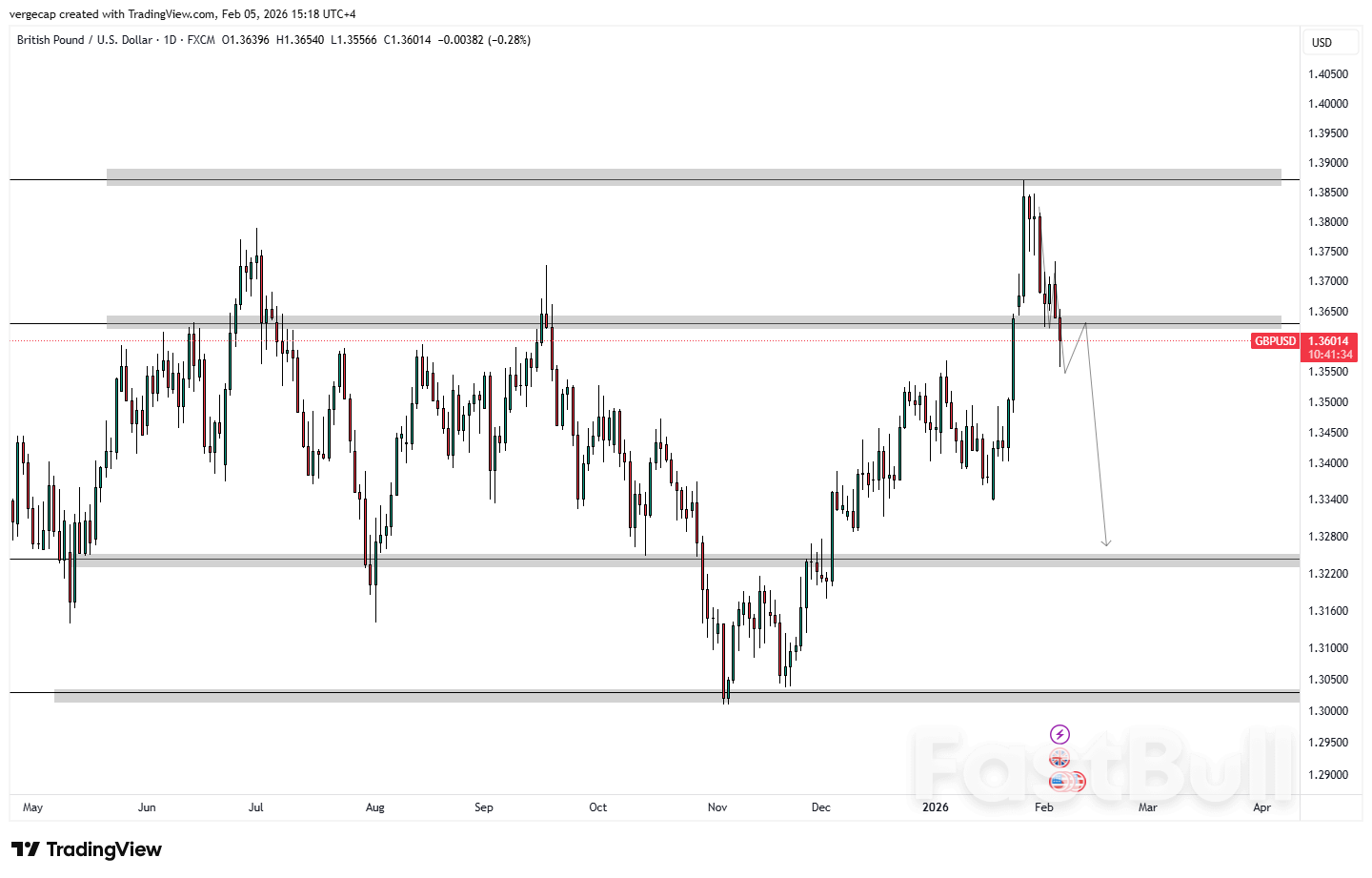
From a technical perspective, GBP/USD is showing signs of a bearish rejection from a major supply zone on the daily chart, suggesting the recent rally may have completed a corrective move within a broader range environment. Price recently rallied aggressively into the 1.3650–1.3900 resistance zone, a region that has repeatedly capped upside since mid-2025, and has already begun to rotate lower after printing a sharp rejection wick.
Structurally, the pair remains in a large horizontal range bounded by resistance near 1.3850–1.3900 and key support around 1.3000–1.3050. The latest rally into resistance appears to have been a liquidity sweep above the 1.3650 mid-range level, followed by immediate bearish follow-through, which typically signals exhaustion of bullish momentum rather than continuation.
In the near term, 1.3650 has now flipped back into resistance, and the loss of momentum below this level suggests sellers are regaining control. If price remains below this zone, the path of least resistance points lower toward the 1.3200–1.3250 support region, which aligns with previous consolidation and range equilibrium. A sustained move below that area would expose the 1.3000–1.3050 range floor, marking a full rotation back to the lower boundary of the broader structure.
On the upside, bulls would need a strong daily close back above 1.3650, followed by acceptance above 1.3850, to invalidate the bearish rejection and reopen the path toward 1.4000. Until that occurs, rallies are likely to be viewed as selling opportunities within the range.
Overall, price action suggests a completed corrective rally and the early stages of a bearish rotation toward mid-range support.
TRADE RECOMMENDATION
SELL GBP/USD
ENTRY PRICE: 1.3600
STOP LOSS: 1.3720
TAKE PROFIT: 1.3250


