The latest Initial Jobless Claims report from the U.S. Department of Labor indicated a subtle shift in employment dynamics. For the week ending February 7, claims rose to 227,000, which—while representing a decline from the previous week's 232,000—notably exceeded the market consensus of 222,000. Despite this slight uptick, the four-week moving average for unemployment claims remains stabilized at approximately 219,500. Although this average increased by 7,000 compared to the prior reading, the broader labor market continues to exhibit signs of structural stabilization.
This data follows the highly anticipated, albeit delayed, release of the Nonfarm Payrolls (NFP) report on Wednesday. Initially, January’s headline data projected a robust picture of the U.S. economy, with 130,000 new jobs created—nearly doubling the expected 70,000 and significantly overshadowing December’s revised figure of 48,000. However, the Bureau of Labor Statistics (BLS) annual benchmark revisions provided a more sobering perspective. Total nonfarm employment for 2025 was adjusted downward by a staggering 898,000 positions. This massive revision effectively slashed the monthly average job creation for last year from 49,000 to a mere 15,000. Despite these structural headwinds, the unemployment rate edged lower to 4.3%, and average hourly earnings advanced by 0.4% month-over-over, suggesting that wage pressures remain persistent.
Against this complex backdrop, Federal Reserve rhetoric remains characteristically nuanced. Kansas City Fed President Jeffrey Schmid recently advocated for a continued restrictive policy stance, noting that inflation remains near 3% and that aggregate demand continues to outpace supply growth. In contrast, Dallas Fed President Lorie Logan adopted a more balanced tone, emphasizing that the labor market is stabilizing and that the balance of risks to the downside has largely diminished.
Simultaneously, the Reserve Bank of Australia (RBA) delivered a 25-basis point hike on February 3, raising the official cash rate to 3.85%. This decision was perfectly synchronized with broad market consensus. Alongside this move, the central bank revised its short-term economic projections, now forecasting growth at 2.1% and inflation at 4.2% by June 2026. These revisions are grounded in the hawkish assumption that the cash rate will likely peak at 4.2% by the end of 2026. However, internal consumer sentiment remains brittle; the Westpac-Melbourne Institute Sentiment Index has declined for three consecutive months, underscoring the strain that elevated rates are placing on discretionary spending. This weakening consumer backdrop, alongside a mixed NAB Business Survey, strengthens the case for a potential pause in the RBA’s tightening cycle during the upcoming March meeting.
Technical Analysis
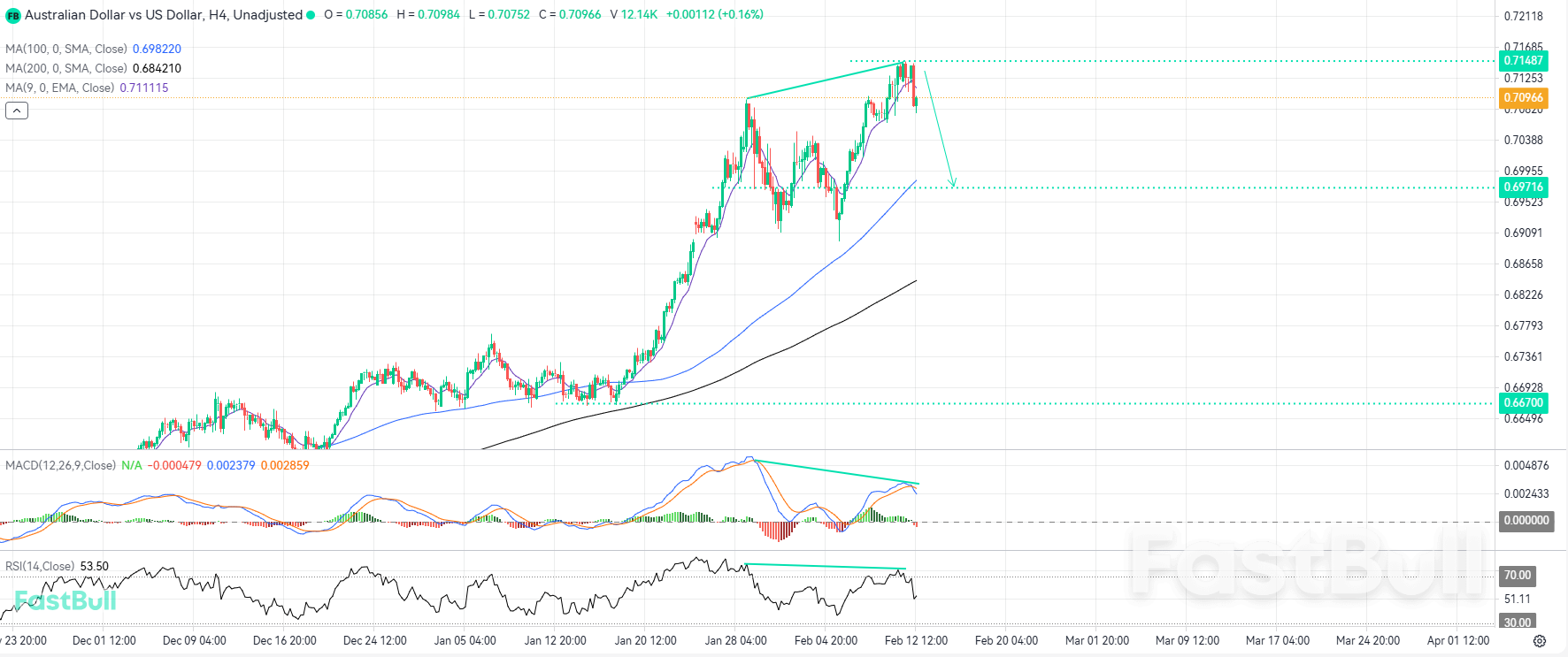
From a technical perspective, AUD/USD recently ascended to the 0.7148 handle, marking a peak within a powerful bullish impulse that originated near 0.6670 in mid-February. This rally has been characterized by its verticality and a lack of significant retracements, pushing price action into territory not witnessed since January 2023.
The current move appears overextended, and signs of significant distribution are beginning to emerge. We are witnessing clear bearish divergences in both the RSI and the MACD on the 4-hour chart. Specifically, the RSI recently touched 74, signaling deeply overbought conditions and suggesting that the bullish drive is nearing exhaustion. Furthermore, the MACD has just completed a bearish crossover, with the histogram transitioning into negative territory and gaining downward depth.
Adding to the bearish conviction, the price recently closed below the 9-period Exponential Moving Average (EMA), which has acted as a tight trailing support throughout the rally. This break often serves as a tactical signal for a shift in short-term control. Structurally, the 100 and 200-period Moving Averages are situated at 0.6982 and 0.6842, respectively.
The primary objective for a potential technical correction is the 0.6971 support zone. This area is critically aligned with the current position of the 100-period Moving Average, providing a high-probability confluence for buyers to step back in. As profit-taking accelerates, we expect price action to gravitate toward this key structural floor before the next directional decision is made.
Trading Recommendations
Trading direction: Sell
Entry price: 0.7100
Target price: 0.6971
Stop loss: 0.7200
Validity: Feb 24, 2026 15:00:00


