Fundamentals
On Tuesday, the GBPUSD experienced a decline. This depreciation can be attributed to a confluence of factors, including a moderating general bearish sentiment towards the US dollar and persistent domestic political uncertainties within the UK. Furthermore, market apprehension regarding the Bank of England's (BoE) future monetary policy trajectory has exerted downward pressure on the pound. Last Thursday, the BoE's narrowly divided decision, with a 5-4 vote to maintain the status quo on interest rates, surprised market participants. Concurrently, the central bank indicated a potential reduction in borrowing costs should inflation continue its projected downward trend. On the political front, UK Prime Minister Keir Starmer faced calls to resign on Monday following the controversy surrounding his appointment of Peter Mandelson as ambassador to the US, which led to the departure of a second senior aide. However, former Deputy Prime Minister Angela Rayner, a potential challenger, has publicly declared her support for Starmer. Lee Hardman, an analyst at MUFG, observed that the Labour Party is likely to encounter significant resistance to initiating a leadership challenge prior to the May local elections, a development that could mitigate the risk of substantial short-term sell-offs in the pound. Michael Pfister, a currency analyst at Commerzbank, commented that despite Starmer's decisive victory in the 2024 general election and his commitment to stability, doubts persist about his ability to complete his term. He posited that "the pound is currently plagued by uncertainty, a situation that could persist until this issue is sustainably resolved." Enrique Diaz-Alvarez, Chief Economist at Ebury, added that an increase in the risk of a leftward political tilt, particularly under a Labour government potentially led by Angela Rayner, would present downside risks for both the pound and UK assets. Broadly, ahead of key US economic data releases on Wednesday, the US dollar exhibited limited volatility against European currencies, while the pound's performance was predominantly influenced by the dual pressures of domestic politics and expectations surrounding monetary policy.
The US experienced an unexpected deceleration in labor cost growth during the fourth quarter, with the annual increase reaching its lowest point in four and a half years, primarily attributed to a cooling labor market demand that tempered wage inflation. Data released by the Bureau of Labor Statistics on Tuesday revealed that the closely watched Employment Cost Index (ECI) rose by 0.7% quarter-over-quarter from October to December, down from 0.8% in the preceding quarter and below economists' projections of 0.8%. For the twelve months ending in December, labor costs climbed by 3.4%, marking the slowest annual rate of increase since the second quarter of 2021. Policymakers regard the ECI as a crucial gauge of labor market tightness and a predictor of core inflation, as it accounts for shifts in employment composition and job quality. Labor market slack is exerting downward pressure on compensation: prior data indicated that in December, there were 0.87 job openings for every unemployed person, a decrease from 0.89 in November and approximately 1.08 a year earlier. Despite easing wage pressures, factors such as import tariffs continue to sustain elevated goods prices, contributing to persistent overall inflation. Economists widely anticipate that the Federal Reserve will maintain its interest rates unchanged through the first half of the year. The Fed had previously kept its benchmark overnight interest rate in the 5.25%-5.50% range in January. Specifically, wages and salaries, which constitute the bulk of labor costs, rose by 0.7% quarter-over-quarter and 3.3% annually. On an inflation-adjusted basis, overall compensation saw a real increase of 0.7% in the twelve months through December, a slight uptick from 0.6% in the third quarter. On Wednesday, February 11th Beijing time, there were no significant fundamental data releases from the UK, with market focus centered on the US January Nonfarm Payrolls report scheduled for release at 9:30 PM.
Technical Analysis
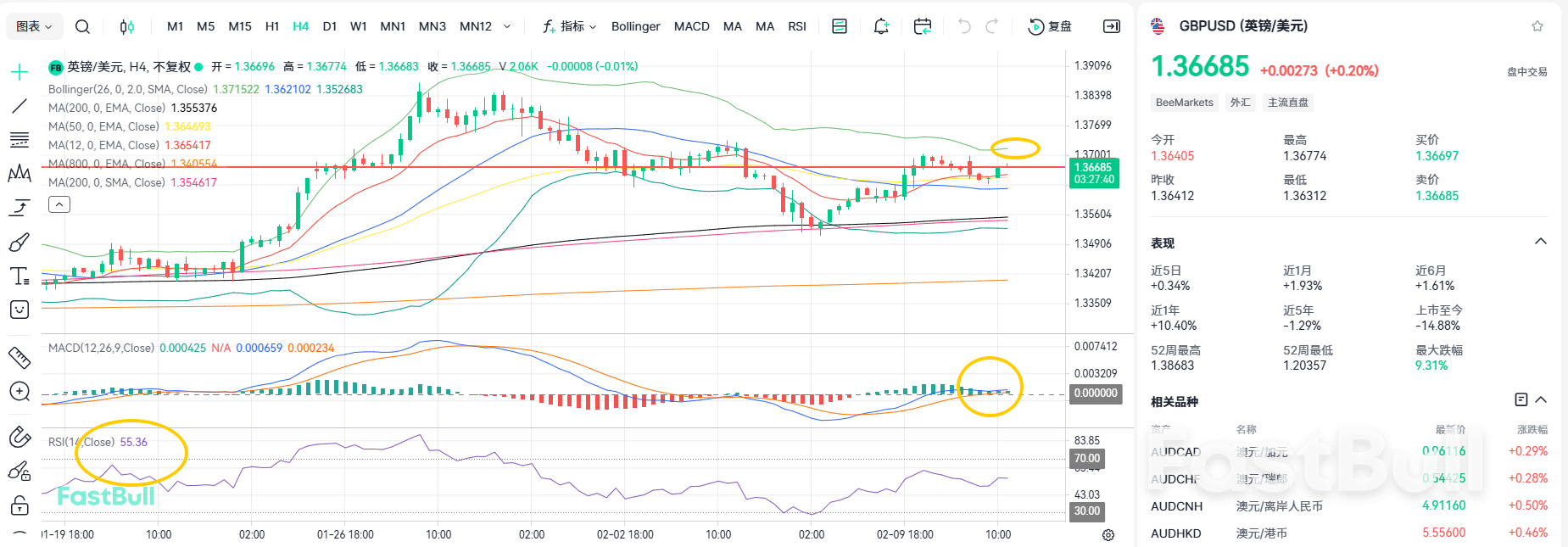
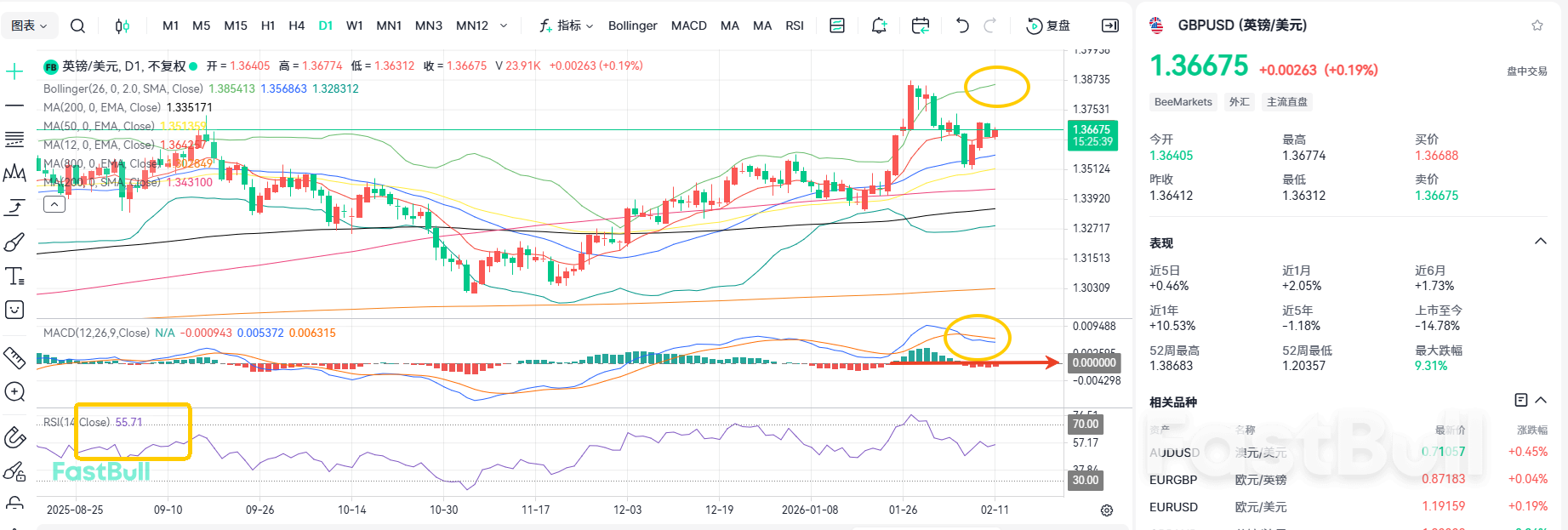
In the 1D timeframe, the GBPUSD is showing a rebound after finding support at the middle Bollinger Band. A short-term outlook suggests that once the price stabilizes above the EMA12, it will likely retest the significant psychological resistance levels and the upper Bollinger Band, specifically around 1.37 and 1.385. The Bollinger Bands are converging, and the moving averages are flattening, indicating a potential shift in market direction. The MACD, after forming a death cross, has its MACD line and signal line attempting to converge towards the zero line. Given the current distance, the corrective phase appears incomplete. The RSI is at 55, suggesting a predominantly bullish sentiment among market participants. In the 4H timeframe, the Bollinger Bands are narrowing, and the moving averages are consolidating. The price is oscillating between the EMA12 and the middle Bollinger Band. The short-term outlook suggests that the current rebound is not over and is likely to continue towards the previous high and the upper Bollinger Band, around 1.387 and 1.371, respectively. The MACD has formed a golden cross, with its MACD line and signal line converging above the zero line, indicating a return to bullish territory. The RSI is at 55, signaling an optimistic market sentiment. Therefore, the recommended strategy is to implement a buy-on-dip approach.
Trading Recommendations
Trading Direction: Buy
Entry Price: 1.366
Target Price: 1.4
Stop Loss: 1.33
Support: 1.34, 1.3, 1.28
Resistance: 1.38, 1.4, 1.41


