Data published by the Office for National Statistics (ONS) showed that UK Gross Domestic Product (GDP) grew by 0.1% in August, outperforming expectations for a 0.1% contraction following the 0.4% increase recorded in July. Industrial Production and Manufacturing Production also came in above forecasts, rising by 0.8% and 1.2%, respectively.
The stronger economic figures give the Bank of England (BoE) additional room to raise interest rates as inflation continues to prove more persistent than expected. As a result, expectations that the central bank could increase borrowing costs before the end of the year have grown, particularly after keeping rates unchanged so far. However, the timing and scale of any potential tightening remain uncertain, as policymakers continue to assess the inflation outlook and the impact of higher energy prices on the wider economy.
Speaking at the International Monetary Fund meeting in Bangkok, BoE Governor Andrew Bailey said it was “too early to form firm views on the scale of second-round effects” on inflation, adding that the current signals were “moderate.” His comments suggest that, despite persistent price pressures, there may be limited immediate justification for an aggressive tightening cycle. The central bank will likely need further evidence of how rising costs are affecting wages, prices and inflation expectations before determining whether additional rate increases are necessary.
Meanwhile, BoE Chief Economist Huw Pill, who has voted in favor of a 25-basis-point rate hike in recent months, said on Thursday that policymakers should avoid giving the impression that an increase at this stage would mark the beginning of a series of consecutive hikes. On Wednesday, Pill also expressed greater skepticism toward market expectations for four borrowing-cost increases by the BoE over the next year. His comments indicate that, although further tightening remains possible, the market may be pricing in a more aggressive policy path than some members of the Monetary Policy Committee consider appropriate.
In the Eurozone, Industrial Production accelerated its decline after contracting for the third consecutive month in August. In addition, final Harmonised Index of Consumer Prices (HICP) data released last week confirmed that annual inflation accelerated to 3.8% in September, its highest level in three years. The combination of rising prices and weakening industrial activity has increased concerns about stagflation, complicating the European Central Bank’s (ECB) decisions as it attempts to contain inflation without placing additional pressure on economic growth.
ECB officials remain divided over the pace of any further monetary tightening. Some policymakers point to the limited second-round effects of higher oil prices and the growing downside risks to economic growth, suggesting that additional rate increases could be difficult to justify. Others warn that persistent inflation could require further tightening to prevent price pressures from becoming entrenched. This divergence in views leaves the outlook for monetary policy uncertain, with future decisions likely to depend on how inflation and economic activity evolve in the coming months.
Technical Analysis
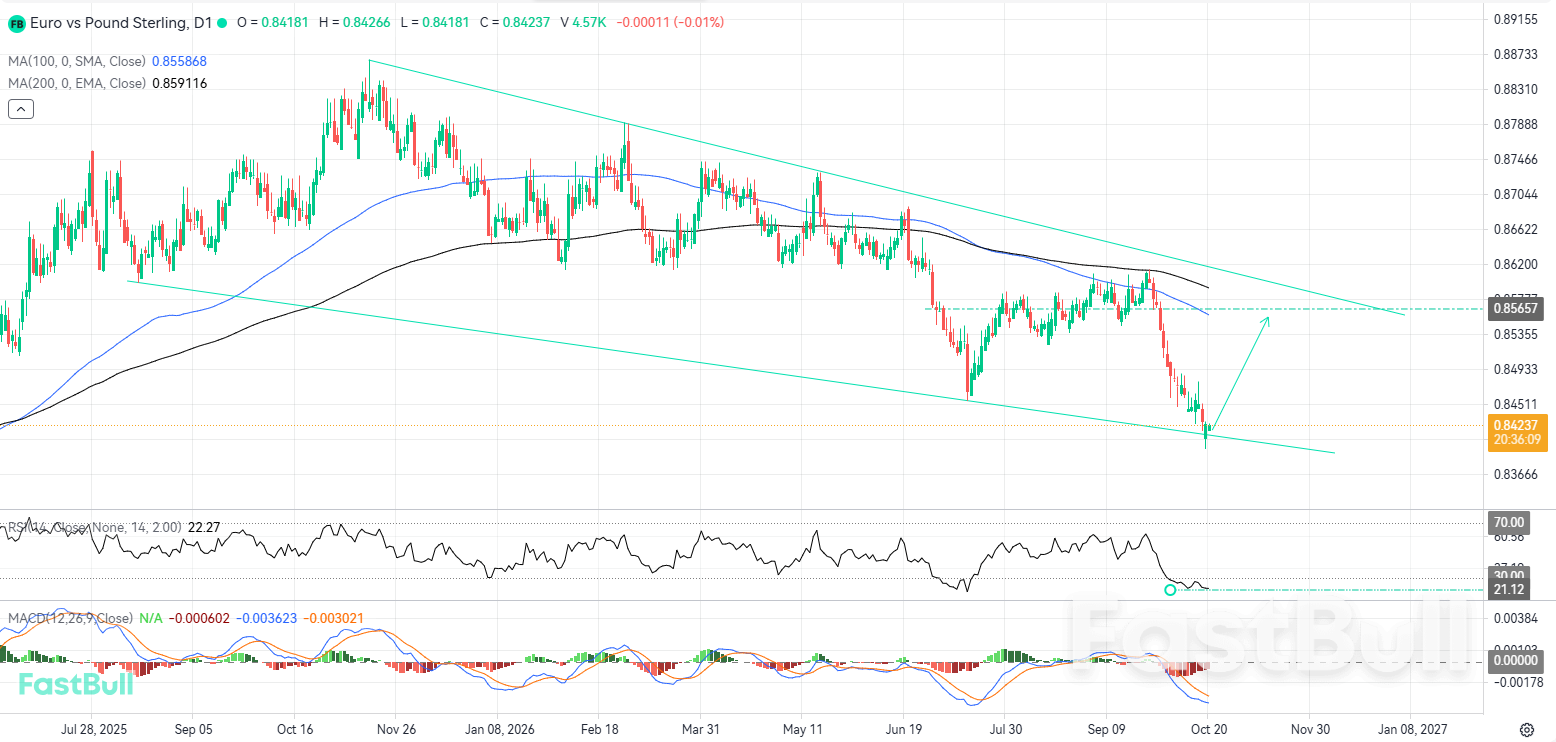
On the daily chart, EURGBP is moving within a descending channel and has recently retested its lower boundary, where the price rejected the level and began to move higher. If the pair manages to hold above this support and sustain its bullish reaction, opportunities could emerge for a recovery toward the local resistance level at 0.8565. This area is close to the upper boundary of the descending channel and is also surrounded by the 100-period and 200-period moving averages, currently positioned at 0.8558 and 0.8591, respectively. As a result, this zone could act as a potential upside target while also presenting resistance that buyers would need to overcome to extend the recovery.
Looking at the oscillators, the RSI has fallen to 21, placing it deep within oversold territory. These conditions could favor a short-term rebound if selling pressure continues to weaken and buyers begin to regain control. Meanwhile, the MACD shows a bearish histogram that is losing depth, suggesting that downside momentum may be easing. However, the signal lines remain firmly in bearish territory, meaning that a sustained bullish crossover would provide further confirmation that the recovery could extend. Until such confirmation appears, the move higher should be treated as a potential corrective rebound rather than a confirmed reversal of the broader downtrend.
Trading Recommendations
Trading direction: Buy
Entry price: 0.8424
Target price: 0.8565
Stop loss: 0.8340
Validity: Oct 30, 2026 15:00:00


