In March, Eurozone inflationary pressures exhibited a significant resurgence, with the headline figure climbing sharply to 2.5% year-over-year, up from the 1.9% recorded in February. While this acceleration aligned perfectly with our internal projections, it arrived slightly beneath the broader market consensus of 2.6%. Conversely, underlying price action remained more tempered; core inflation decelerated to 2.3%, matching our forecasts but undershooting the 2.4% anticipated by the street.
Within the European Central Bank (ECB)—whose mandate is strictly anchored to price stability—the rhetoric among policymakers has transitioned toward an increasingly restrictive posture. Even traditionally dovish members, such as Fabio Panetta, have begun to underscore the imperative of preempting second-round effects, specifically the risk of a wage-price spiral. While Panetta maintained that any policy response must remain proportional, his characterization of "action" as the baseline scenario signals a growing institutional openness toward further interest rate hikes.
This sentiment was reinforced by Governing Council member Gabriel Makhlouf, who asserted that the institution stands ready to intervene once the economic ramifications of the regional conflict become clearer. Makhlouf cautioned that a protracted war would likely push the Eurozone economy toward the "adverse scenario" modeled by the bank. For the moment, the ECB is maintaining a position of strategic neutrality, neither confirming nor discounting any specific policy trajectory.
However, a subtle yet profound shift in language was evident in the communication following the March deliberation. In contrast to February, when the narrative suggested inflation was stabilizing near the 2% target, the Council now emphasizes that it is "monitoring closely" the systemic risks arising from geopolitical tensions. This linguistic nuance suggests heightened institutional caution and paves the way for a more aggressive hawkish pivot in upcoming sessions should upside inflationary risks materialize.
In a high-stakes communication from the Oval Office, U.S. President Donald Trump recently signaled a potential conclusion to regional hostilities, suggesting that the United States would likely "exit Iran very soon." Trump outlined a tactical withdrawal timeline of approximately two to three weeks, emphasizing a commitment to departure regardless of the status of a formal diplomatic accord. Simultaneously, Iranian President Masoud Pezeshkian expressed a reciprocal "necessary will" to terminate the conflict, though he remains steadfast in his demand for ironclad security guarantees to ensure a durable peace.
This nascent diplomatic optimism coincides with a series of robust economic indicators from the United States. The ISM Manufacturing PMI ascended to 52.7 in March, outperforming expectations and building upon previous gains. Labor market data also delivered a hawkish surprise, with ADP Employment Change reporting an addition of 62,000 positions, significantly exceeding the projected 40,000. Furthermore, consumer resilience was evidenced by a 0.6% surge in February Retail Sales, signaling a sharp recovery from January’s downwardly revised contraction.
According to the CME FedWatch Tool, these data points have led markets to price in a period of relative policy stability, with the Federal Reserve expected to maintain interest rates within the 3.50%–3.75% range through 2026. However, should geopolitical tensions continue to dissipate and catalyze a meaningful decline in global oil prices, expectations for a shift toward monetary easing could rapidly resurface.
Technical Analysis
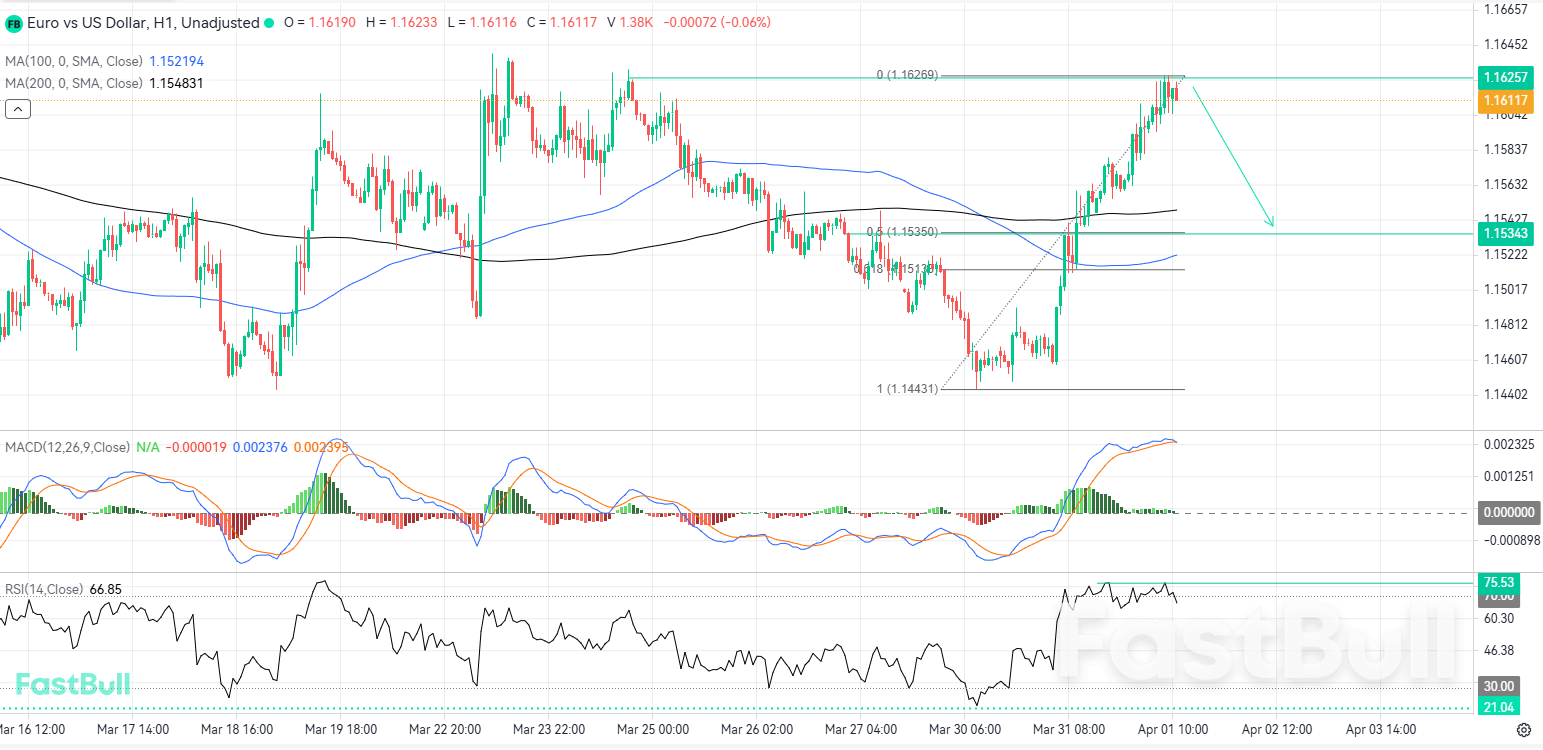
From a technical perspective, EUR/USD has recently executed a powerful bullish impulse, reaching a critical resistance ceiling at 1.1625. This level carries significant historical weight, as it was the exact point of origin for the sharp bearish move on March 24 that ultimately drove the pair down to 1.1443 by month's end. A repeated rejection at this handle would likely catalyze a primary corrective impulse toward the 0.50 Fibonacci retracement level situated at 1.1534.
This downside objective is reinforced by a high-confluence cluster of indicators. Specifically, the 100 and 200-period Moving Averages (MAs) are currently tracking at 1.1521 and 1.1548, respectively. Their alignment within this narrow support zone adds substantial structural weight to the thesis of a corrective move toward these levels.
Our analysis of momentum oscillators strongly supports the case for a tactical reversal. The RSI has reached the 75 level, moving deeply into overbought territory and signaling that the recent rally is technically overextended.
While the MACD is currently exhibiting a bearish histogram crossover, it is important to note that the signal lines remain well-entrenched above the neutral threshold. This configuration suggests that the impending downward movement should be characterized as a technical correction rather than a wholesale trend reversal. Traders should monitor the 1.1534 zone closely for signs of renewed buy-side interest.
Trading Recommendations
Trading direction: Sell
Entry price: 1.1613
Target price: 1.1534
Stop loss: 1.1660
Validity: Apr 10, 2026 15:00:00


