West Texas Intermediate (WTI) US crude oil prices pushed higher on Tuesday, trading around $58.20 per barrel at the time of writing, up roughly 0.9% on the day, as markets reassessed geopolitical risks and their implications for global energy supply. The advance extends a broader short-term recovery in crude, driven less by demand optimism and more by a renewed sense of fragility in the global political landscape.
Oil markets are once again leaning into risk aversion, with expectations for a swift diplomatic resolution to the war in Ukraine continuing to erode. Recent US-led discussions have failed to deliver a meaningful breakthrough, particularly on the most contentious territorial issues, reinforcing the view that the conflict could remain a structural source of uncertainty for commodity markets well into the future. According to reporting by Reuters, Russia has accused Ukraine of launching a drone attack targeting a presidential residence inside Russian territory—an allegation Kyiv has firmly denied. Regardless of the veracity of the claims, the escalation in rhetoric underscores the increasingly brittle state of diplomacy and keeps investors wary of potential spillover effects on energy infrastructure, logistics, and trade routes.
This deterioration in the geopolitical backdrop has encouraged traders to reprice the probability of supply disruptions, lending near-term support to WTI and the broader oil complex. While Russian crude continues to find its way into global markets through alternative channels, any intensification of the conflict raises the risk of tighter enforcement, operational disruptions, or retaliatory measures that could reduce effective supply. In this context, oil’s rally appears less speculative and more insurance-driven, reflecting the market’s need to rebuild a geopolitical risk premium that had thinned during periods of relative calm.
Tensions are not confined to Eastern Europe. Fresh comments from US President Donald Trump have revived concerns over stability in the Middle East, after he warned of possible military action against Iran should certain strategic programs be restarted. The remarks, while hypothetical, are enough to remind markets how quickly sentiment can shift in a region that remains central to global oil supply. With key shipping lanes and major producers concentrated in the Middle East, even verbal escalations tend to amplify price sensitivity, reinforcing crude’s role as a geopolitical barometer.
That said, the upside in oil prices is not without constraints. Structural supply concerns continue to loom large, particularly as demand growth remains uneven across regions. The Organization of the Petroleum Exporting Countries and its allies (OPEC+) has confirmed a modest production increase of 137,000 barrels per day starting in December, a move that signals confidence in market balance but also revives fears of oversupply should global consumption soften. For now, the increase is relatively small, yet it serves as a reminder that producers are gradually easing restraint, potentially limiting the longevity of any geopolitically driven rally.
Investors are also bracing for fresh signals from the US inventory cycle. Attention turns to the weekly crude oil stockpile report from the American Petroleum Institute (API) due later in the day, which could provide near-term direction. A larger-than-expected build would reinforce concerns about sluggish demand and cap gains, while a drawdown could validate the recent price rebound and encourage further buying interest.
Technical Analysis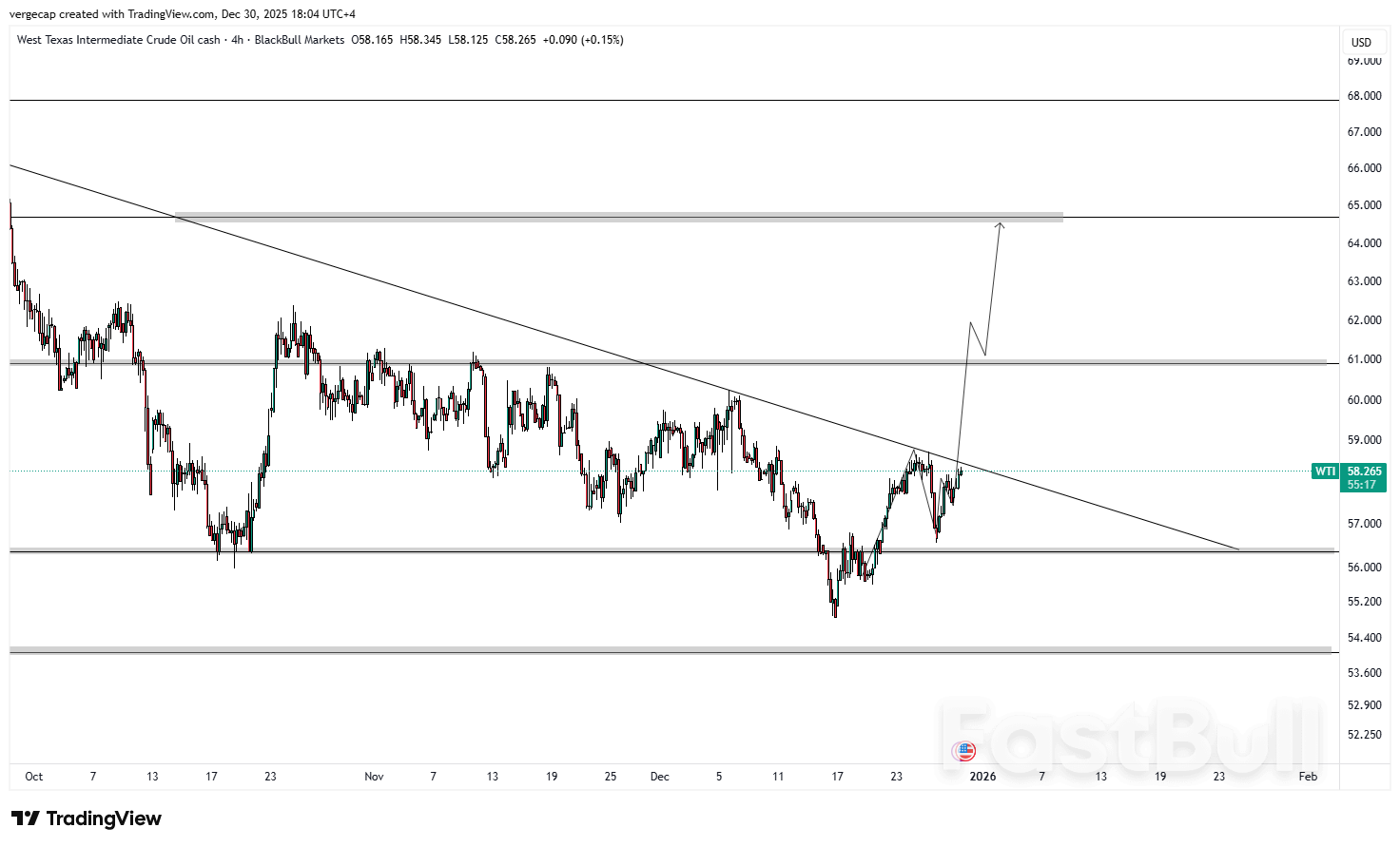
From a technical perspective, crude oil’s latest advance appears constructive. Prices have registered strong intraday gains while holding firmly above the 50-period exponential moving average (EMA50), reinforcing the dominance of the short-term bullish trend. Trading continues to align with an ascending trend line, suggesting that buyers remain in control despite recent volatility. Importantly, the latest leg higher followed a cooling-off phase in momentum indicators, as overbought conditions on the Relative Strength Index were gradually unwound. The emergence of positive overlapping signals from momentum studies now points to renewed upside traction, increasing the probability of further gains as long as key support levels hold.
TRADE RECOMMENDATION
BUY WTI
ENTRY PRRICE: 58.30
STOP LOSS: 57.50
TAKE PROFIT: 61.00


