Crude oil prices clawed back a portion of their recent losses on Wednesday, with the US benchmark West Texas Intermediate rising back above the $93.00 per barrel level after a harrowing two-day decline that sent prices tumbling nearly seven dollars from recent highs to a low of approximately $86.00 — their steepest short-term correction since the Middle East conflict entered its most acute phase five weeks ago.
The partial recovery was driven less by any fundamental improvement in supply conditions and more by the announcement that Washington and Tehran have agreed to dispatch delegations for face-to-face diplomatic talks scheduled to begin in Pakistan this Saturday — the first direct engagement between the two adversaries since hostilities escalated sharply in early March. For oil traders who have been navigating one of the most volatile energy markets in a generation, the news offered a sliver of hope in an otherwise deeply uncertain landscape.
But the optimism, in my assessment, is dangerously thin.
The immediate catalyst behind Wednesday's earlier selloff was Iran's decision to once again seal the Strait of Hormuz — the narrow but strategically irreplaceable waterway through which approximately 20% of the world's seaborne oil supply passes — in direct retaliation for what Tehran has characterized as a flagrant violation of the fragile ceasefire agreement. Israel's large-scale military operation against Hezbollah targets in Lebanon, conducted over the weekend, drew immediate condemnation from Iranian leadership, who argued the strikes fell squarely within the spirit of the ceasefire's prohibition on offensive military action.
Washington and Tel Aviv pushed back forcefully. The United States and Israel jointly affirmed that counter-Hezbollah operations in Lebanon were explicitly excluded from the terms of the ceasefire arrangement, and US President Donald Trump issued a stark public warning to Tehran, signalling that further military and economic consequences would follow if Iran failed to comply with its obligations under the deal. The exchange has ratcheted up tensions at a moment when diplomatic momentum appeared, until recently, to be building.
For global energy markets, the renewed Hormuz closure is not merely symbolic — it is operationally crippling. Gulf producers that might otherwise be positioned to compensate for supply disruptions are now themselves constrained, both by the chokepoint closure and by the very real physical damage sustained by several regional oilfields over five weeks of intensive conflict. The infrastructure wounds are not cosmetic; they will take months to remediate regardless of when a comprehensive peace agreement is eventually reached.
Last weekend's OPEC+ decision to lift collective output quotas by 206,000 barrels per day effective May provided a brief moment of bearish pressure in the market before reality reasserted itself. On paper, the production increase signals the alliance's intent to moderate prices and prevent runaway energy inflation from derailing the global economy. In practice, the move is, at least for now, largely academic.
With the Strait of Hormuz closed and Gulf state production capacity compromised by wartime infrastructure damage, the physical ability of key OPEC+ members to actually deliver that incremental output to global markets is severely in question. This is a distinction that sophisticated energy traders are acutely aware of, and it explains why the production announcement failed to produce a sustained price decline. You can raise your quota all you like — you cannot pump oil you cannot ship.
Stepping back from the day-to-day volatility, the scale of the structural price shift in crude oil since the conflict began is staggering. WTI prices currently stand approximately 40% above the levels at which they traded in the weeks before the Middle East war erupted in earnest. Even accounting for Wednesday's sharp intraday selloff and subsequent partial recovery, the market has absorbed a seismic geopolitical supply shock and repriced accordingly.
What concerns me most as I analyze the current setup is not the day-to-day noise of ceasefire talks and retaliation cycles — it is the market's growing structural acceptance that even a signed peace agreement will not immediately or fully restore supply flows through Hormuz. Legal, diplomatic, and physical reopening of the strait takes time under the best of circumstances. With active distrust between the parties, damaged port infrastructure, and the prospect of spoiler attacks from non-state actors, the earliest realistic timeline for full Hormuz normalization — assuming talks in Pakistan produce a substantive breakthrough this weekend — is weeks to months, not days.
The rebound above $93.00 is real but, in my view, does not represent a durable shift in the near-term trajectory. The market is trading headline risk in both directions with extraordinary sensitivity, and the Pakistan talks — while genuinely constructive as a diplomatic development — remain an opening dialogue rather than a resolution. Iran's track record of using Hormuz access as a negotiating lever is well established, and until verifiable reopening is confirmed and sustained, the geopolitical risk premium embedded in crude prices is not going away.
For energy markets, the path of least resistance remains higher over the medium term, but the journey will be anything but smooth. Traders should expect sharp two-way swings around each diplomatic headline while the underlying supply constraint — rooted in physical damage, closed waterways, and fractured trust — continues to support prices well above pre-war norms.
The world is negotiating. The strait is still closed. And oil remains the currency of conflict.
Technical Analysis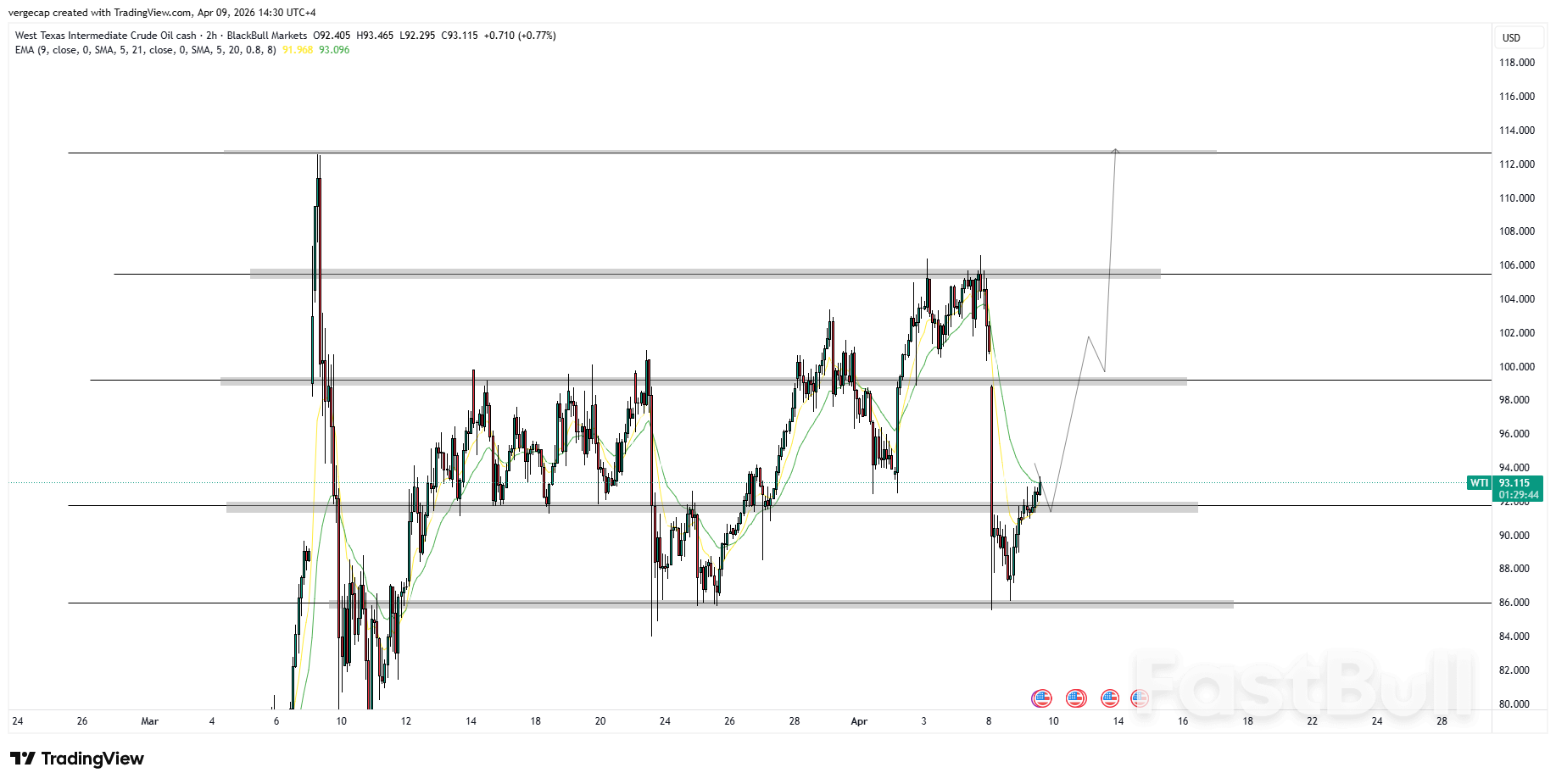
WTI Crude Oil is navigating one of the most violently range-bound yet structurally significant periods seen on the 2-hour chart since the Middle East conflict began. Price is currently trading at $93.115, sitting precisely at the 21-period SMA — a level that has repeatedly served as a dynamic pivot throughout the entire March-to-April trading history visible on this chart. The fact that price is hugging this average after a catastrophic single-session selloff on April 8 — which drove WTI from the $105.00–$106.00 resistance zone all the way down to intraday lows near $87.00 — is technically significant and speaks to the remarkable resilience of the underlying bid in this market.
The April 8 decline was the most brutal single-session move on this chart outside of the initial March spike reversal from $113.00, and it has left a visible scar on the market structure. What makes the current setup particularly compelling is that despite the ferocity of that selloff, price has already reclaimed the $92.00–$93.00 horizontal support band — a zone that has acted as a critical battleground level on multiple occasions throughout both March and early April. The speed of this recovery from the $87.00 lows back to $93.00 within a compressed timeframe suggests aggressive dip-buying activity and reinforces the view that the broader bullish bias from the geopolitical risk premium remains structurally intact.
The 9-period EMA, currently at $91.97, is beginning to curl higher beneath price following the sharp recovery candles from the $87.00 floor. A sustained hold above both the 9 EMA and 21 SMA in the $91.97–$93.10 zone would confirm that the moving average stack is reasserting itself as dynamic support, which would be the technical green light for a continuation of the recovery. Conversely, a failure to hold above the 21 SMA at $93.10 on a closing 2-hour basis would signal that the bounce is merely corrective and that bears retain near-term control following the April 8 breakdown.
The $98.00–$100.00 zone represents the first major resistance target on any recovery attempt, having capped price multiple times during the late March consolidation phase before the breakout to $106.00. A clean reclaim of $100.00 would restore the psychological and structural narrative that was shattered by the April 8 selloff, and would likely attract momentum buyers targeting the $105.00–$106.00 supply zone — the area from which the most recent aggressive breakdown originated. Bulls must recapture and sustain price above $106.00 to reopen the path toward the $111.00–$112.00 major resistance ceiling, which aligns with the measured move projection drawn on the chart and coincides with the upper boundary of the war-era spike range established in early March.
On the downside, the $86.00–$87.00 support band is now the defining line in the sand for the bullish case. This zone absorbed the April 8 selling climax and produced a sharp reversal — but it has limited margin for error. A second test of this level that fails to hold would represent a double-bottom failure, a structurally ominous development that could accelerate selling toward the $84.00–$85.00 region. A sustained break below $84.00 would constitute a full technical breakdown of the war-era price floor and would shift the medium-term bias to bearish, potentially exposing the $80.00 psychological level which has acted as the absolute floor on this chart throughout the entire conflict period.
The projected path drawn on the chart — a shallow consolidation around current levels before a push toward $100.00–$101.00, followed by a continuation leg toward $112.00 — is technically coherent but contingent on the $92.00–$93.00 zone holding as support. The market is at an inflection point, and the next 3–4 candles will be decisive in confirming whether the April 8 selloff was an exhaustive flush or the beginning of a larger corrective move.
TRADE RECOMMENDATION
BUY WTI CRUDE OIL
ENTRY PRICE: $93.20
STOP LOSS: $89.50
TAKE PROFIT: $105.50


