Fundamentals
Spot gold briefly surged above $5,170 intraday last Friday and closed 1.84% higher at $5,174.59 an ounce. The bullish momentum for gold stemmed from two core drivers: first, concerns over an economic slowdown triggered by weak employment data, which boosted gold's safe-haven appeal; second, the rapid deterioration of geopolitical tensions in the Middle East, which has pushed risk aversion to a new high. The leadership transition in Iran's top echelons, blatant military threats from the U.S. and Israel targeting Iran's nuclear facilities and leaders, coupled with the deployment of three countries' aircraft carrier strike groups to the Middle East, have sent expectations of war risk spillover soaring. UN Secretary-General's warning that the situation "could spiral out of control" is by no means an alarmist talk. Such extreme political uncertainty has provided strong downside support for gold.
However, the gold market is facing a formidable headwind: the surge in oil prices and the resulting expectations of monetary policy tightening. With actual disruptions to shipping in the Strait of Hormuz, Iraq's crude oil production has plummeted from 4.3 million b/d to 1.3 million b/d, and both Brent and WTI crude have broken above the $100 mark. The oil price surge not only directly lifts inflation, but more importantly, it has reshaped the market's interest rate expectation logic: the market is growing concerned that the Fed may be forced to postpone or even abandon its planned rate cut cycle and adopt a more hawkish monetary policy to curb inflationary pressures transmitted by oil prices. Such expectations have translated into upward momentum for the U.S. dollar, which in turn weighs on dollar-denominated gold. This is the fundamental reason why gold rose on the back of geopolitical risks and recession fears but recorded its first weekly decline in five weeks – the market has to price in the threat of "tightening" between "safe-haven demand" and "inflation hedging".
Bloomberg analysis noted that the surge in crude oil prices has amplified U.S. inflation concerns, raising the probability that the Fed will hold rates steady for longer or even hike further, putting pressure on gold. Higher borrowing costs and a stronger U.S. dollar are typically bearish for precious metals.
The immediate trigger for the weak performance of the U.S. Dollar Index was the February nonfarm payrolls report released by the U.S. Bureau of Labor Statistics. Data showed nonfarm payrolls unexpectedly fell by 92,000 in the month, far worse than the market expectation of a 59,000 increase, and the unemployment rate edged up to 4.4%. The underwhelming employment data once reinforced market expectations for Fed rate cuts within the year, thus pressuring the dollar. Nevertheless, remarks from Fed officials quickly doused the market's enthusiasm for rate cuts.
Cleveland Fed President Loretta Mester explicitly stated that interest rate policy will likely remain unchanged for "a considerable period of time", and Boston Fed President Susan Collins echoed that "there is no need to change the monetary policy stance". This combination of "weak data + hawkish officials" has sent market bets on the Fed keeping rates unchanged at its three consecutive meetings in March, April and June surging from around 40% to 70%. Therefore, the dollar's decline on Friday was not a trend-based collapse, but a contradictory pullback amid the squeeze of weak data and hawkish comments.
According to data from the U.S. Commodity Futures Trading Commission (CFTC), in the week ending March 3, 2026, speculative net short positions in the U.S. Dollar Index jumped sharply from 1,789 contracts in the previous week to 4,989 contracts. Meanwhile, commercial net long positions, which mainly reflect actual corporate hedging demand, rose from 2,582 contracts to 5,223 contracts.
Technical Analysis
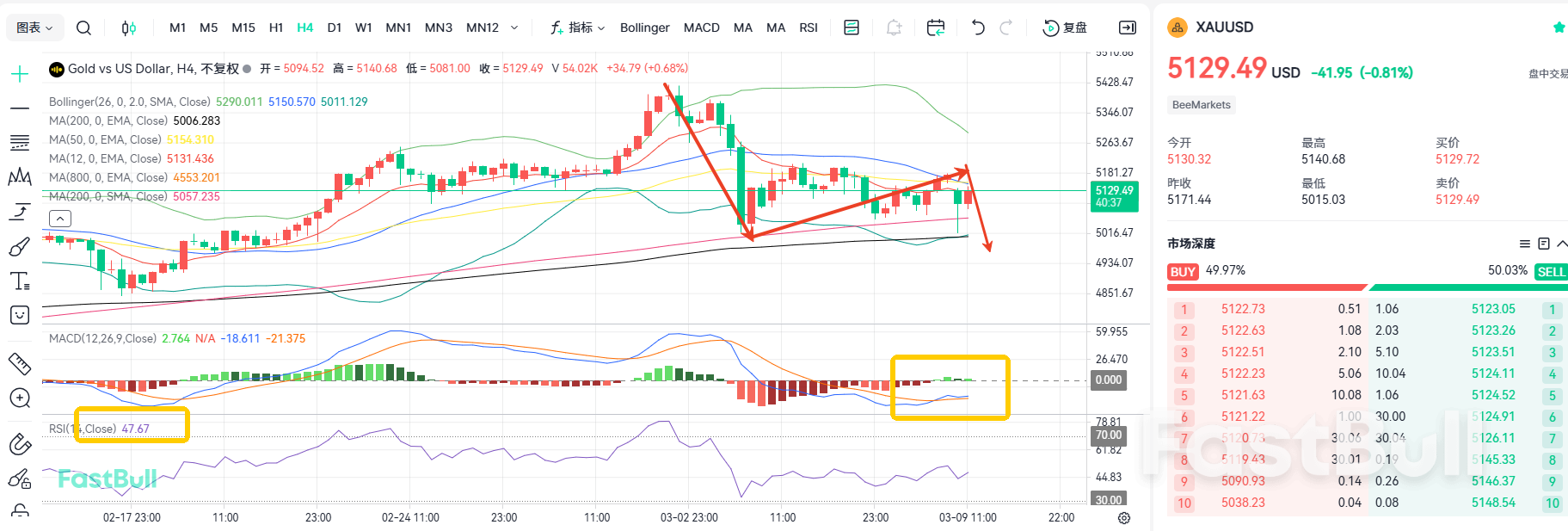
On the 4-hour timeframe, gold's Bollinger Bands are opening downward with MAs diverging lower, indicating the trend has turned bearish. After coming under pressure around 5,400, prices once broke below 5,000 and are now consolidating in a wide range in the short term. A failure to hold above 5,000 would open the door for a test of around 4,900, while a successful hold would trigger a rebound towards 5,500 and 5,600.
The MACD has formed a bullish crossover with bearish momentum fading, and the fast and slow lines are pulling back towards the zero line with some distance remaining, suggesting the rebound is not yet complete. The RSI stands at 47, indicating a dominant selling sentiment in the market, while the gradually rising RSI lows signal an ultra-short-term rebound.
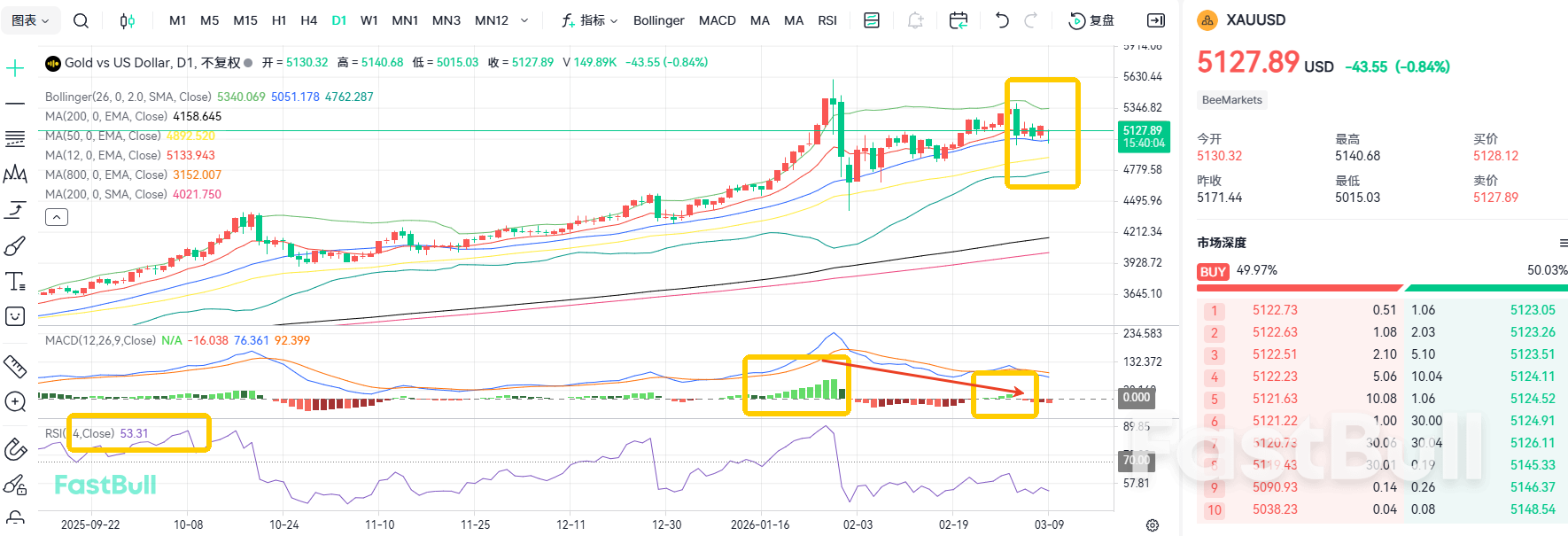
On the daily chart, gold prices hit resistance at the upper Bollinger Band, forming a candlestick with a long upper shadow, followed by a large bearish candlestick breaking below the EMA12 and the middle Bollinger Band, indicating the pullback is far from over. The MACD has formed a bearish crossover with bullish momentum ebbing steadily, a bearish divergence signal that points to an impending decline. The RSI is at 53, reflecting strong market indecision.
Therefore, the trading strategy is to sell on rallies.
Trade Recommendations
Trade Direction: Sell
Entry Price: 5100
Target Price: 4300
Stop Loss: 5700
Support: 4500/4300/4100
Resistance: 5400/5500/5600