West Texas Intermediate crude futures on the New York Mercantile Exchange are exhibiting a cautious retreat, trading slightly lower near the $98.00 per barrel mark. This measured pullback comes after a vigorous four-day rally that briefly threatened to pierce the critical $100 psychological barrier, fueled by escalating geopolitical tensions in the Middle East and a stark warning from the White House.
The price action this morning reflects a market caught between two powerful and opposing forces: the hope of diplomatic intervention and the fear of an escalating regional conflict. The initial catalyst for the stall above $100 appears to be a direct and unusually public appeal from United States President Donald Trump. In a series of posts on Truth.Social, President Trump urged major global economies—specifically naming China, France, Japan, South Korea, and the United Kingdom—to commit naval assets to a joint task force aimed at securing the Strait of Hormuz.
“Many Countries, especially those who are affected by Iran’s attempted closure of the Hormuz Strait, will be sending War Ships, in conjunction with the United States of America, to keep the Strait open and safe,” President Trump stated, framing the operation as a necessary response to an “artificial constraint” by a “Nation” threatening this vital waterway. The President further escalated the rhetoric by warning that NATO’s future would be “very bad” should European members decline to participate in his administration’s burgeoning military posture toward Iran.
From a market perspective, this represents a high-stakes diplomatic bluff. While the immediate reaction saw a slight softening of prices, it’s crucial to understand the nuance. The market is not pricing in a resolution; it is pricing in the hope of a resolution. The Strait of Hormuz is the world’s most critical oil chokepoint, handling roughly 20% of global petroleum consumption. Any multilateral naval deployment, while ostensibly intended to keep the strait open, simultaneously validates the severity of the threat and risks a miscalculation that could lead to direct military confrontation. For now, traders are cautiously optimistic that a massive show of force might deter further Iranian provocations, hence the pullback from the $100 peak.
However, the bullish undercurrents remain potent and were reinforced overnight by a significant development on the other side of the UAE. Reports confirmed a halt in old loadings at the Port of Fujairah following a drone strike. This is not merely a logistical hiccup; it is a fundamental shift in the risk calculus. Fujairah is not just another port; it is the UAE’s primary oil export terminal located on the Gulf of Oman, strategically positioned to bypass the Strait of Hormuz entirely.
The attack on Fujairah effectively closes the only major alternative export route for Gulf oil that avoids the strait. For the market, this signals that no infrastructure is safe. The immediate halt in loadings implies a tangible disruption to supply chains originating from the UAE. More importantly, it shatters the illusion of a "safe" bypass. If both the Strait of Hormuz and the Fujairah bypass route are under threat, the entire Gulf oil export network is now priced with a heightened risk of interruption.
Technical Analsysis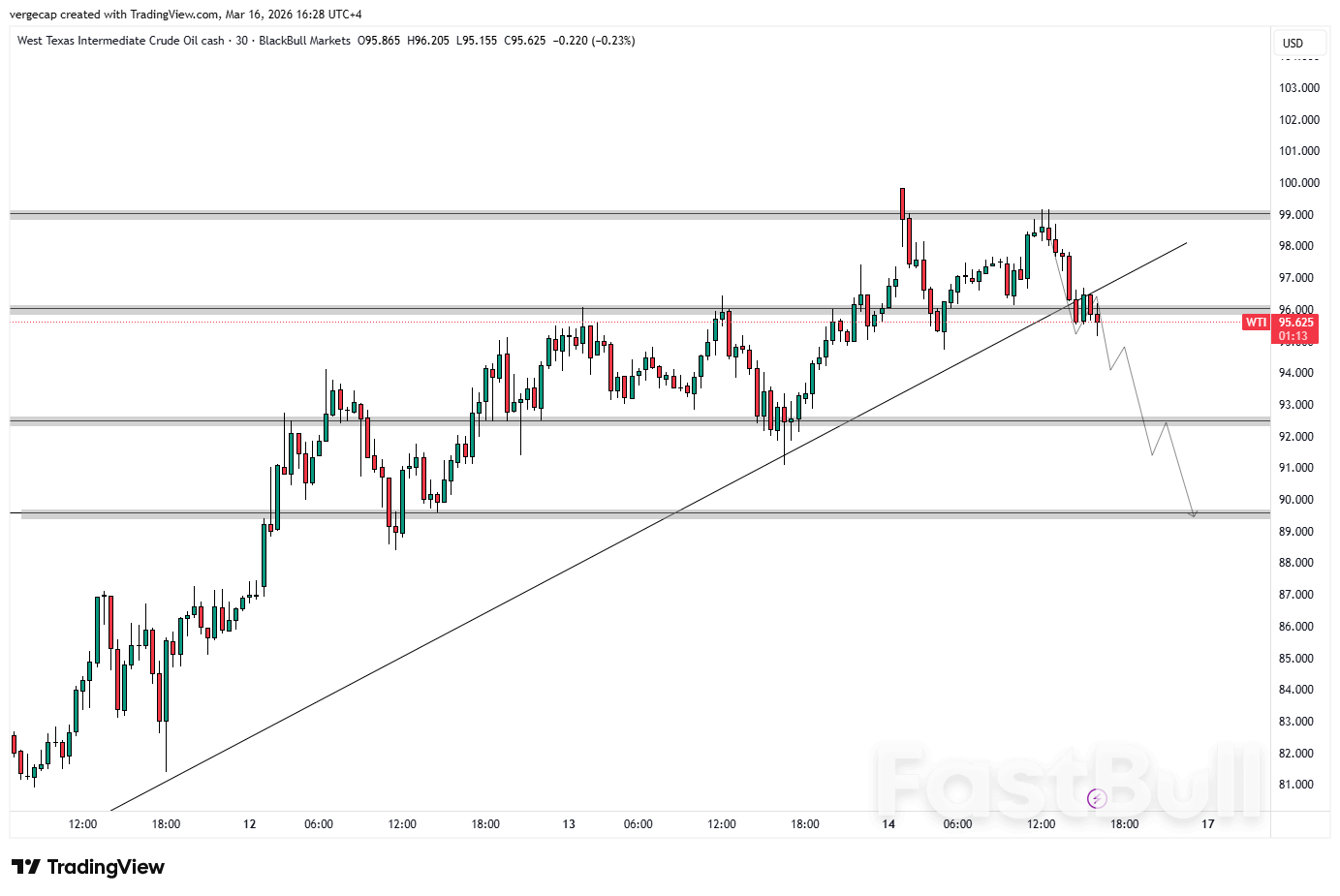
From a technical perspective, WTI crude oil is beginning to show signs of structural weakness after a prolonged bullish advance. On the 30-minute chart, prices previously traded within a well-defined ascending trendline, which supported the steady sequence of higher highs and higher lows that drove the market higher from the $82 region toward the $99 resistance zone. However, recent price action indicates that bullish momentum is fading, with the market now testing the lower boundary of this trend structure.
Currently, WTI is trading near the $95.60 region, which aligns closely with a key horizontal support level around $96.00. This zone has acted as a significant pivot area throughout recent sessions, serving alternately as both support and resistance. The repeated tests of this level suggest that the market is entering a critical decision point, where either buyers defend the structure or sellers force a decisive breakdown.
The ascending trendline, which has guided the broader rally since mid-March, is now under considerable pressure. A decisive break below both the $96.00 support level and the trendline would represent a meaningful deterioration in the bullish structure and could trigger an acceleration of downside momentum. Such a breakdown would confirm a transition from a bullish trending environment to a corrective or potentially bearish phase.
If sellers successfully push the market below this support, the next downside target is likely to emerge near the $93.00 support zone, which previously served as a consolidation base during earlier stages of the rally. A sustained move beneath this level would expose the $90.00 psychological handle, a region that represents the next major demand zone and a critical technical threshold for the broader trend.
On the upside, bullish traders would need to reclaim and hold above the $96.00–$97.00 resistance corridor to stabilize the market. A sustained recovery above this zone could allow prices to retest the $99.00 resistance level, where the market previously encountered strong supply pressure. A break above that region would likely reestablish the broader bullish momentum and shift focus toward the $100.00 psychological level, a milestone that could attract renewed speculative buying.
Price behavior currently suggests corrective consolidation rather than immediate trend continuation. The recent rejection from the $98.50–$99.00 region indicates that buyers are losing control in the short term, while sellers are gradually gaining traction near key support levels. As long as WTI remains below the $97.00 resistance area and continues to pressure the ascending trendline, the risk of a deeper pullback remains elevated.
Overall, the technical structure suggests that downside risks are increasing, particularly if the market confirms a break below the trendline support that has sustained the rally.
TRADE RECOMMENDATION
SELL WTI CRUDE OIL
ENTRY PRICE: 95.00
STOP LOSS: 97.20
TAKE PROFIT: 90.00


