The oil market is currently navigating a complex landscape of geopolitical brinkmanship and shifting commercial realities. West Texas Intermediate is holding steady around the $65.70 mark, digesting its strongest daily gain in recent weeks as traders attempt to quantify the tangible risks emanating from the Persian Gulf.
While the headlines scream of heightened tensions between Washington and Tehran, a nuanced view is beginning to take shape on the trading floors. The recent price action reflects a market that is acknowledging the threat of supply disruption without yet panicking over an outright, region-wide conflagration. The core of the anxiety lies in the Strait of Hormuz, a narrow choke-point through which roughly a fifth of the world's daily oil consumption passes. As strategists at ANZ highlighted, any direct military confrontation carries the inherent risk of drawing this vital artery into the conflict, a scenario that would send prices skyrocketing.
However, the market’s cautious advance, rather than a feverish spike, suggests many participants are heeding the analysis of veteran strategists like Hiroyuki Kikukawa of Nissan Securities. Speaking to Reuters, Kikukawa posited that while tensions remain dangerously elevated, the probability of a full-scale war is viewed as low. His assessment hinges on a critical factor: the economic calculus of the Trump administration. "Trump is unlikely to favor a sharp spike in crude prices," Kikukawa noted, suggesting that any retaliatory military action would likely be "limited to short-term airstrikes" designed to signal resolve rather than trigger an oil shock that could derail the global economy. This perspective provides a powerful counterbalance to the more alarming rhetoric emerging from the political sphere, where Vice President JD Vance has stated Iran failed to meet US red lines, and President Trump has left the military option firmly on the table.
Yet, beneath the surface of the US-Iran standoff, a quieter but equally significant shift is reshaping the physical oil market: the return of Venezuela. In a striking move that underscores the relentless pursuit of refinery margins, US processors Phillips 66 and Citgo Petroleum are reportedly planning to bypass traditional intermediaries and trading houses to purchase heavy crude directly from Venezuela’s state firm PDVSA starting next month. This direct engagement, circumventing even US major Chevron, signals a voracious appetite for the heavy sour grades that US Gulf Coast refineries are configured to process, especially as global supplies of similar grades remain tight.
The pull of Venezuelan oil is proving to be truly global. In a landmark development for the Asian market, India’s state-run Bharat Petroleum Corporation Limited has executed its first-ever purchase of Venezuelan crude. Simultaneously, HPCL Mittal Energy Limited has re-entered the market, buying cargoes from the South American producer for the first time in two years, according to sources familiar with the matter. This wave of new demand from both the US and India is effectively drawing Venezuelan barrels back onto the world market, potentially easing the search for heavy crude and providing a new, competitive dynamic for suppliers.
For now, the oil market remains suspended between these two forces: the latent, explosive threat of a Gulf conflict and the tangible, commercial reality of shifting crude flows. The next move in prices will likely depend on whether the geopolitical rhetoric translates into a sustained military campaign—or whether the market’s focus shifts fully to the evolving supply picture from Caracas.
Technical Analysis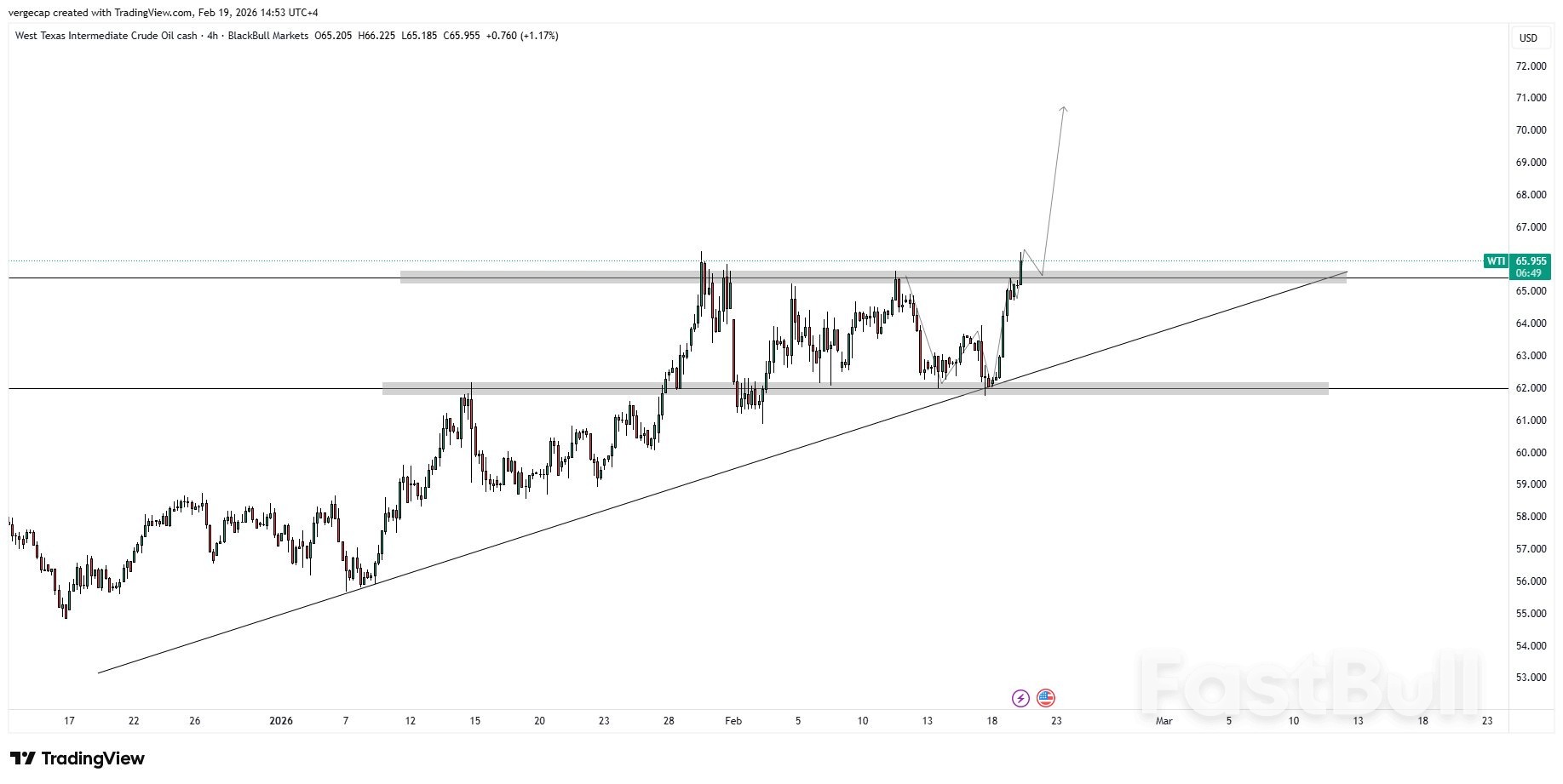
From a technical perspective, WTI crude oil remains positioned within a constructive bullish structure, underpinned by a well-respected rising trendline that has guided price action higher since mid-January. On the 4-hour chart, prices have rebounded decisively from the ascending trendline near the $62.00–$62.50 support zone, confirming this area as a key demand region and reinforcing the broader higher-low sequence.
Price is now pressing into a major horizontal resistance band around $65.50–$66.00, a zone that has repeatedly capped upside attempts in recent weeks. The current advance into this region is technically significant, as it follows a clean bounce from trendline support rather than an extended rally, suggesting improving risk-reward conditions for bullish continuation. A sustained 4-hour close above this resistance band would represent a structural breakout, likely triggering momentum-driven follow-through and opening the door toward the $69.00–$70.00 zone, where the next psychological and technical objectives reside.
On the downside, the $62.00 region remains the first critical layer of support, aligning with both horizontal structure and the rising trendline. A decisive break below this level would undermine the current bullish setup and signal a deeper corrective phase, with downside risks extending toward $60.00, followed by $58.50, where prior consolidation occurred. A sustained move below those levels would suggest a broader trend deterioration rather than a routine pullback.
Momentum indicators favor consolidation with a bullish tilt rather than exhaustion. The Relative Strength Index (RSI) has recovered into positive territory and remains comfortably above the 50 mark, indicating strengthening upside momentum without reaching overbought conditions. Meanwhile, the MACD has turned higher and is pushing further above the zero line, confirming improving bullish momentum and supporting the case for an upside resolution, provided resistance gives way.
Overall, the technical picture favors bullish continuation, but confirmation hinges on a clean break above the $65.50–$66.00 supply zone.
TRADE RECOMMENDATION
BUY WTI
ENTRY PRICE: 65.60
STOP LOSS: 62.00
TAKE PROFIT: 70.00


