WTI crude remains under pressure on Tuesday, extending its recent losing streak and trading around $90.20 per barrel during the European session. Oil initially attempted to recover but surrendered those gains as fresh diplomatic developments reduced concerns over supply disruptions in the Middle East.
The latest pressure follows reports that Iran has proposed reopening the Strait of Hormuz within seven days, provided the United States takes initial steps to ease economic and military pressure on Tehran. The proposal was reportedly communicated through intermediaries as world leaders gather in New York for the United Nations General Assembly.
The possibility of negotiations is removing part of the geopolitical premium that had previously driven crude sharply higher. Attention now turns to US President Donald Trump's appearance at the UN, with the possibility of a meeting with Iranian President Masoud Pezeshkian adding to expectations that diplomatic efforts could accelerate.
Physical supply conditions are also becoming less threatening. Crude shipments successfully moved through the Strait of Hormuz over the weekend, further reducing immediate fears of a severe supply shortage. Saudi Arabia reportedly transported approximately 2.9 million barrels per day through the waterway over the past six days.
Tanker activity at Saudi Gulf terminals has also increased substantially. Satellite data showed supertankers capable of carrying a combined 14 million barrels docked at export facilities over the weekend, representing the highest observed tanker presence since at least June. The stronger flows suggest that regional crude exports are proving more resilient than markets had previously feared.
The improvement in supply conditions is also weighing on Brent. Deutsche Bank noted that the international benchmark briefly moved back below the psychological $100-per-barrel level, with growing optimism over a possible diplomatic solution contributing to the decline.
For WTI, the combination of improving Hormuz flows, stronger Saudi exports and renewed US-Iran diplomacy has weakened the supply-risk argument that previously supported prices. Middle East tensions remain capable of producing sudden volatility, but unless negotiations deteriorate or energy infrastructure suffers fresh disruption, crude could remain vulnerable to further corrective pressure.
Technical Analysis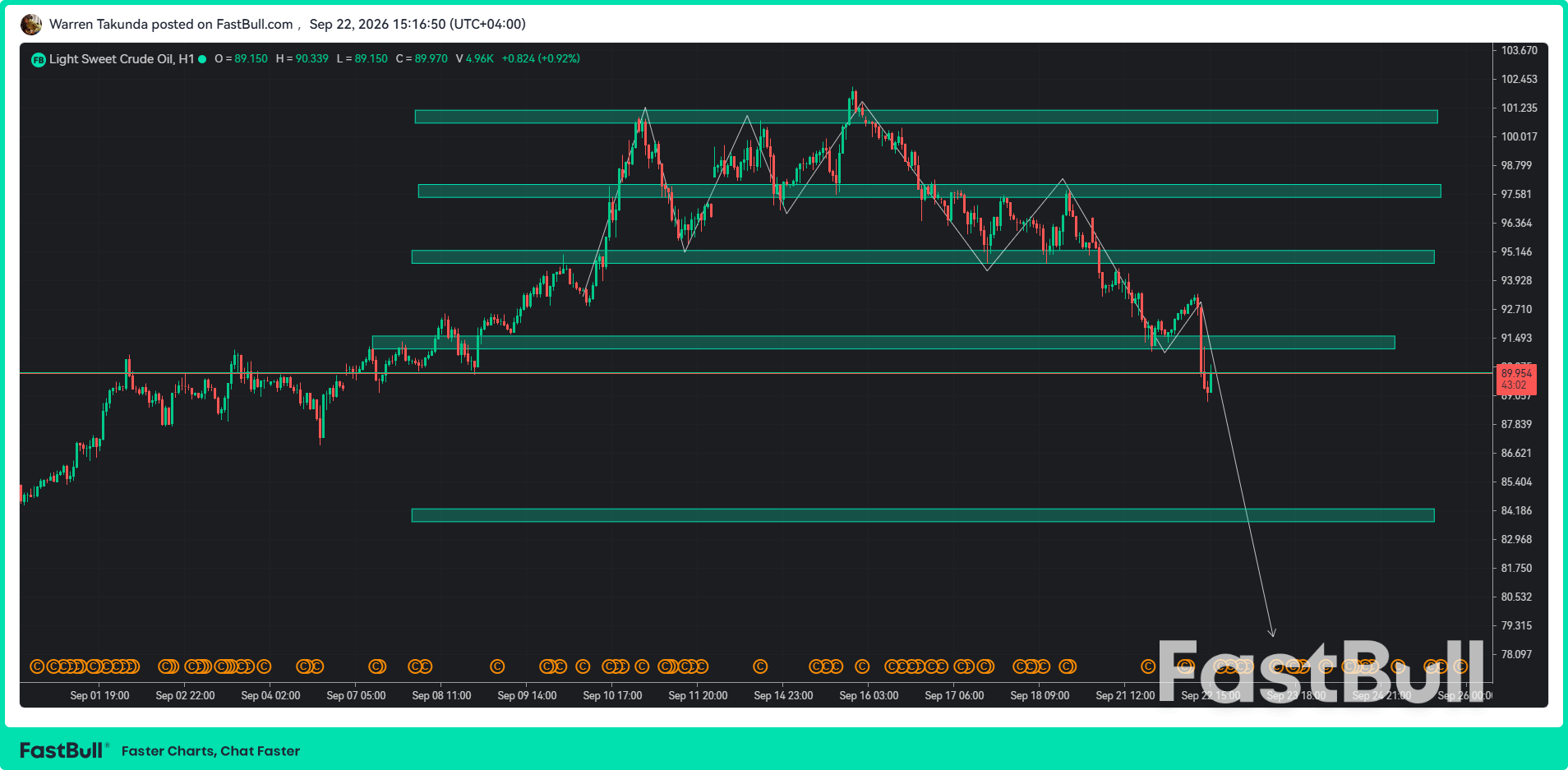
WTI’s technical structure has deteriorated further on the 1-hour chart, with crude trading around $89.95 after decisively breaking beneath the $91 area. The market has been forming a consistent sequence of lower highs and lower lows since peaking above $101 in mid-September, leaving sellers firmly in control of the short-term trend.
The latest breakdown is particularly significant because price has lost the $90.90–$91.50 support zone. This area had previously attracted buyers and briefly halted the decline, but the subsequent rebound failed quickly before sellers drove WTI underneath it. That failed recovery reinforces the bearish structure and turns the former support region into resistance.
A short-term rebound remains possible following the speed of the latest decline. However, unless WTI can reclaim $91.50, any recovery would look corrective rather than the beginning of a broader reversal. A retest and rejection of the broken zone would provide further confirmation that sellers remain dominant.
The chart shows several former support levels above current price, including approximately $94.60–$95.20 and $97.40–$97.90. These areas would become increasingly important only if buyers manage to recover above $91.50.
On the downside, the next substantial demand zone sits around $83.70–$84.20. With relatively little visible structural support between current levels and that region, sustained selling below the recent lows could accelerate the decline.
More importantly, the projected price path suggests the bearish move could eventually extend beyond $84.00. If that support also gives way, WTI could expose the $79.00–$80.00 region, representing a much deeper retracement of September's earlier rally.
Overall, the chart continues to favor a sell-the-recovery scenario. The break below $91 confirms another deterioration in market structure, and without a decisive recovery above that former support, the path remains tilted toward $84 initially and potentially $79–$80 thereafter.
TRADE RECOMMENDATION
SELL WTI
ENTRY PRICE: $90.00
STOP LOSS: $95.00
TAKE PROFIT: $84.00


