Oil prices are giving back part of their recent geopolitical rally on Tuesday, with WTI falling roughly 3% to trade near $82.00 per barrel. The pullback suggests traders are becoming less willing to pay an elevated risk premium as Washington increasingly turns toward financial pressure on Iran rather than expanding direct military action.
The latest trigger came from the US Treasury, which is preparing a tougher sanctions campaign designed to squeeze Iran’s access to international finance and trade. Treasury Secretary Scott Bessent has promised an aggressive enforcement strategy targeting businesses and financial channels that continue facilitating Iranian economic activity.
Despite the forceful language coming from Washington, the announcement has not produced the kind of supply fears that previously sent crude prices sharply higher. The key issue is that markets have yet to see enough detail on how quickly the sanctions will be implemented, which entities will be targeted and how aggressively secondary measures will be enforced.
That uncertainty is encouraging some traders to take profits after oil's recent surge. The market had built a substantial geopolitical premium around the possibility of a broader military confrontation, particularly given the importance of Middle Eastern shipping routes to global energy supplies. Moving the confrontation toward sanctions reduces the immediate probability of physical barrels being removed from the market.
Danske Bank broadly shares that interpretation, arguing that Washington’s latest measures have so far generated only a limited market response. Without concrete enforcement details, the announcement appears to have been interpreted more as an opening warning than an immediate disruption to Iranian exports.
The change in tone is also important. Saxo Bank has highlighted the transition from military confrontation toward economic pressure as one reason anxiety across the oil market has started to ease. That does not mean geopolitical risk has disappeared, but it does reduce the urgency that previously drove buyers into crude.
China could become increasingly important to the effectiveness of Washington's strategy. Beijing has already defended its economic relationship with Tehran, insisting that its cooperation with Iran complies with international law and should not be disrupted by outside pressure. Iran has also indicated that it expects major trading partners such as China to resist US demands.
This creates an important test for the oil market. Sanctions will matter far more if they translate into a measurable reduction in Iranian crude exports. Until there is evidence of barrels actually disappearing from global supply, traders may remain reluctant to rebuild the geopolitical premium that recently pushed WTI sharply higher.
The move back toward $82 looks more like a correction in geopolitical pricing than a fundamental collapse in oil’s broader outlook. Washington has raised the economic pressure substantially, but markets are distinguishing between aggressive sanctions rhetoric and an immediate threat to physical supply. The risk is that this calm could reverse quickly if Iran retaliates or the confrontation returns to the military arena.
Technical Analysis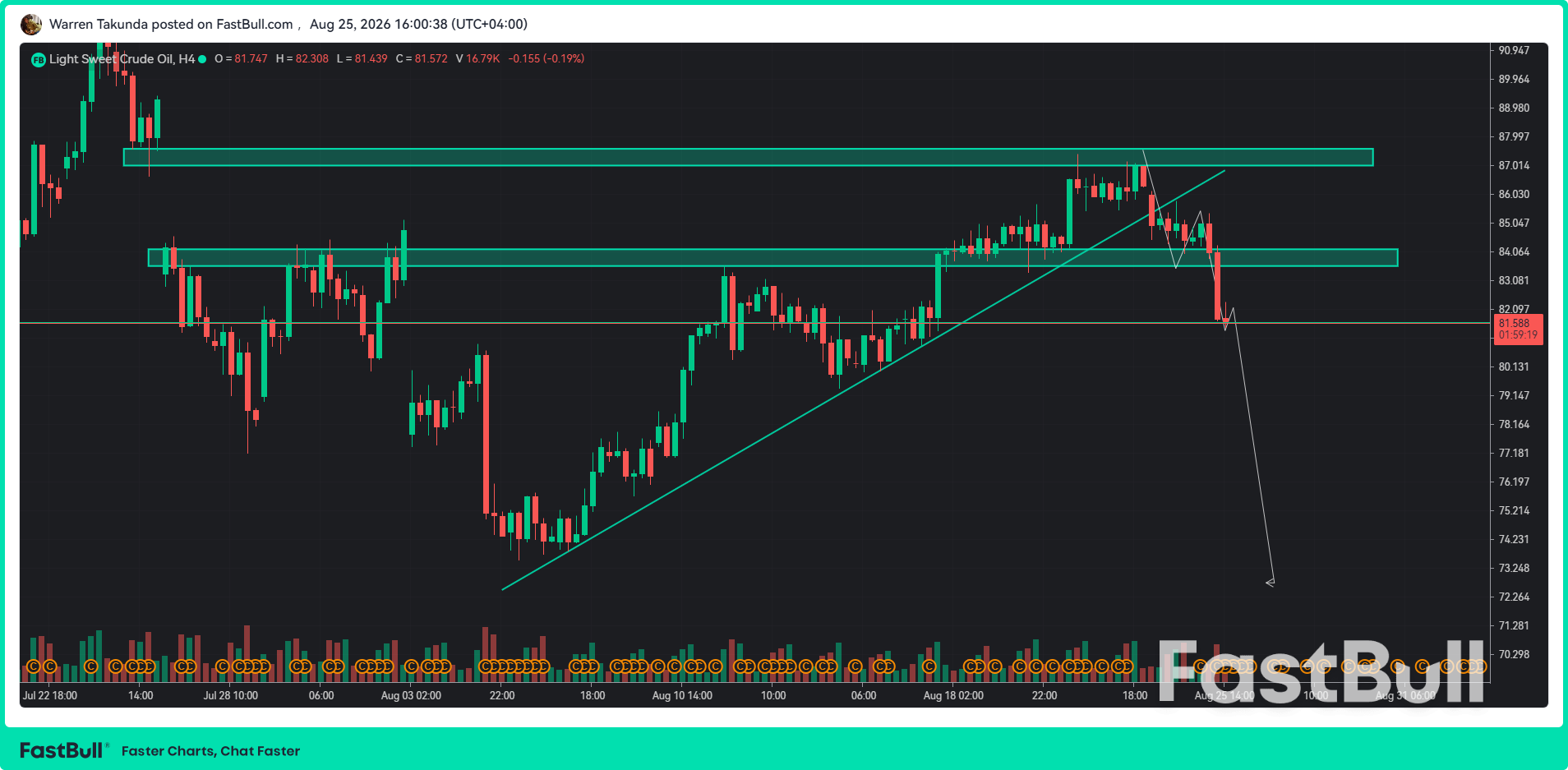
WTI has suffered a meaningful deterioration in its short-term structure on the 4-hour chart, with the latest selloff breaking the ascending trendline that had supported the recovery from the early-August lows near $73.00. The rejection from the $87.00–$87.50 supply zone proved decisive, with buyers failing to extend the rally and sellers subsequently forcing crude back through several layers of support.
The most important development is the breakdown beneath the $83.50–$84.20 region. This zone previously acted as a major resistance barrier before being reclaimed during the recent rally, meaning the move back below it represents a clear shift in momentum. The breakdown was also accompanied by a large bearish candle and stronger selling volume, adding credibility to the move rather than suggesting a minor intraday pullback.
WTI is now trading around $81.60, where price is attempting to stabilize after the initial decline. A short-lived rebound from current levels remains possible following the speed of the selloff, but the former $83.50–$84.20 support zone should now act as resistance. A retest and rejection from this region would reinforce the bearish setup and potentially provide the foundation for another leg lower.
On the downside, a sustained move beneath $81.00–$81.50 would expose the $80.00 psychological handle. However, given the loss of the rising trendline and the breakdown of previous support, the broader corrective target extends considerably lower. Below $80.00, sellers could target $78.00–$79.00, followed by the $75.00 area. If bearish momentum continues to accelerate, the major $72.50–$73.00 support region, where the August recovery originated, becomes the larger downside objective.
For bulls to regain control, WTI would first need to reclaim $84.20 and establish itself back above the broken support zone. A stronger recovery through $85.00 would reduce immediate downside pressure, while a return above $87.00–$87.50 would be required to materially invalidate the bearish structure.
For now, the technical picture has shifted in favour of sellers. The combination of rejection from major resistance, a broken ascending trendline and the loss of $84.00 support suggests that rallies may increasingly be treated as selling opportunities. Unless WTI quickly recovers the broken $83.50–$84.20 area, the path of least resistance appears lower.
TRADE RECOMMENDATION
SELL WTI
ENTRY PRICE: 81.60
STOP LOSS: 88.00
TAKE PROFIT: 73.00


