The New Zealand Dollar strengthened modestly against its US counterpart on Friday, with NZD/USD climbing toward the 0.5865 region and posting a 0.22% gain on the day. The move higher comes as the US Dollar retreats slightly, with the US Dollar Index (DXY) slipping to around 98.65, down roughly 0.18%, in what appears to be a corrective pullback rather than a shift in broader market direction.
Despite a persistently tense geopolitical backdrop, particularly surrounding ongoing friction between the United States and Iran in the Strait of Hormuz, the Greenback has struggled to maintain its recent strength. Typically, such geopolitical risks would underpin demand for safe-haven assets, including the US Dollar. However, as the trading week draws to a close, this defensive positioning appears to be fading, allowing higher-beta currencies like the New Zealand Dollar to regain some ground. In my view, this reflects a temporary unwinding of risk-off trades rather than a fundamental shift in sentiment, suggesting that the USD’s broader support structure remains intact.
From a macroeconomic standpoint, recent US data continues to reinforce the narrative of economic resilience. Weekly Initial Jobless Claims showed only a marginal uptick, confirming that the labor market remains robust despite tighter financial conditions. At the same time, the latest S&P Global Purchasing Managers’ Index (PMI) readings indicated ongoing expansion across key sectors of the economy, highlighting sustained business activity. This combination of solid employment and steady growth continues to support US Treasury yields, which in turn limits the downside potential for the US Dollar even as it undergoes a near-term correction.
Adding another layer to the outlook is the persistent rise in energy prices, largely driven by supply disruptions linked to geopolitical tensions in the Middle East. Elevated oil prices are keeping inflation risks firmly on the radar, prompting markets to reassess the trajectory of US monetary policy. Expectations for aggressive rate cuts from the Federal Reserve have been scaled back considerably, with traders increasingly pricing in a prolonged period of restrictive policy. This “higher-for-longer” narrative remains a key pillar underpinning the US Dollar over the medium term, and in my assessment, it is likely to reassert itself once the current corrective phase runs its course.
On the New Zealand side, domestic fundamentals are offering a degree of support to the Kiwi. Inflationary pressures remain persistent, with recent data showing annual inflation holding above the Reserve Bank of New Zealand’s target range. This has fueled speculation that the central bank may be forced to maintain a cautious stance, delaying any easing cycle or even leaving the door open for additional tightening if price pressures fail to moderate. Such expectations are providing a buffer for the NZD, helping it recover from recent lows and sustain its current rebound against the US Dollar.
Nevertheless, the broader picture for NZD/USD remains nuanced. While the pair is benefiting from short-term USD weakness and supportive domestic factors, the underlying strength of the US economy and the recalibration of Federal Reserve expectations continue to act as headwinds. The divergence between a resilient US macro backdrop and a relatively smaller, more externally sensitive New Zealand economy suggests that upside in the pair may remain limited unless global risk sentiment improves more decisively.
Technical Analysis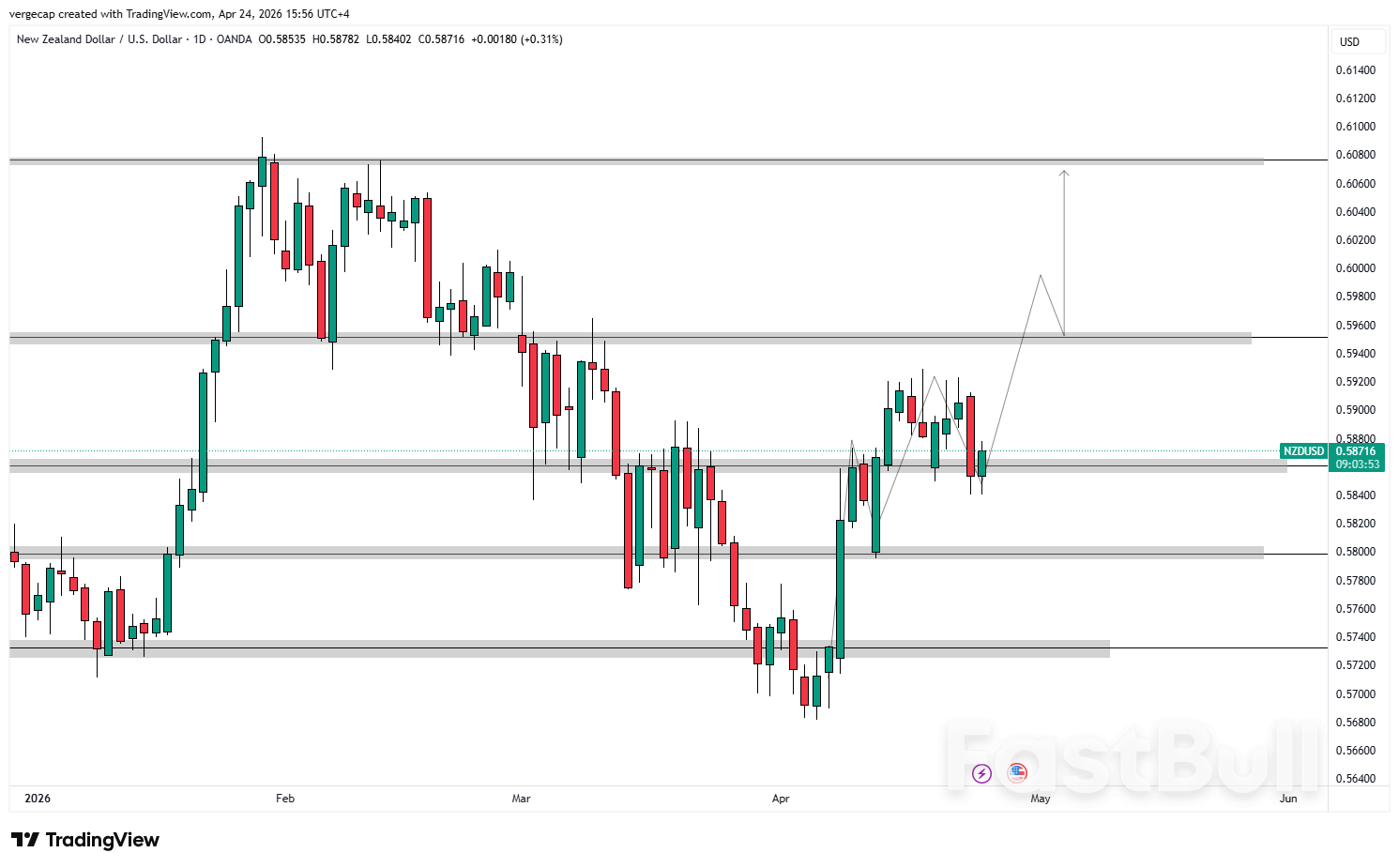
From a technical perspective, NZD/USD is transitioning from a broader downtrend into a corrective recovery phase, with price action on the daily chart showing early signs of stabilization but not yet a confirmed bullish reversal. The pair is currently trading around the 0.5870 region, consolidating just above a key horizontal support-turned-pivot zone near 0.5850, which has emerged as an important short-term equilibrium level.
Recent price behavior highlights a notable rebound from the April lows near the 0.5700 handle, where buyers stepped in aggressively following an extended period of downside pressure. This recovery has been characterized by a sequence of higher lows, suggesting that bullish momentum is gradually building. However, the structure remains fragile, as the pair continues to trade within a broader range defined by lower highs from the February peak near 0.6080.
In the near term, NZD/USD appears to be consolidating between 0.5850 support and resistance around 0.5950. This upper boundary aligns with a previously established supply zone and has already capped recent upside attempts, indicating that sellers remain active at higher levels. The inability to sustain a break above this region suggests that the recovery is still corrective in nature rather than impulsive.
The presence of multiple horizontal zones on the chart reinforces the importance of range dynamics. Below current levels, immediate support is seen at 0.5800, followed by a stronger base around 0.5720–0.5740. A decisive break beneath this lower support cluster would invalidate the current recovery structure and expose the pair to a renewed bearish leg, potentially targeting the 0.5600 psychological region.
On the upside, a sustained move above 0.5950 would mark a significant technical development, as it would break the sequence of lower highs and shift short-term market structure in favor of the bulls. Such a breakout could open the door toward the 0.6000 handle initially, with further upside potential extending to 0.6080, which represents a major resistance level from earlier in the year.
The projected path on the chart suggests a potential bullish continuation scenario, with a pullback into the 0.5850 zone followed by a renewed push higher. This aligns with typical market behavior, where breakouts are often preceded by consolidation or minor retracements to build momentum.
Momentum dynamics appear to support a consolidation phase rather than a reversal. While explicit indicators are not shown, the price action—characterized by smaller candles and overlapping ranges—indicates a cooling of momentum after the recent rebound. This suggests that the market is in a rebalancing phase, with neither buyers nor sellers fully in control.
In my view, NZD/USD is at a critical juncture. The pair has shown encouraging signs of recovery, but it must break above the 0.5950 resistance zone to confirm a more sustained bullish shift. Until then, the broader bearish structure remains intact, and rallies may continue to face selling pressure.
TRADE RECOMMENDATION
BUY NZD/USD
ENTRY PRICE: 0.5875
STOP LOSS: 0.5790
TAKE PROFIT: 0.6000


