The New Zealand Dollar is extending its advance for a second session, hovering near the 0.6060 handle against a subdued US Dollar as we head into the European crossover. While the Greenback remains surprisingly heavy despite a powerful recalibration of Federal Reserve policy expectations—markets now pricing a staggering 92% probability of a hold at the next meeting—the Kiwi is drawing its own brand of support from pre-positioning. Traders are hunkering down ahead of next week’s Reserve Bank of New Zealand (RBNZ) policy meeting, where Governor Orr is universally expected to keep the Official Cash Rate in a holding pattern. The immediate catalysts, however, are micro-targeted: tomorrow’s Q1 Inflation Expectations survey from the RBNZ, and later today, the main event—US Consumer Price Index (CPI) data finally hitting the tape after a delayed start to the year.
Let’s address the elephant in the trading pit: the dollar should, by all conventional logic, be ripping higher. January’s Nonfarm Payrolls headline of 130,000 absolutely smashed consensus calls of 70,000. The Unemployment Rate dipped to a respectable 4.3% from 4.4%. And yet, here we are, watching NZD/USD hold its line.
The paradox is explained not by the headline, but by the fine print—and the futures book. According to the CME FedWatch tool, the probability of the Fed remaining on hold at the upcoming meeting has surged to nearly 92%, up from 80% just 24 hours ago. But here is where it gets nuanced for FX traders: the hawkish repricing has a ceiling. While aggressive bets on a 50-basis-point cut have been aggressively unwound, the market is still holding onto a June lifeline for the first 25bp reduction, with September penciled in for a follow-up .
This isn’t a market that believes the Fed is turning hawkish; it’s a market that has accepted the Fed needs to wait. That distinction is critical. Yields have stabilized rather than spiked, and the dollar’s reaction function is muted. Against that backdrop, the Kiwi—a high-beta proxy for risk and Chinese growth sentiment—has room to breathe.
Across the Pacific, the narrative in Wellington is one of deliberate, almost painful, patience. The RBNZ is boxed in. Fourth-quarter labor data revealed the unemployment rate climbed to 5.4%—the highest print since 2015. That is not a statistic that screams urgency for tightening .
Westpac’s latest research note encapsulates the street’s view: the RBNZ will stand pat at next week’s meeting. Perhaps more telling is the forecast shift for the first hike, now pushed out to December 2026 . This is a central bank that is happy to let the lagged effects of previous tightening wash through the system.
Yet the Kiwi is firmer. This is the nuance of FX pre-positioning. The bar for a dovish surprise from the RBNZ is now extraordinarily high. With the market already priced for a terminal rate that is low and far away, the risk of a hawkish tilt—or even just a less-dovish statement regarding inflation persistence—is asymmetric. Traders are covering shorts, not necessarily building new longs.
Technical Analysis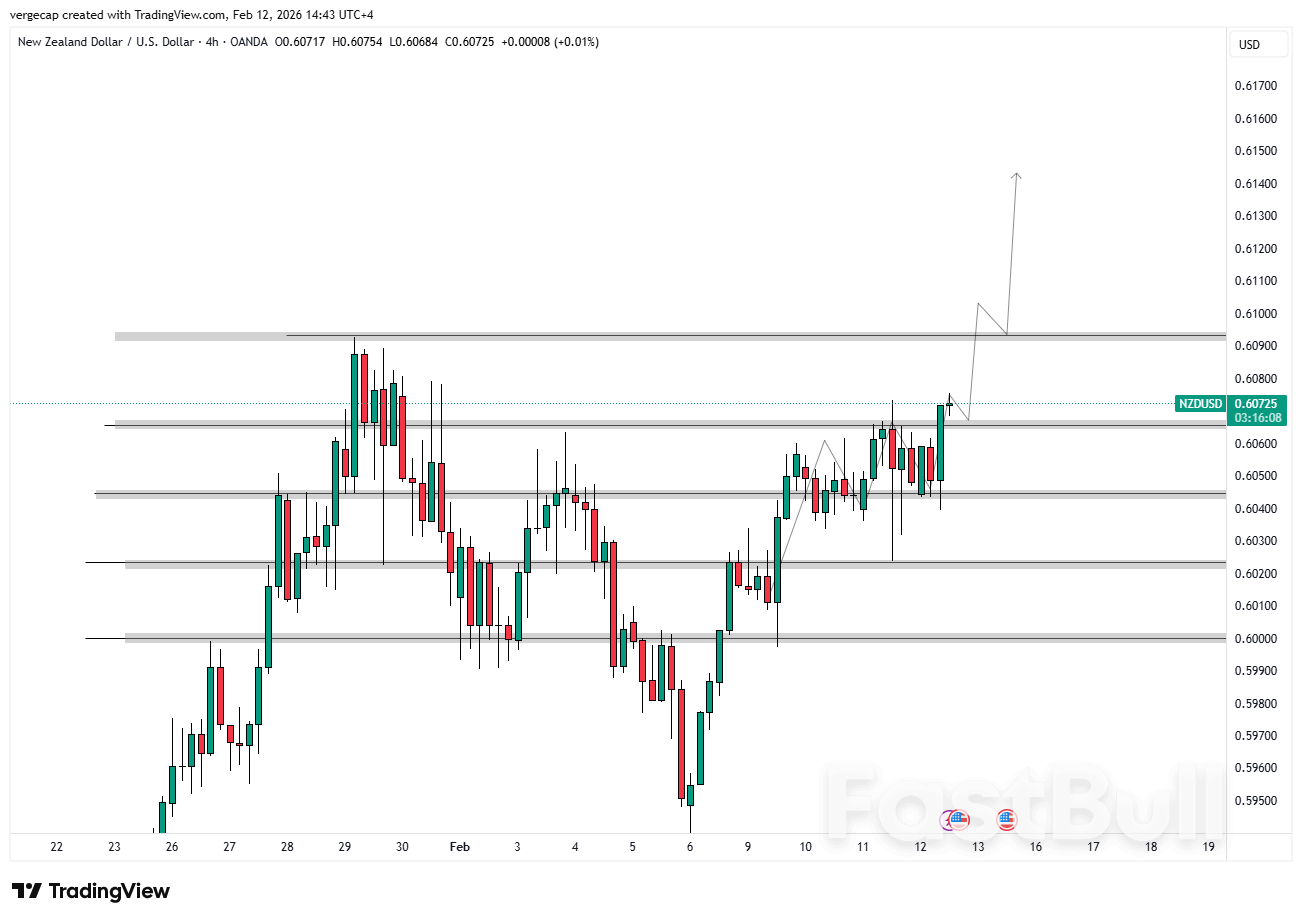
From a technical perspective, NZD/USD is attempting to transition from recovery into a short-term bullish structure, with price now pressing against a key resistance cluster on the 4-hour chart. The pair has staged a steady rebound from the early-February low near 0.5950, carving out a sequence of higher lows and higher highs that signals improving upside momentum.
Price action is currently challenging a well-defined horizontal resistance zone around 0.6070–0.6090, an area that previously acted as both support and resistance in late January. This level is now the primary barrier separating the pair from a broader upside extension. Multiple recent candles have probed this region, showing rejection wicks but also persistent buying pressure, suggesting bulls are gradually absorbing supply rather than retreating sharply.
Beneath the market, several layered support zones reinforce the developing bullish bias. The first and most immediate support sits near 0.6040–0.6050, which marks a recent breakout area and short-term consolidation shelf. A pullback into this region would likely be viewed as a technical retest rather than a trend reversal. Below that, stronger structural support is seen around 0.6000–0.6010, a psychological level that also aligns with a prior demand zone where buyers previously stepped in aggressively. As long as price remains above this region, the short-term recovery structure remains intact.
The broader recovery leg originates from the 0.5950 swing low, which now serves as the key higher-low reference point. A decisive move back below 0.6000, followed by sustained trade under 0.5950, would invalidate the emerging bullish structure and shift focus back toward the 0.5900 area, signaling that the recent rally was corrective rather than the start of a trend reversal.
On the upside, a clear and sustained break above 0.6090 would represent a meaningful technical breakout. Such a move would confirm that buyers have overpowered the supply zone and would likely open the path toward 0.6140–0.6160, where the next visible resistance sits from prior swing highs. A stronger bullish extension could then target the 0.6200 psychological handle, a level that would mark a significant recovery milestone for the pair.
Price behavior also reflects compression just beneath resistance, often a precursor to a volatility expansion. The series of higher lows pushing into a flat resistance band suggests building upward pressure. If buyers maintain control and dips remain shallow, the probability of an upside breakout increases.
Overall, the technical landscape favors a cautiously bullish outlook while price holds above the 0.6000–0.6010 support base, with the 0.6090 ceiling acting as the trigger level for the next directional move.
TRADE RECOMMENDATION
BUY NZD/USD
ENTRY PRICE: 0.6075
STOP LOSS: 0.5990
TAKE PROFIT: 0.6150


