Fundamentals
Precious metals prices edged lower due to partial profit-taking and the unwinding of long positions by short-term futures traders. Nevertheless, given that the U.S. consumer price index (CPI) inflation unexpectedly retreated in November, market expectations for further Federal Reserve interest rate cuts are growing, which may limit gold's potential downside. Lower interest rates can reduce the opportunity cost of holding non-yielding gold, thereby supporting its price. In addition, geopolitical tensions between the U.S. and Venezuela, combined with strong industrial and investment demand, may provide some support for safe-haven assets like gold. Holdings of SPDR Gold Trust — the world's largest gold ETF — remained unchanged at 1,052.54 tons, indicating institutional sentiment remains in a wait-and-see mode. Goldman Sachs reiterated its bullish stance on gold in its latest report, forecasting a 14% rise to $4,900 per ounce by December 2026 under its base case. It cited robust central bank structural gold buying demand and Fed rate-cut cycle support as key drivers, while noting that diversification in private-sector investments could further push up prices. The bank continues to recommend maintaining long positions in gold. Geopolitically, the EU Brussels Summit failed to reach a consensus on using proceeds from Russia's frozen assets to fund "compensation loans" for Ukraine, exposing deep divisions among member states over legal liability and financial risks. Belgium, as the primary custodian of Russian assets, plays a pivotal role in the progress of this issue due to its cautious approach. Moreover, U.S. President Trump publicly urged Ukraine to move quickly, warning that "every time they take too much time, then Russia changes their mind." This public pressure, previously applied privately, sets a tone of seeking a rapid resolution ahead of the high-level U.S.-Ukraine meeting scheduled for December 19th–20th in Florida.
According to the CME FedWatch tool, financial markets currently see only a 26.6% probability of a Fed rate cut at its next meeting in January, even though the Fed cut rates by 0.25 percentage points at each of its past three meetings. On Wednesday, President Trump stated that the next Fed chair would be someone who believes in significantly lowering interest rates. He also said he would soon announce the successor to current Fed Chair Jerome Powell. Latest data from the U.S. Bureau of Labor Statistics showed that core CPI rose 2.6% year-on-year in November, down notably from 3.0% earlier; headline CPI rose 2.7% YoY, well below the market expectation of 3.1%, with core CPI hitting a new low since March 2021. Although inflation is still rising year-on-year, its growth rate has slowed to near a three-year low, somewhat easing concerns about a resurgence in inflation. After the data release, the probability of a Fed rate cut in January 2026 nudged up from 26.6% to 28.8%. However, some analysts noted that the CPI data may have been affected by incomplete price collection during the U.S. government shutdown and technical revisions to October's figures, potentially impacting accuracy; actual inflation may still be close to 3.0%. Chicago Fed President Goolsbee called the report positive data, saying that if the trend continues, it could create conditions for further rate cuts next year, but economists cautioned against overinterpreting a single month's data. Traders will pay closer attention to the University of Michigan's December Consumer Sentiment Index, due out late Friday.
Technical Analysis
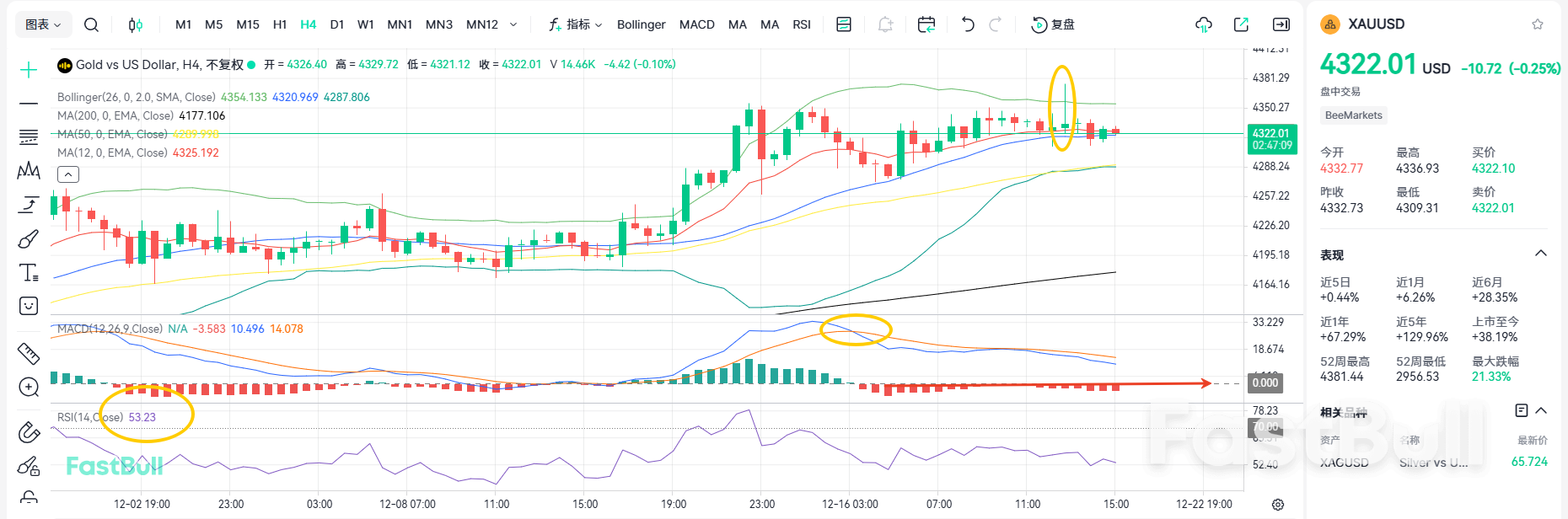
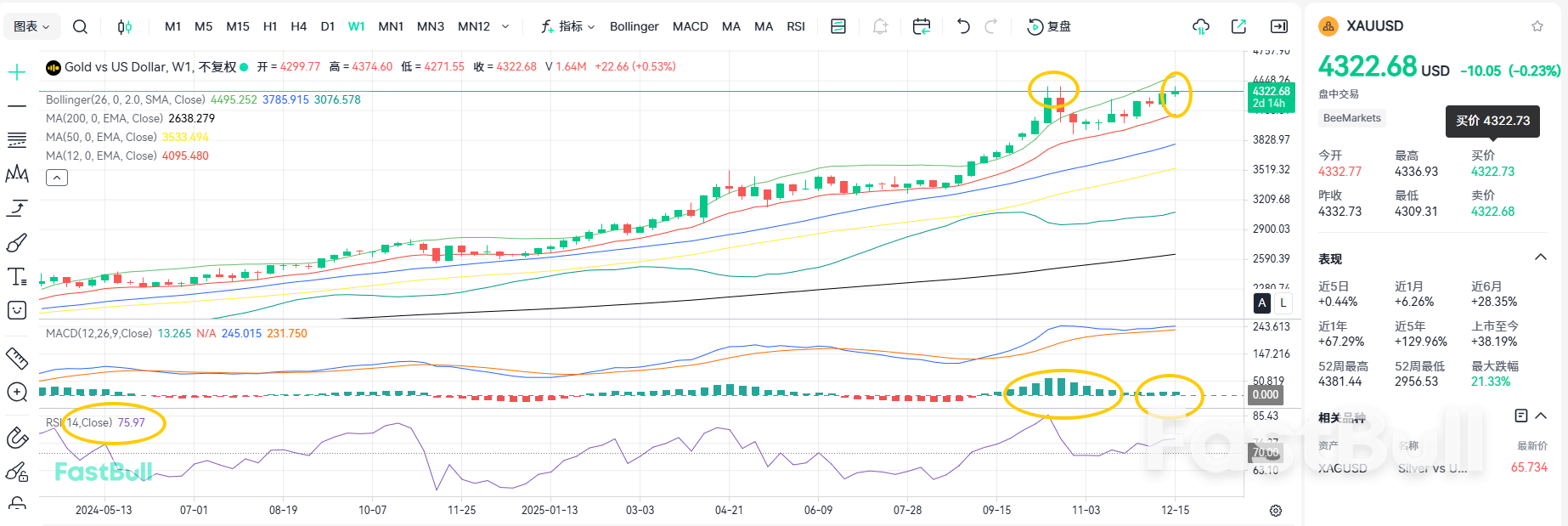
Regarding the four-hour chart, gold's Bollinger Bands are narrowing, and the candlestick pattern forms a shooting star. Price is oscillating around the EMA12 line and the Bollinger Middle Band, remaining in a short-term sideways range and susceptible to sudden directional shifts. After forming a death cross, the MACD and signal lines are moving back toward the zero axis but remain some distance away, suggesting the adjustment is not yet complete. RSI stands at 53, reflecting strong market indecision. Support levels lie at 4300 and 4270. On the weekly chart, the price is rising strongly along the Bollinger Upper Band. As long as it holds above the EMA12, the overall uptrend remains intact. This week's closing pattern will be key: a doji star likely signals an adjustment next week, while a bullish candle implies continued gains, with resistance at 4380 and 4400. Meanwhile, an RSI of 75 indicates the market is in overbought territory. Therefore, it is recommended to sell now and buy later.
Trading Recommendations:
Trading direction: Sell
Entry price: 4325
Target price: 4100
Stop loss: 4400
Support: 4200/4100/3800
Resistance: 4380/4500/5000


