Fundamentals
Reserve Bank of Australia (RBA) Deputy Governor, Andrew Hauser, stated on Wednesday that inflation remains elevated, and policymakers are committed to employing all necessary measures to guide it back to the target range. Speaking at a business event in Sydney, she observed that while several economic sectors are performing robustly, overall growth is constrained by supply-side bottlenecks. Furthermore, persistent credit expansion suggests that the current monetary policy stance is not sufficiently restrictive to curb aggregate demand. This announcement follows the RBA's decision last week to increase the cash rate by 25 basis points to 3.85%, partially reversing three previous rate cuts. The RBA also cautioned that further policy tightening would be implemented if inflation declines more slowly than anticipated. Markets are already pricing in a subsequent rate hike, with a roughly 70% probability of a further increase to 4.10% at the May meeting. Inflationary pressures continue to be a significant concern. The core inflation rate rose to 3.4% in the December quarter, marking the fastest pace in a year and exceeding the RBA's projections. Consequently, the RBA has revised its forecast for the peak in core inflation this year to 3.7%, still considerably above its long-term target range of 2% to 3%. Tightness in the labor market further corroborates the economy's capacity constraints. The unemployment rate unexpectedly fell to 4.1% in December, a seven-month low, indicating a potential tightening in labor supply. Concurrently, robust consumer spending, record-high housing prices, and accommodative credit conditions for households and businesses all suggest that financial conditions are not as restrictive as the RBA had projected. The latest credit data reinforce this assessment. Mortgage lending increased by 9.5% quarter-on-quarter in the December quarter, continuing a trend from the previous quarter, while investor lending reached an all-time high, demonstrating that the market has not significantly retreated despite rising interest rates.
The U.S. Bureau of Labor Statistics reported that nonfarm payrolls increased by 130,000 in January, significantly exceeding economists' forecasts of 70,000. The unemployment rate marginally declined to 4.3%. Despite a delay in the report's release due to the federal government shutdown, market sentiment regarding the labor market's stabilization remained robust. Angelo Kourkafas, a strategist at Edward Jones, commented that this stronger-than-expected report "provides ammunition for Fed hawks, reinforcing a patient stance on interest rate cuts." Consequently, the interest rate futures market rapidly adjusted its expectations for rate reductions. The probability of a rate cut in April fell from approximately 40% before the report's release to just 20%, while the likelihood of rates remaining unchanged in June increased from about 25% to nearly 40%. Data from the London Stock Exchange Group further indicated that the market's expected timing for the initial 25-basis-point rate cut has shifted from June to July. At their meeting on January 27-28, the Federal Reserve voted 10-2 to maintain the federal funds rate within the 3.50% to 3.75% range, continuing a pause following three rate cuts in late 2023. Among the two dissenting governors, Christopher Waller had previously warned that the labor market's actual weakness last year was significantly underestimated, with considerable downside risks ahead. The latest annual benchmark revisions partially supported his assessment, showing that employment gains for the 12 months ending March 2023 were revised down by 862,000 from initial estimates, with average monthly job growth for the entirety of 2023 at a mere 15,000, far below the pre-pandemic monthly average of 183,000 between 2010 and 2019. However, the robust January employment figures also countered Waller's projection of "zero" job growth. The average of the latest three months' new jobs has risen to approximately 73,000. Dallas Fed President Lorie Logan cited this as evidence that downside risks to the labor market have significantly diminished. Logan, a prominent voice opposing further interest rate cuts within the Federal Reserve, stated that the current policy focus should shift more towards inflation risks. Market interpretations of the jobs report were also divided. Jordan Rizzuto, Chief Investment Officer at Gamma Road Capital Partners, noted that the stock market reacted positively to the data, primarily because the employment situation appears more robust than the Federal Open Market Committee's recent assessment. He added that if subsequent revised data support the current readings, it would imply that economic conditions are closer to a neutral interest rate than the market anticipates. Overall, the January employment report provides the Federal Reserve with more room to maintain current interest rates, but the policy path will remain highly dependent on subsequent inflation performance. Markets are now looking ahead to Friday's upcoming inflation data to further gauge the timing of the Fed's next move.
Technical Analysis
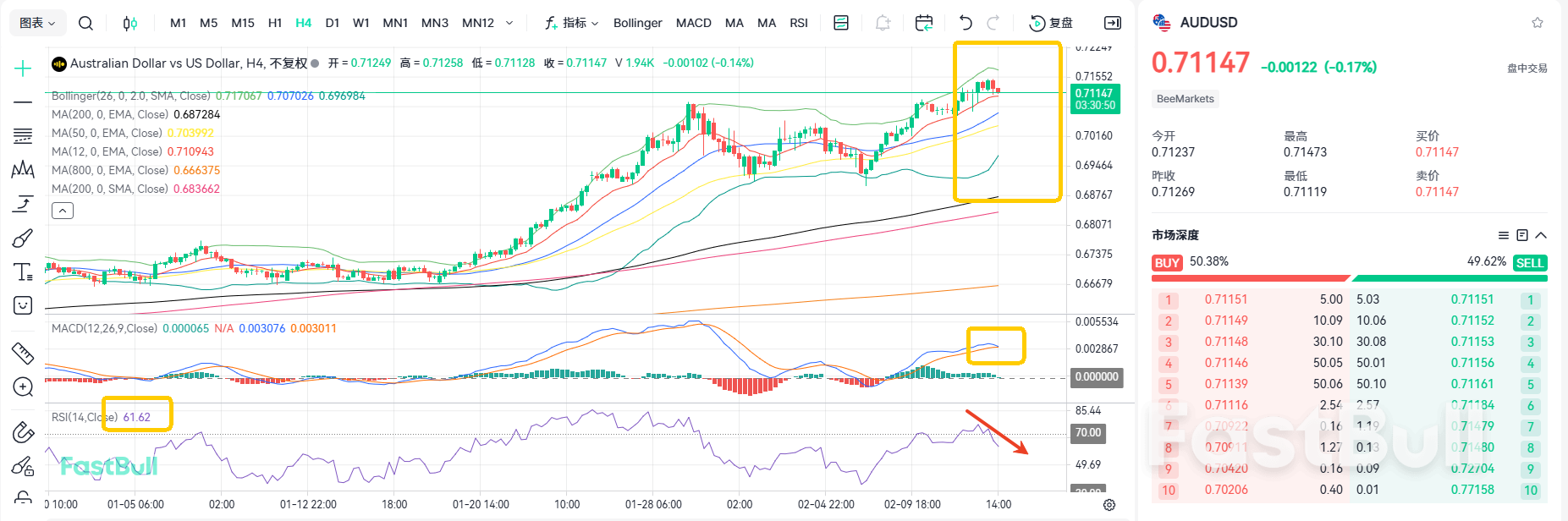
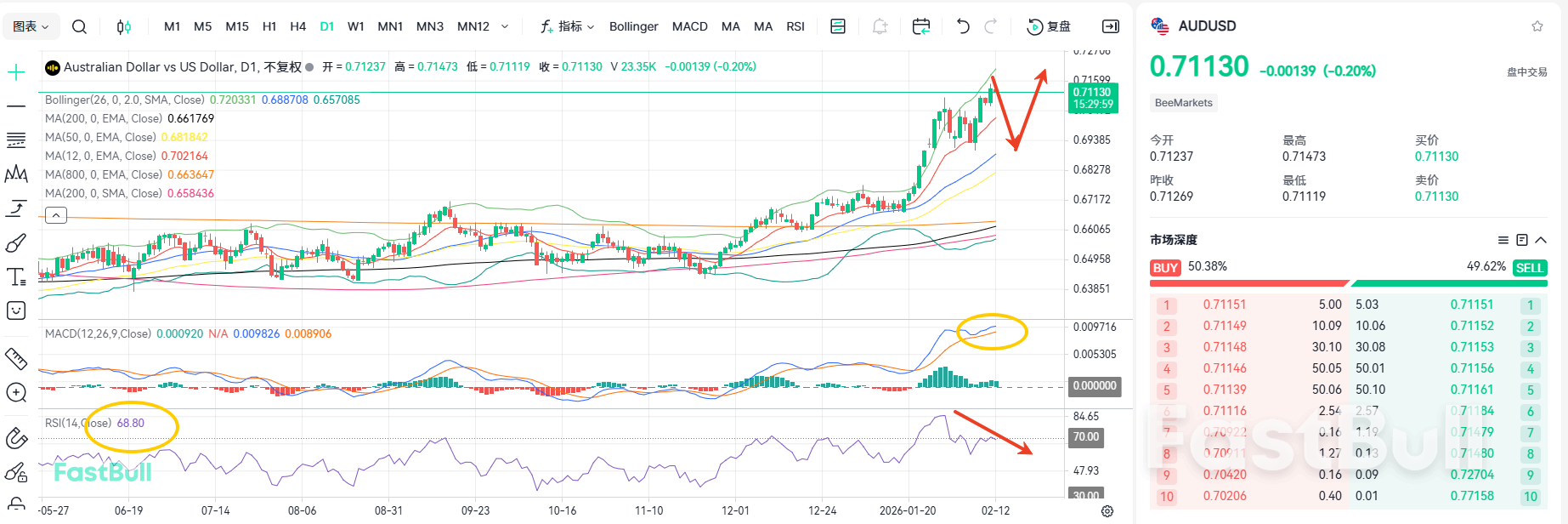
Analyzing the AUDUSD in the 4H timeframe, the Bollinger Bands are contracting, indicating narrowing volatility, while the moving averages are flattening. Price action is consolidating around the EMA12. Previously, upon a new high in price, the MACD's MACD line and signal line formed a death cross, accompanied by a diminishing bullish momentum, signaling a potential bearish divergence. The RSI is currently at 61, suggesting a generally optimistic market sentiment. However, the declining peaks in the RSI indicate a potential shift in market dynamics. In the 1D timeframe, the Bollinger Bands are expanding upwards, and the moving averages are diverging positively, reinforcing the established bullish trend. The MACD's MACD line and signal line are converging, and the RSI is at 67, situated within a strong upward trajectory. However, similar to the four-hour chart, the RSI's peak values are decreasing, which signals a potential bearish divergence. Consequently, a short-term pullback to the EMA12 or the middle Bollinger Band is probable, with target levels projected around 0.7 or 0.688. Therefore, the recommended trading strategy is to initiate short positions first, followed by long positions.
Trading Recommendations
Trading Direction: Sell
Entry Price: 0.711
Target Price: 0.67
Stop Loss: 0.73
Support: 0.7, 0.69, 0.67
Resistance: 0.715, 0.737, 0.75


