U.S. President Donald Trump recently issued a stark statement via his social media platform, Truth Social, declaring: "Venezuela is completely surrounded by the largest Navy ever assembled in South American History." He demanded the immediate return of "all oil, land, and other assets previously stolen from the U.S.," alleging that the "illegitimate Maduro regime" is utilizing these resources to finance drug terrorism, human trafficking, and other violent crimes. Consequently, the administration has officially designated the Venezuelan regime as a foreign terrorist organization.
On the economic front, recent data from the U.S. Bureau of Labor Statistics (BLS) presented a conflicting narrative. While November’s workforce expansion exceeded forecasts, the unemployment rate simultaneously climbed to its highest peak since 2021. Despite this labor market softening—which theoretically supports aggressive monetary easing—expectations for a January 2026 rate cut remain notably low at approximately 25%, according to Capital Edge data.
Further complicating the outlook, delayed retail sales figures from the U.S. Census Bureau suggest that American consumer spending remains resilient, with October sales holding steady. However, the underlying data reveals a growing burden on households due to rising costs for food, furniture, and imported goods—inflationary pressures exacerbated by current tariff policies.
Atlanta Fed President Raphael Bostic characterized the latest jobs report as a "mixed bag," stating it has not fundamentally altered his perspective. He expressed a preference for holding rates steady during recent deliberations, citing "multiple surveys" that indicate rising input costs for businesses. Bostic noted that firms are determined to protect profit margins by passing these costs on to consumers, cautioning that the Fed should not prematurely declare victory over inflation despite projecting 2026 GDP growth at roughly 2.5%.
Fed Governor Christopher Waller offered a slightly different view, noting that previous rate cuts have positively impacted the employment sector. He estimated that current rates remain 50 to 100 basis points above neutral levels. However, he emphasized that there is no immediate rush to continue reducing the Fed funds rate, as he believes inflation is "unlikely to re-accelerate."
The Bank of Japan (BoJ) is widely expected to hike interest rates this week, a move that could significantly bolster the Yen (JPY) and create a strong headwind for the USD/JPY pair. Markets anticipate a rate increase to 0.75% from the current 0.5% during the two-day policy meeting ending Friday. This shift would push the benchmark rate to a three-decade high. BoJ Governor Kazuo Ueda reiterated last week that the probability of achieving the bank’s core economic and price outlook has been increasing, signaling that Japan is nearing its long-sought inflation target.
Technical Analysis
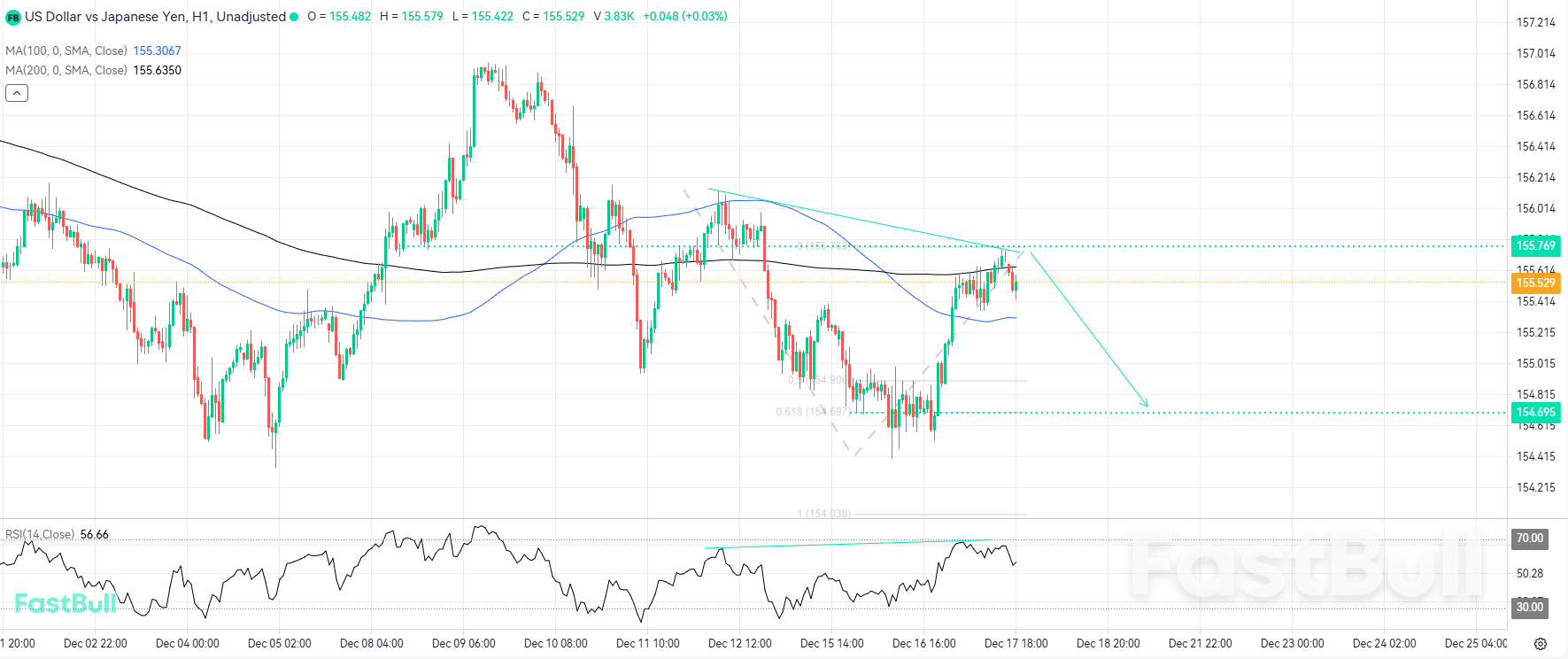
The USD/JPY pair recently staged a bullish retracement to the 155.76 level, only to be met with a swift rejection from the 200-period Moving Average (MA). This rapid reversal, combined with RSI levels that approached the 70 mark before retreating, suggests that a new bearish leg may be in development.
Since hitting a local high of 156.95 on October 9th, the pair has consistently printed lower highs, a hallmark characteristic of a sustained downtrend. This latest rejection reinforces the bearish bias, potentially driving the price toward the 154.69 support zone.
Currently, the 100-period and 200-period MAs are situated at 155.30 and 156.63, respectively. A decisive close below the 100-period MA could accelerate downward momentum. Technical targets include the 0.618 Fibonacci expansion at 154.69 and potentially the 1.00 expansion at 154.03, especially if the Bank of Japan delivers a hawkish policy surprise. Conversely, a forceful bullish breakout above the recent local highs would invalidate the current bearish setup and open the door for a continued move to the upside.
Trading Recommendations
Trading direction: Sell
Entry price: 155.52
Target price: 154.70
Stop loss: 156.20
Validity: Dec 26, 2025 15:00:00


