Swiss inflation was comfortably positioned beneath the Swiss National Bank's (SNB) target mandate long before the recent volatility in global energy pricing surfaced. Within this environment, the central bank’s primary focus was initially directed toward the downside risks to price stability stemming from the Swiss Franc’s (CHF) persistent strength. This currency appreciation has been largely catalyzed by a surge in safe-haven demand following the escalation of the Middle East conflict. Consequently, the SNB has maintained its steadfast readiness to intervene in the foreign exchange market to dampen further currency appreciation and protect the domestic economy. SNB Chairman Martin Schlegel has also sought to minimize the significance of the recent uptick in headline inflation, which climbed to 0.6% in April from March’s 0.3%, asserting that medium-term inflationary pressures remain virtually unchanged. This assessment is currently corroborated by core inflation metrics, which moderated to a modest annualized rate of 0.3% in April.
Nevertheless, should the closure of the Strait of Hormuz persist and trigger a more structural and enduring energy shock, the SNB’s relatively accommodative posture could begin to pivot. In such a scenario, the probability of interest rate hikes would intensify, accompanied by a greater institutional tolerance for a strong CHF as a strategic tool to curb upside inflationary risks. Indeed, the Swiss interest rate market has already begun discounting a higher likelihood of a tightening move by the SNB before the close of the calendar year. Simultaneously, late Wednesday, President Trump arrived in Beijing, marking the first state visit to China by an American leader in nine years. This significant diplomatic event comes as the world's two largest economies strive to stabilize bilateral ties through a high-stakes summit staged against the volatile backdrop of the ongoing war in Iran. Both Washington and Beijing are currently evaluating a strategic framework that would enable each nation to identify approximately $30 billion worth of goods eligible for significant tariff reductions, specifically focusing on sectors that do not compromise national security interests.
On the domestic front, the Bureau of Labor Statistics (BLS) reported that inflation, as measured by the Consumer Price Index (CPI), accelerated to a 3.8% year-over-year expansion in April. This figure exceeded the previous 3.3% print and overshot market forecasts of 3.7%. On a month-over-month basis, the CPI rose by 0.6%, aligning with analyst expectations. However, Core CPI—which strips out volatile food and energy costs—ascended to 2.8% year-over-year from its prior 2.6%, also surpassing the consensus estimate of 2.7%. The report underscored that energy prices were a primary catalyst, surging by 3.8% in April and accounting for over 40% of the headline index’s monthly increase. Coupled with rising shelter and food costs, these figures have intensified concerns regarding the persistence of inflationary pressures within the U.S. economy. Meanwhile, labor metrics provided a nuanced view; weekly ADP data showed that private-sector employers added an average of 33,000 jobs per week over the four weeks ending April 25, signaling a modest yet steady improvement in labor market momentum. Chicago Fed President Austan Goolsbee added to the hawkish narrative on Tuesday, warning that the absence of central bank independence would likely lead to a forceful resurgence of inflation and emphasizing the structural necessity of the Federal Reserve's autonomy.
Technical Analysis
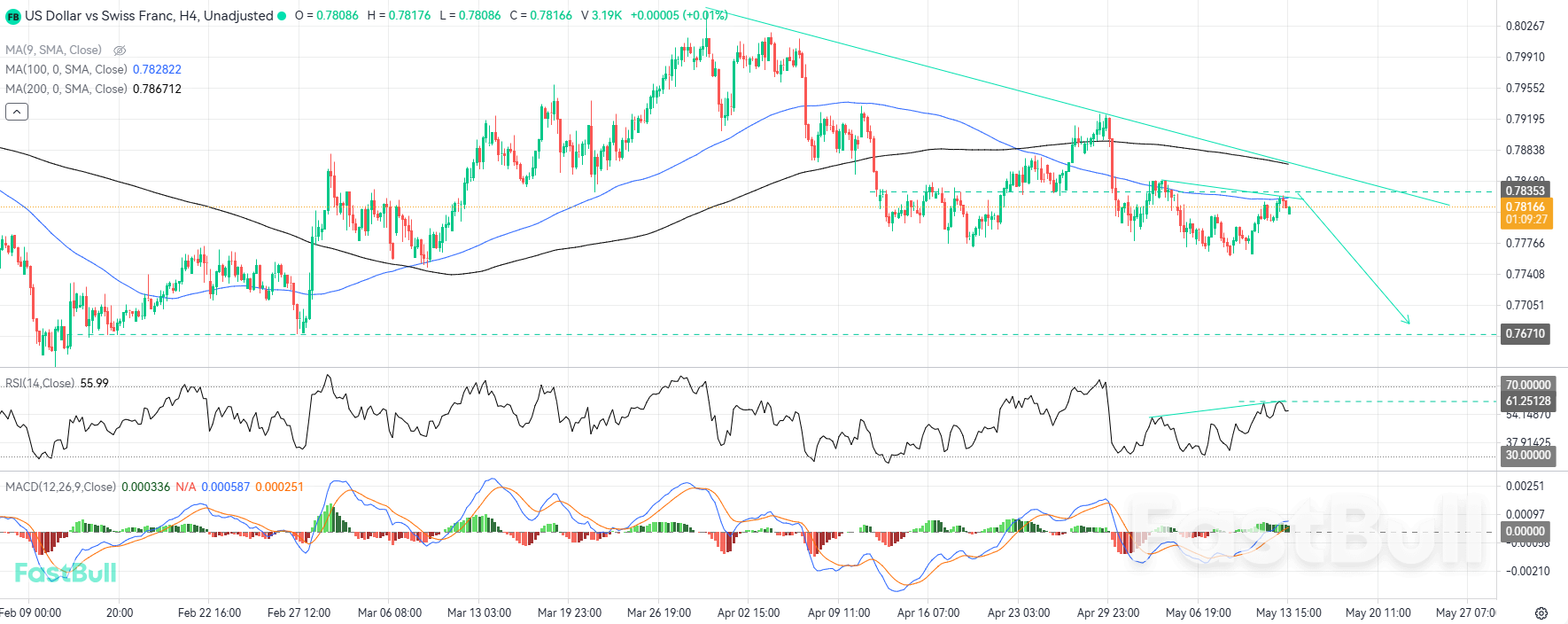
From a technical perspective, USD/CHF has retraced toward the 100-period Moving Average (MA), currently positioned at 0.7828. This specific zone has once again exhibited decisive bearish price action; on the previous occasion the pair tested this level, it reacted aggressively to the downside. Given that USD/CHF remains entrenched in a well-defined bearish trajectory, a renewed downward expansion appears highly probable from this structural ceiling. This primary downward trendline is further reinforced by the 200-period MA situated at 0.7867, suggesting that the entire region will exert sustained downward pressure, targeting a move toward the 0.7671 handle, which represents the most critical local support floor.
Our analysis of momentum oscillators provides further validation for this bearish outlook. The Relative Strength Index (RSI) recently peaked at the 61 level, a reading higher than the previous test of the moving average, which points to a notable technical divergence. This indicates that bullish strength is dissipating rapidly despite the higher RSI print. Simultaneously, the MACD continues to print an upward-sloping histogram that is beginning to lose depth with significant velocity. With the signal lines hovering only marginally above the neutral threshold, a bearish crossover of both the signal lines and the histogram appears imminent, which would provide the final technical confirmation required for a sustained and more profound expansion toward the downside.
Trading Recommendations
Trading direction: Sell
Entry price: 0.7816
Target price: 0.7671
Stop loss: 0.7880
Validity: May 26, 2026 15:00:00


