The U.S. labor market demonstrated significant resilience in March, according to the latest data released by the Bureau of Labor Statistics (BLS). The economy added a robust 178,000 jobs, vastly outperforming market expectations of 60,000. This headline strength came alongside a notable downward revision for February’s figures, which now reflect a deeper contraction of 133,000 positions compared to the previously reported loss of 92,000. Despite these revisions, the overall health of the employment sector remained evident as the unemployment rate ticked lower to 4.3%, down from 4.4%.
However, the report also highlighted a moderation in wage growth, a factor closely monitored by inflation hawks. Average hourly earnings rose by a modest 0.2% month-over-month, missing the 0.3% forecast and decelerating from the prior month’s 0.4%. On an annual basis, wage growth printed at 3.5%, trailing the expected 3.7% and marking a slowdown from the previous 3.8% reading.
This cooling in wages was balanced by other indicators of economic vitality. The ISM Manufacturing PMI ascended to 52.7 in March, outperforming analyst expectations and building upon previous gains. The labor market also delivered a notably hawkish surprise earlier in the week, as the ADP Employment Change reported an addition of 62,000 positions, vastly exceeding the projected 40,000. Furthermore, consumer resilience was underscored by a 0.6% surge in February Retail Sales, signaling a decisive recovery from January’s downwardly revised contraction.
According to the CME FedWatch Tool, market participants have aggressively recalibrated their expectations in light of this data. Investors now widely anticipate that the Federal Reserve will maintain interest rates within the 3.50%–3.75% range for the remainder of the year. This represents a significant departure from earlier forecasts, which had fully priced in at least two rate cuts for 2026.
On the geopolitical front, President Trump provided a strategic national address regarding the administration's stance on Iran. The central narrative propagated by the White House centered on the assertion that "fundamental U.S. strategic objectives" are nearing completion. Trump reinforced this perspective by suggesting a resolution would materialize "very quickly," claiming the nation is "very close" to achieving its final goals. This rhetoric appears strategically designed to soothe public sentiment and mitigate anxieties regarding a potential long-term military quagmire, drawing a contrast to historical involvements in Iraq or Afghanistan.
In Switzerland, inflationary pressures exhibited a slight uptick, rising to 0.3% year-over-year in March from 0.1% in February. While this was the highest reading in a year—largely reflecting elevated energy costs tied to Middle Eastern tensions—it fell short of the 0.5% forecast. As price growth remains near the lower bound of the Swiss National Bank’s (SNB) 0–2% target, the pressure for a shift in monetary policy remains minimal. Consequently, the SNB opted for stability during its March deliberations, maintaining its primary policy rate at 0.00%. However, the true focal point was the bank’s recalibration of its foreign exchange guidance, signaling an increased readiness to intervene in the currency markets to prevent an excessive appreciation of the Swiss Franc (CHF).
Technical Analysis
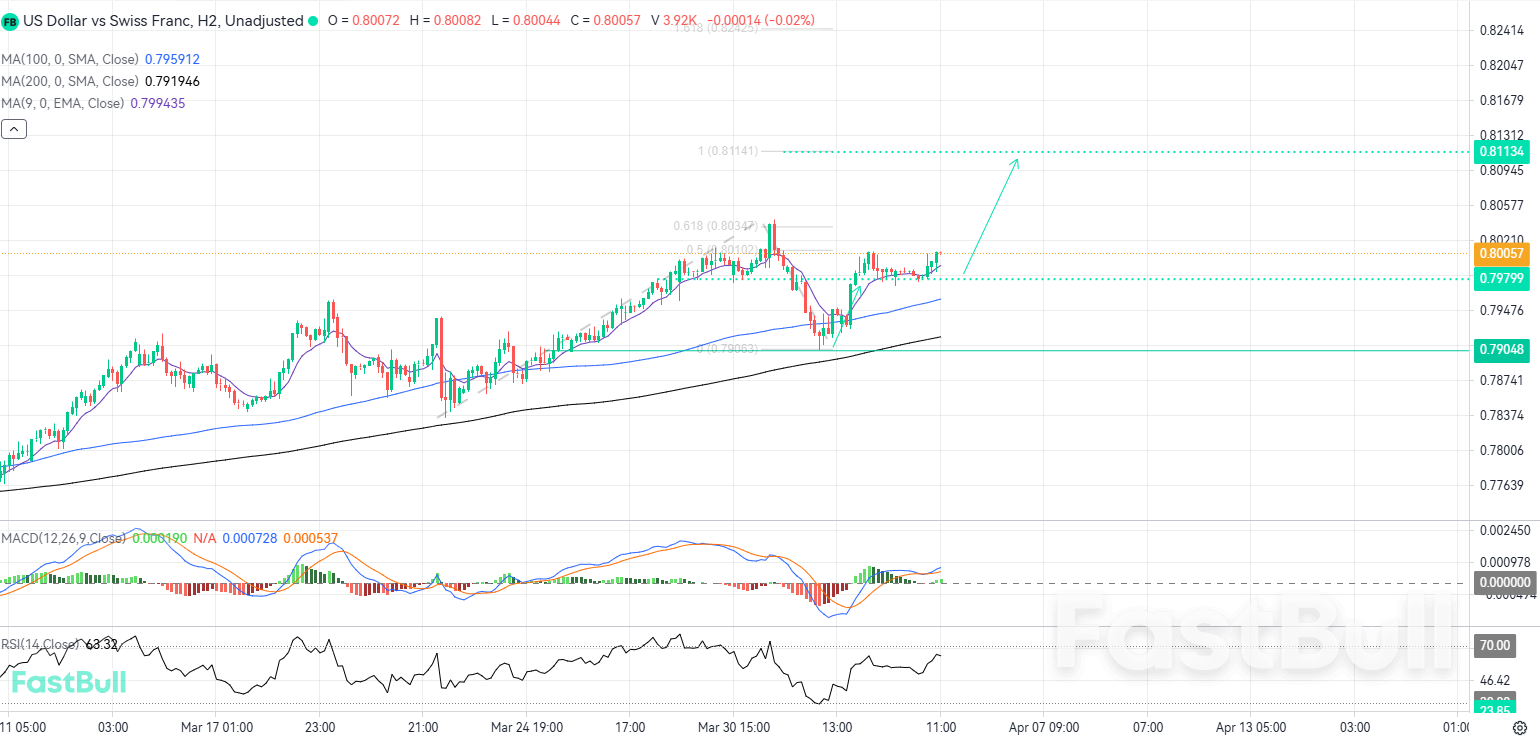
From a technical perspective, USD/CHF remains entrenched in a well-defined bullish trend. Following a period of consolidation, the pair recently underwent a technical retracement on April 1, descending to the 0.7904 level. This pivot point is situated precisely within the corridor of the 100 and 200-period Moving Averages (MAs) on the 2-hour chart, currently tracking at 0.7959 and 0.7919, respectively.
Notably, this zone has re-established its status as a formidable dynamic support floor, reminiscent of the bullish rejection witnessed on March 23. Should the pair successfully maintain this upward momentum, we could see an expansive move targeting the 0.8113 Fibonacci extension—a projection that aligns with the magnitude of the previous bullish impulse.
Our analysis of momentum oscillators provides further validation for this upside thesis. The RSI is currently hovering at the 63 level; while it is trending toward overbought territory, it retains sufficient "runway" for an extended upward move. Simultaneously, the MACD histogram has remained consistently bullish since the inception of the current rebound.
As long as the MACD bars continue to gain depth and the signal lines remain resiliently positioned above the neutral baseline, the technical outlook favors a continuation of the bullish expansion. Traders should closely monitor the 0.7959 resistance for a decisive breakout to confirm the next leg higher.
Trading Recommendations
Trading direction: Buy
Entry price: 0.8000
Target price: 0.8113
Stop loss: 0.7910
Validity: Apr 15, 2026 15:00:00


