Summary:The Japanese government raises its economic growth forecast for the current fiscal year and expects further acceleration in growth next fiscal year. Official projections suggest that, supported by large-scale fiscal stimulus, private consumption and capital expenditure will remain resilient. Tax cuts and slowing inflation are expected to stabilize household spending, while subsidies and tax incentives targeting infrastructure, artificial intelligence, and semiconductors will drive investment growth.
Fundamentals
Released this week, the BoJ meeting minutes revealed that a systematic discussion at its October policy meeting had begun, evaluating whether to continue raising interest rates and assessing the necessity of further increasing the policy rate to a level considered "neutral" for the economy. The minutes show that most policymakers believe that gradually adjusting the degree of monetary easing will help achieve long-term stable economic growth as economic activity and price conditions improve. Some members also noted that recent yen depreciation could pose upside inflation risks by pushing up import costs. Although the BoJ kept the interest rate unchanged at 0.5% during its October 29–30 meeting, Governor Kazuo Ueda signaled a more hawkish stance, with two board members even proposing an immediate hike to 0.75%. Ultimately, the BoJ officially raised the policy rate to 0.75% at its December meeting—the highest level in 30 years—marking a further exit from its long-standing ultra-loose monetary policy. Governor Ueda stated that Japan's underlying inflation is steadily accelerating and approaching the 2% target. With real interest rates still extremely low, if economic and price trends align with the bank's baseline scenario, further rate hikes would be reasonable. At the same time, he pointed out that persistent labor market tightness, demographic shifts, and companies passing on costs to a broader range of goods and services indicate that a mechanism of wage growth keeping pace with inflation is gradually forming. While markets expect the BoJ to hold rates steady at its January meeting, upcoming economic and inflation forecasts will serve as key indicators for future policy direction—especially against the backdrop of yen weakness exerting upward pressure on prices.
Markets widely expect the U.S. Federal Reserve to ease monetary policy further in 2026. This expectation has overshadowed strong U.S. economic growth data and continues to weigh on the dollar. In fact, the U.S. Department of Commerce reported that the world's largest economy grew at an annualized rate of 4.3% in the July–September period, exceeding both market expectations and the previous quarter's 3.8% growth. However, given signs of slowing inflation and cooling in the U.S. labor market, traders still anticipate the Fed will cut rates twice more next year. President Trump declared that any candidate for Fed Chair must commit to lowering interest rates even when the economy performs well. This has heightened uncertainty around the Fed's long-term policy credibility and reinforced the bearish outlook for the Dollar Index. Nevertheless, tightening liquidity toward year-end serves as a reminder for aggressive short sellers to remain cautious and prepare for potential further dollar declines.
Technical Analysis
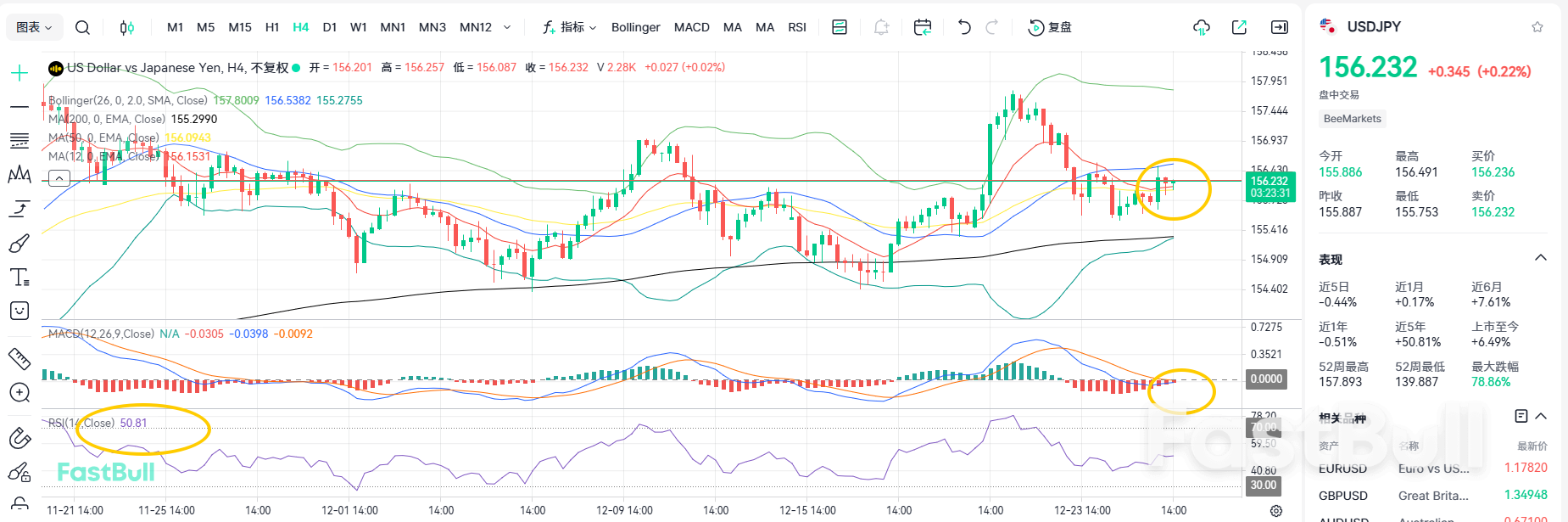
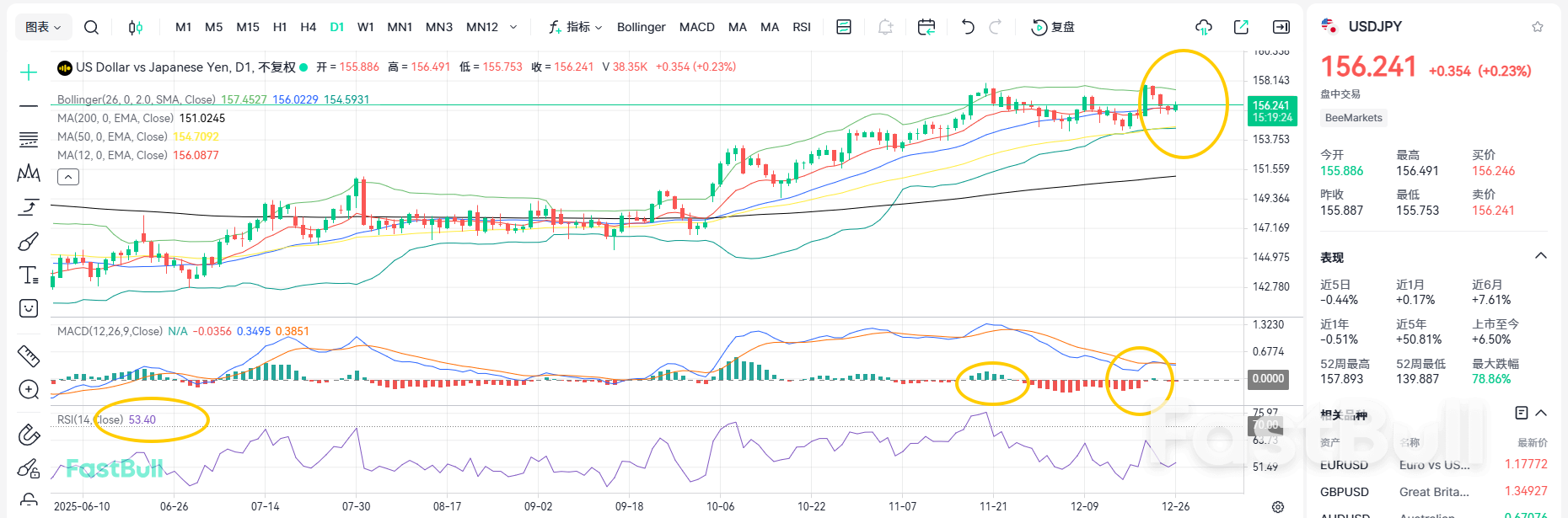
As shown in the daily chart, USD/JPY displays narrowing Bollinger Bands and flattening moving averages. After a strong bullish candle broke above the Bollinger Upper Band last Friday, prices have retreated over the past two days to test and confirm support at the Bollinger Middle Band, suggesting a resumption of the short-term uptrend. If the pair can sustain above 155, it is likely to retest 158 or even 160. The MACD lines are pulling back near the zero axis, indicating that the adjustment phase is nearing completion. RSI stands at 53, reflecting relatively strong market indecision; support levels lie at 156 and 155. From the 4-hour perspective, the price oscillates around the EMA12 and breaks above the upper trendline of the descending channel, signaling potential to reclaim 157. A golden cross is forming with the signal and MACD lines returning to the 0-axis. A confirmed breakout above and sustained move above the Bollinger Middle Band would reinforce bullish momentum. RSI is at 50, showing prevailing market caution. Buying at lows is currently recommended.
Trade Recommendations:
Trade Direction: Buy
Entry Price: 156
Target Price: 160
Stop Loss: 154
Support: 154.7/153.2/150
Resistance: 158/158.8/160
Risk Warnings and Investment Disclaimers
You understand and acknowledge that there is a high degree of risk involved in trading with strategies. Following any strategies or investment methodologies is the potential for loss. The content on the site is being provided by our contributors and analysts for information purposes only. You alone are solely responsible for determining whether any trading assets, or securities, or strategy, or any other product is suitable for you based on your investment objectives and financial situation.


