European Central Bank (ECB) policymaker Joachim Nagel recently emphasized that the upcoming April policy decision will remain heavily contingent upon evolving developments surrounding the Strait of Hormuz. Highlighting a persistent lack of "sufficient clarity" regarding the geopolitical landscape, Nagel underscored that the ECB intends to maintain "full optionality" in its upcoming deliberations. He further clarified that there is no predetermined commitment regarding interest rate trajectories, reiterating the bank’s primary and unwavering mandate to ensure long-term price stability.
This institutional caution is unfolding against a backdrop of shifting political dynamics. The recent election results in Hungary—marking the conclusion of Viktor Orbán’s 16-year tenure—have been widely interpreted as a significant relief factor for the Eurozone. This political transition has provided a localized tailwind for the Euro, bolstering the common currency across several major pairs as markets price in a more cohesive European landscape.
However, despite this burst of political optimism, structural industrial fragility continues to plague the Eurozone’s core. In Germany, industrial production recorded a 0.3% monthly decline in February, significantly underperforming the anticipated 0.9% growth and following a stagnant January performance. On a year-over-year basis, the sector remains effectively stalled, coming off a revised 0.9% contraction in the preceding month.
Further complicating the outlook, Eurozone annual inflation climbed to 2.5% in March—its highest level since January 2025—exceeding the ECB’s 2% target due to surging energy expenditures. In response, ECB President Christine Lagarde reaffirmed that monetary policy will remain restrictive until inflation is sustainably anchored at the target. Complementing this stance, ECB Vice President Luis de Guindos noted that the impact of the Middle Eastern conflict remains contingent upon its duration, while Boris Vujčić suggested that current energy prices, for now, remain aligned with the bank’s baseline projections.
Regarding the ongoing conflict with Iran, British policymakers remain deeply concerned about persistent price pressures. Analysts suggest it could take several months to fully realize the impact of the recent energy shock on the UK economy, especially given the precipitous rise in global energy prices. Looking ahead, the UK economic agenda will focus on the release of Gross Domestic Product (GDP) figures, which are widely expected to show a modest improvement from stagnant growth to a 0.1% month-over-month expansion for February.
Technical Analysis
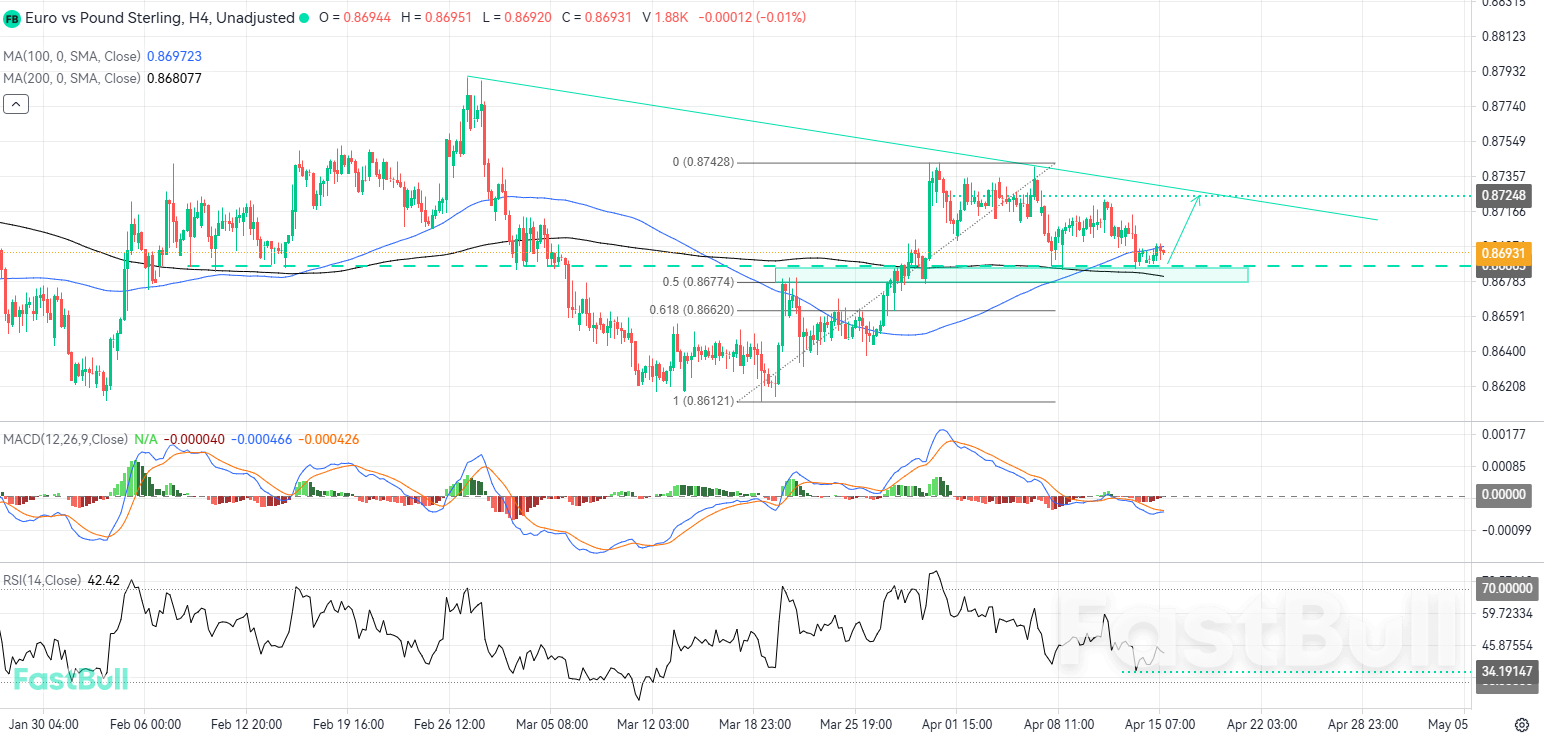
From a technical perspective, EUR/GBP is currently entrenched in a corrective downward move that has recently encountered a formidable local support zone at 0.8686. This specific level has historically functioned as a reliable springboard, having successfully rejected price action to the upside on multiple occasions. Should this structural floor be successfully defended once more, we anticipate a resurgent bullish impulse targeting the primary descending trendline, which aligns with local resistance at 0.8724.
The pair currently benefits from a high-confluence cluster of indicators near this floor. The 100 and 200-period Moving Averages (MAs) on the 1-hour chart are currently tracking at 0.8698 and 0.8680, respectively. Their proximity to the support zone adds significant structural weight to the case for a bullish rebound, provided the 0.8680 level remains unbreached on a closing basis.
Our analysis of momentum oscillators provides further validation for a potential upside pivot. The Relative Strength Index (RSI) recently descended to the 34 level, moving within striking distance of oversold territory but retaining just enough "runway" for a final test of support. Notably, the 0.50 Fibonacci retracement level is situated at 0.8677, creating a narrow "zone of interest" for buy-side participation between 0.8677 and 0.8686.
Simultaneously, the MACD is printing a bearish histogram, but with visibly diminishing depth, suggesting that a bullish crossover may be imminent. While the signal lines are currently oscillating just beneath the neutral baseline, a positive histogram transition would likely propel the signal lines back into bullish territory, providing the final technical confirmation required to target the 0.8724 resistance handle.
Trading Recommendations
Trading direction: Buy
Entry price: 0.8686
Target price: 0.8725
Stop loss: 0.8670
Validity: Apr 24, 2026 15:00:00


