The Bank of Canada's (BoC) core inflation measure, which excludes more volatile components such as food and energy, increased by 2.0% over the past year and advanced by 0.4% compared with the previous month. The monthly increase suggests that underlying price pressures remain relevant, even as the annual measure continues to show a more moderate pace of inflation. This indicates that inflationary pressures have not completely eased, leaving room for further adjustments to monetary policy if price developments require it.
Bank of Canada (BoC) Governor Tiff Macklem appeared before the House of Commons, where he stated that further interest rate increases could become necessary depending on how economic conditions develop. His comments suggest that the central bank remains concerned about inflationary pressures and is not ruling out additional monetary tightening if price stability requires it. This leaves the possibility of further adjustments to monetary policy open, depending on how inflation evolves over the coming months.
US retail sales increased to $748.2 billion in October, according to data released on Tuesday by the US Census Bureau. This followed the 0.8% expansion recorded in the previous month and matched market expectations for a 0.2% increase. On a year-on-year basis, retail sales advanced by 6.8%, indicating that consumer spending continues to show resilience despite the broader economic conditions.
The Census Bureau also highlighted that total sales between August 2026 and October 2026 increased by 6.4% (±0.5%) compared with the same period last year. Meanwhile, the percentage change between August and September 2026 was not revised and remained at an increase of 0.8% (±0.2%), according to the official press release. These figures suggest that consumer activity remains relatively strong, providing additional support for the US economy and reflecting continued resilience in household spending.
Private-sector hiring in the United States strengthened further toward the end of October. According to NER Pulse, the weekly supplemental report to the ADP National Employment Report, companies added an average of 23,750 jobs per week during the four weeks ending October 31.
This represents a modest increase compared with the previous reading of 19,250, pointing to a further improvement in private-sector hiring activity. The latest figures suggest that labor demand remains relatively stable, despite some signs of moderation in other areas of the employment market. This could reinforce expectations that the US labor market continues to provide support for economic activity.
Technical Analysis
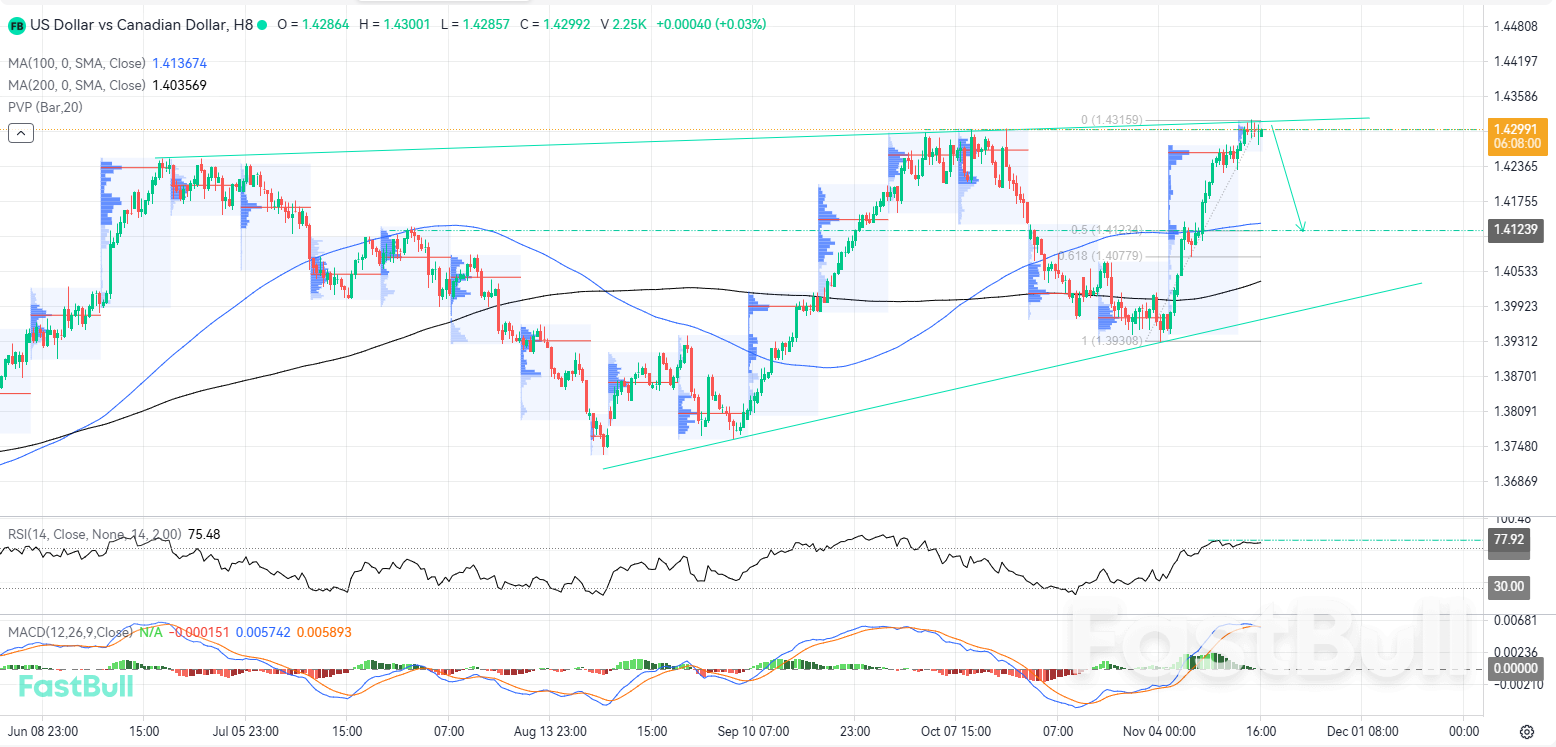
USD/CAD is once again testing the resistance level around 1.4300, an area that the pair also reached on October 14. However, by extending a trendline from the local high recorded on June 24, it becomes clear that the current resistance zone closely aligns with the upper boundary of a potential triangle formation. This confluence could become an important area for a downside rejection, particularly if buyers fail to establish a sustained breakout above this structure.
If price action encounters selling pressure around this level, a bearish correction could develop toward 1.4123. This area is particularly relevant because it coincides with the 0.50 Fibonacci retracement level, while the 100-period moving average is also located nearby at 1.4136. Meanwhile, the 200-period moving average stands closer to the lower boundary of the triangle, around 1.4035. The alignment of these technical levels adds further relevance to the potential geometric formation and provides additional reference points for a possible downside correction.
Regarding the oscillators, the RSI recently reached 77, moving further into overbought territory. This suggests that bullish momentum could be becoming increasingly stretched, potentially leaving buyers with less room to extend the current movement and increasing the possibility of a downside correction. Meanwhile, the MACD displays a histogram that has already lost most of its previous depth, indicating that the strength of the bullish momentum is beginning to fade. However, both signal lines remain firmly positioned within positive territory. Therefore, any potential downside movement should currently be considered a corrective retracement rather than a confirmed change in the broader trend.
Trading Recommendations
Trading direction: Sell
Entry price: 1.4300
Target price: 1.4125
Stop loss: 1.4385
Validity: Nov 27, 2026 15:00:00


