A recent survey conducted by Reuters indicates a significant shift in market expectations regarding the European Central Bank’s (ECB) monetary policy trajectory. Approximately 85% of respondents now anticipate that the ECB will elevate its deposit rate by 25 basis points to 2.25% during the upcoming June assembly—a sharp increase from the narrow majority that held this view prior to the April session. This hawkish sentiment is further bolstered by remarks from ECB policymaker Joachim Nagel, who observed on Wednesday that the probability of the central bank needing to implement higher borrowing costs has intensified, largely due to the inflationary risks associated with the ongoing conflict in Iran. Conversely, the ECB’s Chief Economist, Philip Lane, has advocated for a more measured approach. Lane argued that officials must rigorously evaluate the broader impact on regional growth and inflation before committing to further tightening, emphasizing that determining the appropriate monetary stance remains a nuanced matter of institutional judgment.
Complementing this policy debate, recent economic data from the Eurozone revealed that Germany’s Harmonized Index of Consumer Prices (HICP) climbed by 2.9% year-over-year in April, a result that aligned perfectly with the median market consensus. While inflationary data held steady, a surprising spark of optimism emerged from the ZEW Economic Sentiment survey for May; the index surged to -10.2 from its previous print of -17.2, handily outperforming the pessimistic forecasted dip of -19.8. Despite these glimmers of sentiment recovery in the bloc's largest economy, the prevailing macroeconomic forecast continues to point toward a gradual and perceptible moderation in regional economic expansion. Following an estimated growth peak of 1.5% in 2025, the Eurozone’s Gross Domestic Product (GDP) is projected to cool to a tepid 1.0% in 2026 before seeing a modest recovery to 1.3% by 2027. This cooling growth profile presents a complex backdrop for the ECB as it attempts to anchor inflation without stifling the nascent recovery.
In Switzerland, inflation remained comfortably positioned beneath the Swiss National Bank's (SNB) target mandate long before the recent volatility in global energy pricing surfaced. Within this environment, the central bank’s primary focus was initially directed toward the downside risks to price stability stemming from the Swiss Franc’s (CHF) persistent strength. This currency appreciation has been largely catalyzed by a surge in safe-haven demand following the escalation of the Middle East conflict, which has historically driven investors toward the Franc during periods of geopolitical unrest. Consequently, the SNB has maintained its steadfast readiness to intervene in the foreign exchange market to dampen further currency appreciation and protect the domestic export-oriented economy. SNB Chairman Martin Schlegel has also sought to minimize the significance of the recent uptick in headline inflation, which climbed to 0.6% in April from March’s 0.3%, asserting that medium-term inflationary pressures remain virtually unchanged. This assessment is currently corroborated by core inflation metrics, which moderated to a modest annualized rate of 0.3% in April, granting the SNB significant policy flexibility.
Technical Analysis
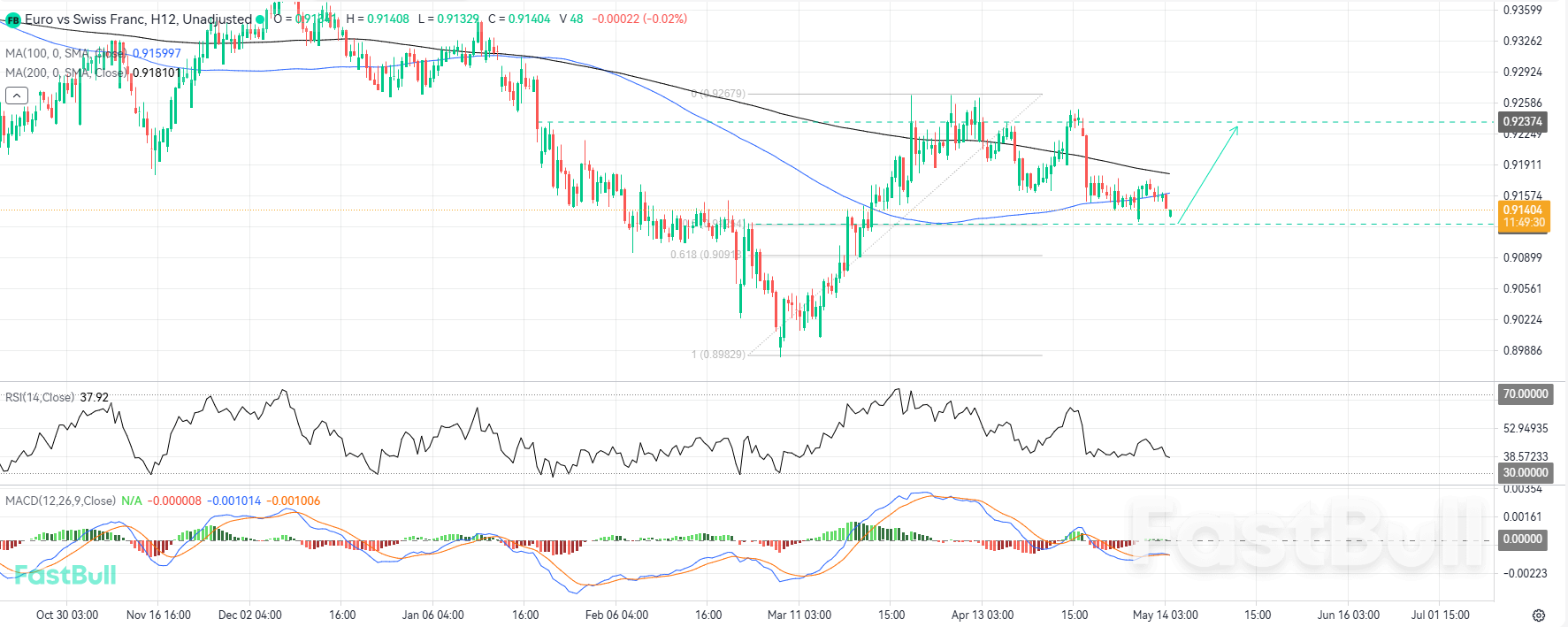
From a technical perspective, EUR/CHF is currently entrenched in a corrective downward phase following a robust bullish impulse that repeatedly tested a local peak of 0.9267 in early April. The repeated failure to overcome this structural resistance has catalyzed a technical pullback that appears to be targeting the 0.9134 handle. This specific level represents a high-confluence support zone as it aligns precisely with the 0.50 Fibonacci retracement level, serving as a primary objective for corrective movements. Should price action begin to exhibit bullish rejection signals at this floor, we could see the inception of a recovery aimed at retesting the aforementioned resistance ceiling. Furthermore, the 100 and 200-period Moving Averages (MAs) are currently tracking at 0.9159 and 0.9180, respectively. A decisive daily close above these moving averages would significantly enhance the bullish thesis and potentially accelerate the next leg of the upward expansion.
Our analysis of momentum oscillators provides additional evidence for a potential pivot in the near term. The Relative Strength Index (RSI) is currently tracking at the 35 level, signaling that the pair is fast approaching oversold territory. This technical exhaustion often attracts the attention of potential buyers who remain vigilant for any signs of an upside reaction from key structural zones. Simultaneously, the MACD is printing a bullish histogram, although it notably lacks significant depth at this stage. This suggests that the pair may need to fully test the primary support floor before a meaningful bullish reversal can materialize. With the signal lines currently oscillating beneath the neutral threshold, a decisive bullish crossover accompanied by a transition into a positive histogram would provide the final technical confirmation required for a sustained move back to the upside.
Trading Recommendations
Trading direction: Buy
Entry price: 0.9125
Target price: 0.9237
Stop loss: 0.9080
Validity: May 26, 2026 15:00:00


