Fundamentals
The BoE announced on Thursday that it would maintain its benchmark interest rate at 3.75%. While this decision aligned with broad market expectations, the 5–4 vote split among Monetary Policy Committee (MPC) members revealed significant internal disagreement—those favoring no change narrowly won, a closer margin than the 7–2 split predicted in a Reuters poll beforehand. This highlighted a more dovish-than-expected policy stance. Kirstine Kundby-Nielsen, an analyst at Danske Bank, noted that markets had already reacted to this more dovish voting outcome.
In this decision, the BoE sent a key policy signal: if inflation continues to slow, future rate cuts may be implemented. It also removed previous language about interest rates following a "gradual downward path," shifting to a cautious easing guidance. The central bank slashed its inflation forecast, expecting inflation to fall to the 2% target in April this year, earlier than previously anticipated, and further decline to 1.7% thereafter. From the second quarter of next year until the end of the three-year forecast period, inflation is projected to hover near the 2% target. However, the BoE emphasized the need to ensure inflation declines are not one-off events and to keep inflation stable.
On economic expectations, the BoE lowered its 2026 growth forecast from 1.2% to 0.9%, with a gradual recovery expected in 2027 and 2028. It also raised the peak unemployment forecast from 5.1% to 5.3%. Despite slowing growth, regular wage growth in the private sector is likely to decline only slowly; annual growth is expected to drop from 3.4% at the end of 2025 to 3.3% by the end of 2026, while a wage growth rate of around 3.25% aligns with the target inflation rate. Notably, as the UK has the highest inflation rate among major advanced economies, the BoE has cut rates four times in 2025, including a 0.25 percentage point reduction in December via another 5–4 vote, but policymakers have consistently stressed the need for caution when balancing inflation control with economic recovery (amid post-Brexit, post-pandemic, and post-2022 energy price surge challenges).
Kevin Walsh's nomination as the next Chair of the Federal Reserve sparked speculation that the Fed's stance might be less dovish than expected. Coupled with heightened market volatility, the US dollar's status as the global reserve currency was strengthened. In fact, the US Dollar Index (DXY), which tracks the U.S. dollar against a basket of currencies, hit a new high since January 23rd, becoming a key factor pressuring the GBP/USD pair. Initial jobless claims in the US last week rose more than expected, possibly linked to severe weather across many parts of the country recently. However, overall labor market conditions remain stable. Data released by the US Department of Labor on Thursday showed that seasonally adjusted initial state unemployment claims increased by 22,000 to 231,000 for the week ending January 31st. This figure exceeded the Reuters poll forecast of 212,000. Analysts pointed out that blizzards and freezing temperatures affecting most of the US in late January may have temporarily displaced some workers. Additionally, typical volatility in early-year data and recent layoffs announced by companies like UPS may have influenced the numbers. Still, the labor market is generally seen as being in a moderate mode, with both hiring and firing activity relatively subdued. Economists believe uncertainty from import tariff policies and the growing adoption of AI technology are partially responsible for cautious corporate hiring and stagnant labor market growth. They also expressed cautious optimism that employment growth could rebound this year as tax cuts potentially boost consumer spending. Meanwhile, continuing jobless claims, a broader measure of labor market conditions, rose by 25,000 to 1.844 million for the week ending January 24th.
Technical Analysis
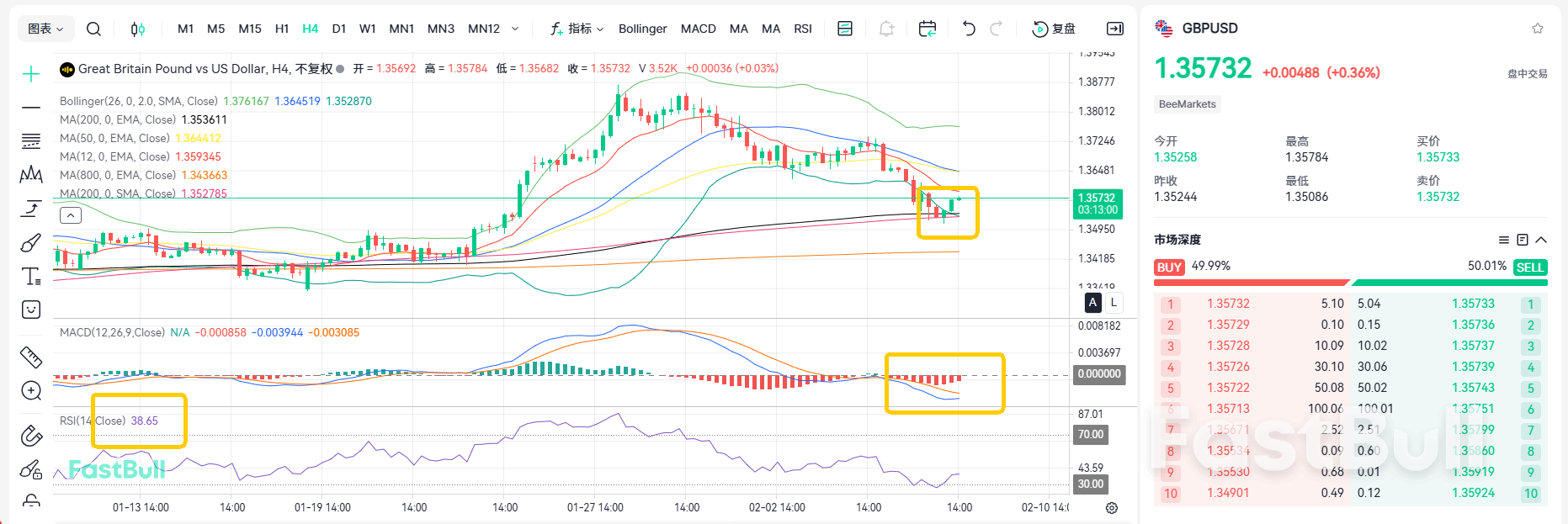
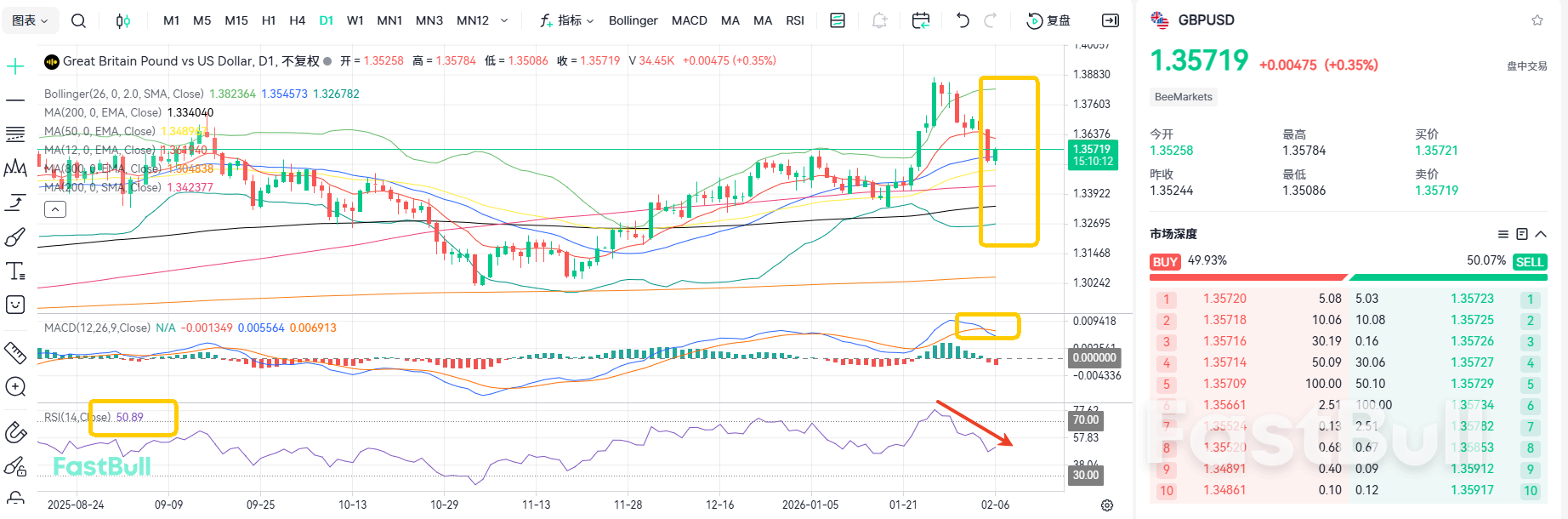
GBP/USD rebounded after finding support at the Bollinger Middle Bands in the daily chart. If prices can sustain above the middle band, they may challenge levels above 1.37 again; otherwise, they could continue falling toward the EMA50 or EMA200. The narrowing Bollinger Bands and flattening moving averages suggest an impending trend reversal. After forming a death cross, the MACD and signal lines are pulling back toward the zero axis but remain far apart, indicating the adjustment is incomplete. The RSI stands at 50, reflecting a wait-and-see mood among investors. Regarding the 4-hour chart, the Bollinger Bands are opening downward, and moving averages are diverging lower, showing the overall downtrend remains intact. However, after finding support at the EMA200, a "Morning Star" candlestick pattern appeared, suggesting a short-term uptick is likely toward the EMA12 and the Bollinger Middle Band, around 1.359 and 1.364, respectively. With the RSI at 38, the market is in oversold territory, indicating continued selling pressure but potential for a rebound. Therefore, the strategy is to buy now and sell later.
Trading Recommendations:
Trading direction: Buy
Entry Price: 1.354
Target Price: 1.4
Stop Loss: 1.33
Support: 1.34/1.3/1.28
Resistance: 1.38/1.4/1.41


