Fundamentals
As the world's fourth-largest oil producer and a net energy exporter, Canada is theoretically positioned to benefit from higher oil prices. Energy exports account for almost a quarter of the country's total exports, with elevated oil prices typically driving increased export earnings, government revenue, and energy sector investments. However, several economists argue that the current oil price surge is likely to inflict more adverse economic impacts than positive effects. Rising oil prices directly affect gasoline and transportation costs, exacerbating inflation and eroding consumer purchasing power. Given energy's 6% weight in Canada's Consumer Price Index, even short-term price fluctuations can significantly influence overall inflation. The recent tensions in the Middle East pushed Canadian gasoline prices upward by approximately 16 cents per liter within a week, intensifying household cost-of-living pressures. Prolonged conflicts would see energy costs permeate transportation, aviation, manufacturing, and food sectors, broadening inflation's scope. Economists estimate that brief oil price highs could raise GDP inflation by about 0.3 percentage points, whereas sustained elevated prices might drive a 1 percentage point inflation increase alongside amplified second-order cost pressures. Simultaneously, higher energy costs could dampen global demand and impede economic growth, heightening stagflation risks characterized by simultaneous inflation acceleration and growth deceleration. This evolving scenario has triggered swift recalibrations in financial markets' monetary policy expectations. Elevated energy prices are fueling upward inflationary pressures, prompting investors to increasingly anticipate that central banks, including Canada's, may be compelled to raise interest rates. Market data indicates that investors expect a Canadian rate hike at the final policy meeting in 2026 with near-unanimous certainty, with notable increases in speculative positioning for rate tightening in late 2025 and mid-2026. This represents a marked shift from pre-Middle East conflict projections when markets widely anticipated Canada's 2.5% policy rate would remain stable for extended periods. Rising energy costs are creating complex monetary policy trade-offs, as central banks may face pressure to implement contractionary measures even amid sub-par economic growth should inflationary trends resurface. The G7 energy ministers convened an emergency session to address oil price volatility stemming from supply shocks, yet failed to achieve agreement on releasing strategic oil reserves. Instead, they mandated the International Energy Agency (IEA) to conduct a market assessment and formulate alternative containment strategies. Concurrently, Canada's government announced plans to enhance domestic crude production through diplomatic engagement with both oil sands producers and refineries, proposing maintenance delays at key extraction facilities and incentives for onshore processing to bolster export capacity. Despite these initiatives, the inherent production constraints of oil sands projects limit Canada's ability to rapidly alter global energy markets, maintaining the country's influence at a protracted level.
U.S. consumer spending in January maintained robust growth, yet rising prices and Middle East conflict-driven energy cost increases could amplify inflationary pressures and bolster market expectations that the U.S. Federal Reserve will delay rate cuts until at least September. Data from the U.S. Department of Commerce indicates a 0.4% rise in consumer outlays for January, matching December's 0.4% increase and exceeding economists' consensus forecasts of 0.3%. However, inflation-adjusted real consumer spending grew merely 0.1%, indicating the expenditure rise was partly driven by higher prices. Other economic indicators further highlight risks of a deteriorating macroeconomic outlook. The U.S. fourth-quarter GDP annualized growth rate was revised downward to 0.7%, significantly below the initial 1.4% estimate and far below the 4.4% recorded in the previous quarter. The downward adjustment primarily stemmed from weaker consumer spending, reduced exports, declines in state and local government investment, and lower corporate expenditures on intellectual property and manufacturing facilities. Non-defense capital goods orders (excluding aircraft) remained unchanged in January, following a 0.8% increase in December. Durable goods orders also held steady in January, reversing a 0.9% contraction in December. Concurrently, consumer confidence waned in early March. These developments present a policy dilemma for the Federal Reserve, balancing a volatile labor market—marked by an unexpected job loss in February—against persistently high inflation. Economists broadly anticipate the central bank will maintain its benchmark interest rate within the 3.50% to 3.75% range next week and delay signals of potential rate cuts. Financial markets currently project a single rate reduction in September as the only feasible option this year. Nationwide Chief Economist Kathy Bostjancic stated that rising gasoline and energy prices, disrupted global trade, and deteriorating business confidence are expected to push second-quarter inflation higher while economic activity weakens.
Technical Analysis
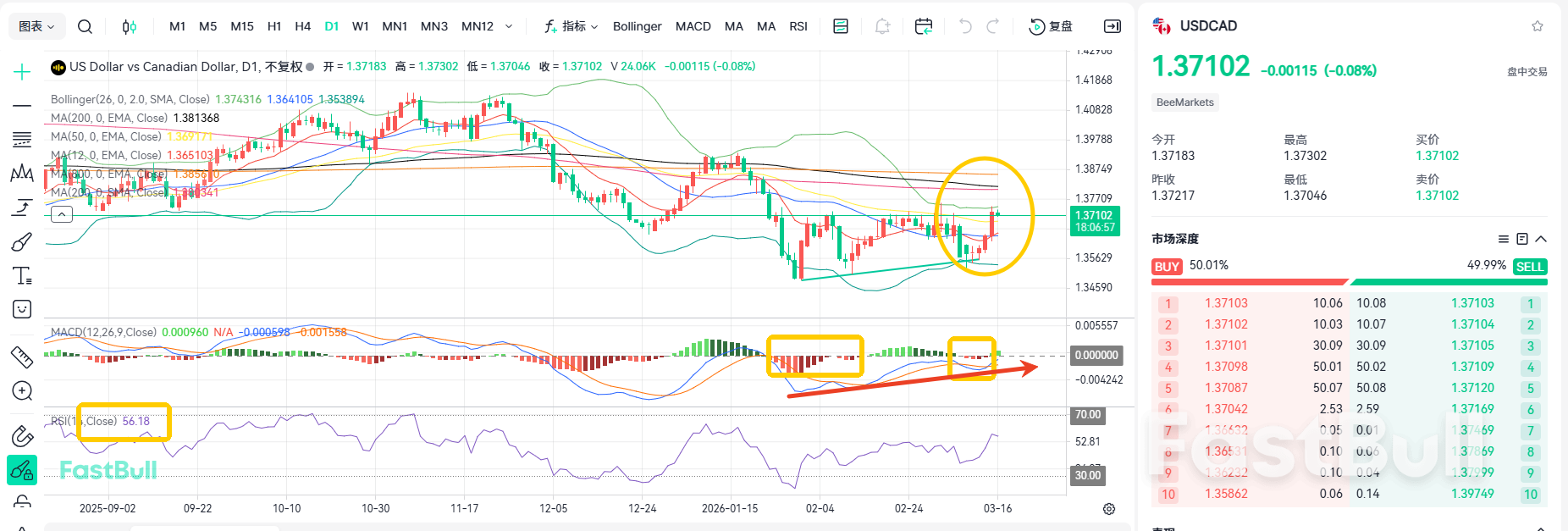
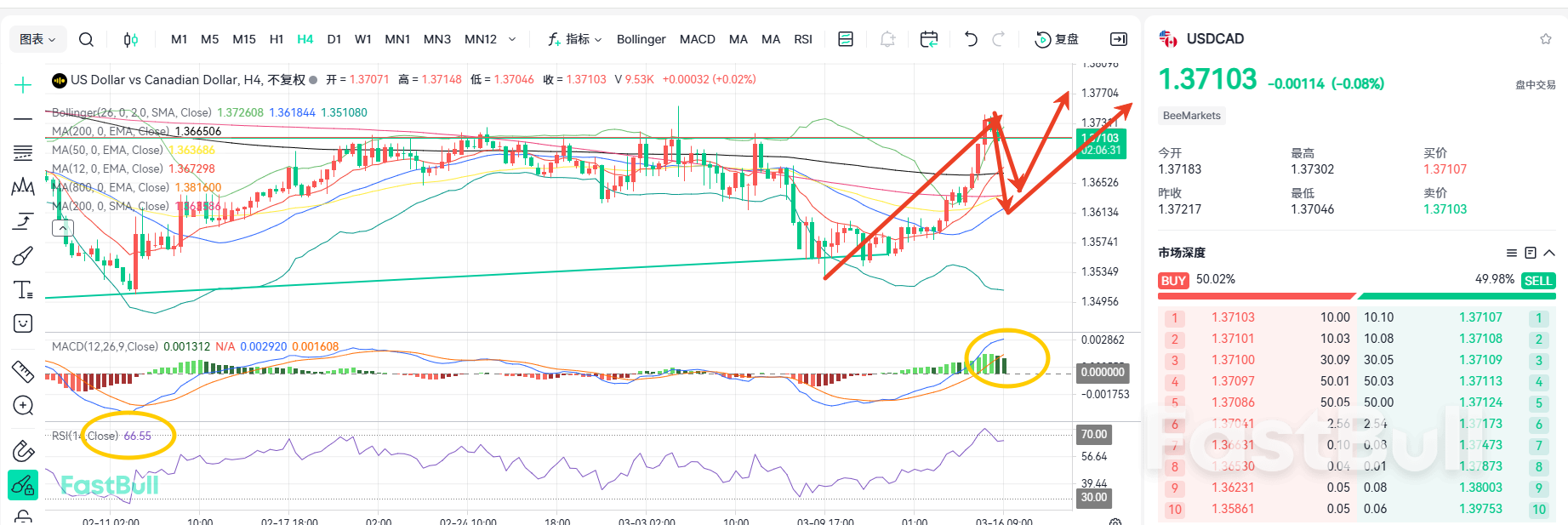
In the 4H timeframe, Bollinger Bands are expanding upwards with moving averages in bullish divergence, signaling a resumption of the uptrend. The price oscillates higher along EMA12 and the upper Bollinger band, while MACD lines remain above the zero line, sustaining the upward momentum. Key resistance levels lie at the prior high of 1.366 and round number 1.37. RSI at 66 indicates a buy-dominant market bias. Analyzing the 1D timeframe reveals narrowing Bollinger Bands, flattened moving averages, and a recent MACD golden cross with MACD line and signal line hovering near the zero line. This pattern suggests diminished bearish energy and potential trend reversal, as evidenced by bullish divergence. A Friday opening candle pierced the Bollinger middle band and EMA50, confirming a path toward EMA200 at approximately 1.38. The RSI at 56 reflects cautious sentiment with support levels gradually ascending, limiting potential downside. This suggests a strategy of buying on dips.
Trading Recommendations
Trading Direction: Buy
Entry Price: 1.366
Target Price: 1.4
Stop Loss: 1.35
Support: 1.35, 1.325, 1.28
Resistance: 1.38, 1.4, 1.42


