The safe-haven allure of Gold (XAU/USD) is facing its sternest test in weeks, as investors attempt to parse conflicting signals from the Middle East and the Federal Reserve. The precious metal managed to retain a positive bias through the first half of the European session on Wednesday, yet the price action tells a story of hesitation. After spiking to a weekly high near the psychologically significant $4,600 mark earlier in the session, the commodity has since drifted sideways, underscoring the market’s inability to commit to a directional bias in the current climate.
From a technical perspective, the rebound has been nothing short of dramatic. The latest leg higher marks a solid recovery from the technically significant 200-day Simple Moving Average (SMA) near the $4,100 level—a zone that also represented a four-month low. For many chart watchers, holding above this long-term moving average is a crucial signal that the bull market isn’t yet broken. But as we saw in the aftermath of the Asian trading session, momentum is fleeting. The current price action suggests that before we can call this a true bottom, the market needs to see a sustained break above the $4,600 resistance.
The primary driver of the recent volatility—and the ensuing caution—remains the fluid geopolitical landscape in the Middle East. Headlines out of Washington and the Persian Gulf are currently offering a dual narrative that is keeping commodity markets, including gold, on a hair trigger.
On the one hand, there is a palpable sense of de-escalation brewing. Diplomatic sources indicate that a framework for a one-month ceasefire mechanism is being constructed, aimed specifically at allowing US and Iranian negotiators to sit down and hammer out a plan to end the broader conflict. This diplomatic push gained traction following President Donald Trump’s decision earlier this week to delay planned strikes on Iran’s energy infrastructure by five days. The administration cited ongoing indirect negotiations as the reason for the pause, a move that initially doused some of the geopolitical risk premium that had been priced into assets.
Adding fuel to the optimistic fire, President Trump disclosed that Iran had offered a “present” linked to the security of energy flows through the Strait of Hormuz—a gesture widely interpreted as a goodwill overture to keep negotiations alive. For the energy complex, this is a seismic development. The prospect of stable crude oil flows is weighing heavily on oil prices, and by extension, easing the inflationary concerns that have gripped central banks. For non-yielding Gold, the initial market reaction was straightforward: if inflation fears subside, the aggressive hawkishness required to tame it subsides, lowering the opportunity cost of holding the yellow metal. This dynamic was enough to lure some follow-through buyers back into the market earlier in the day.
However, to characterize the Middle East as calm would be a grave misreading of the situation. The diplomatic overtures are occurring against a backdrop of active, kinetic warfare that shows no signs of pausing.
Israel continues its targeted strikes deep inside Iranian territory, while the United States is physically reinforcing its footprint in the region. In a significant escalation of force posture, the Trump administration has directed thousands of soldiers from the US Army’s elite 82nd Airborne Division to deploy to the Middle East. This is not a signal of impending withdrawal; it is a signal of preparation for a prolonged engagement.
On the other side of the ledger, Iran has reportedly fired a new missile barrage at Israeli positions, and the conflict is metastasizing across the region. Gulf states have reported repeated interceptions of drones and missiles, while the fighting in Lebanon and Iraq is intensifying. For every headline suggesting a deal is near, there is a corresponding headline reminding the market that the guns are still firing.
This persistent violence is acting as a floor under energy prices and a backstop for gold’s downside. Investors remain on edge, acutely aware that the ceasefire talks could collapse at any moment. Consequently, while gold is struggling to break higher, it is also proving resilient to sell-offs, as a core of the market continues to hedge against the possibility that the current diplomatic window slams shut.
If geopolitics is the engine pushing and pulling gold, the Federal Reserve is the anchor keeping it from sailing too far. The macroeconomic landscape has shifted dramatically in recent weeks, creating a formidable headwind for the precious metal.
Traders have effectively priced out any hope of further interest rate cuts by the US Federal Reserve this year. In a stunning reversal of sentiment from just a few months ago, the swaps market is now rapidly increasing the probability of a rate hike before the end of the year. This hawkish repricing is rooted in the stubborn resilience of the US economy and the lingering fear that energy prices, even with the recent diplomatic relief, will keep inflation sticky.
The implication for gold is severe. A hawkish Fed underpins the US Dollar, which continues to trade with a firm bid. For international buyers, a strong dollar makes gold more expensive, capping demand. Moreover, the prospect of a rate hike raises the opportunity cost of holding a non-yielding asset like gold, forcing investors to demand a higher risk premium.
Given this dual reality—geopolitical uncertainty offering support versus a hawkish Fed and strong dollar capping gains—the current price action feels less like a reversal and more like a consolidation.
Technical Analysis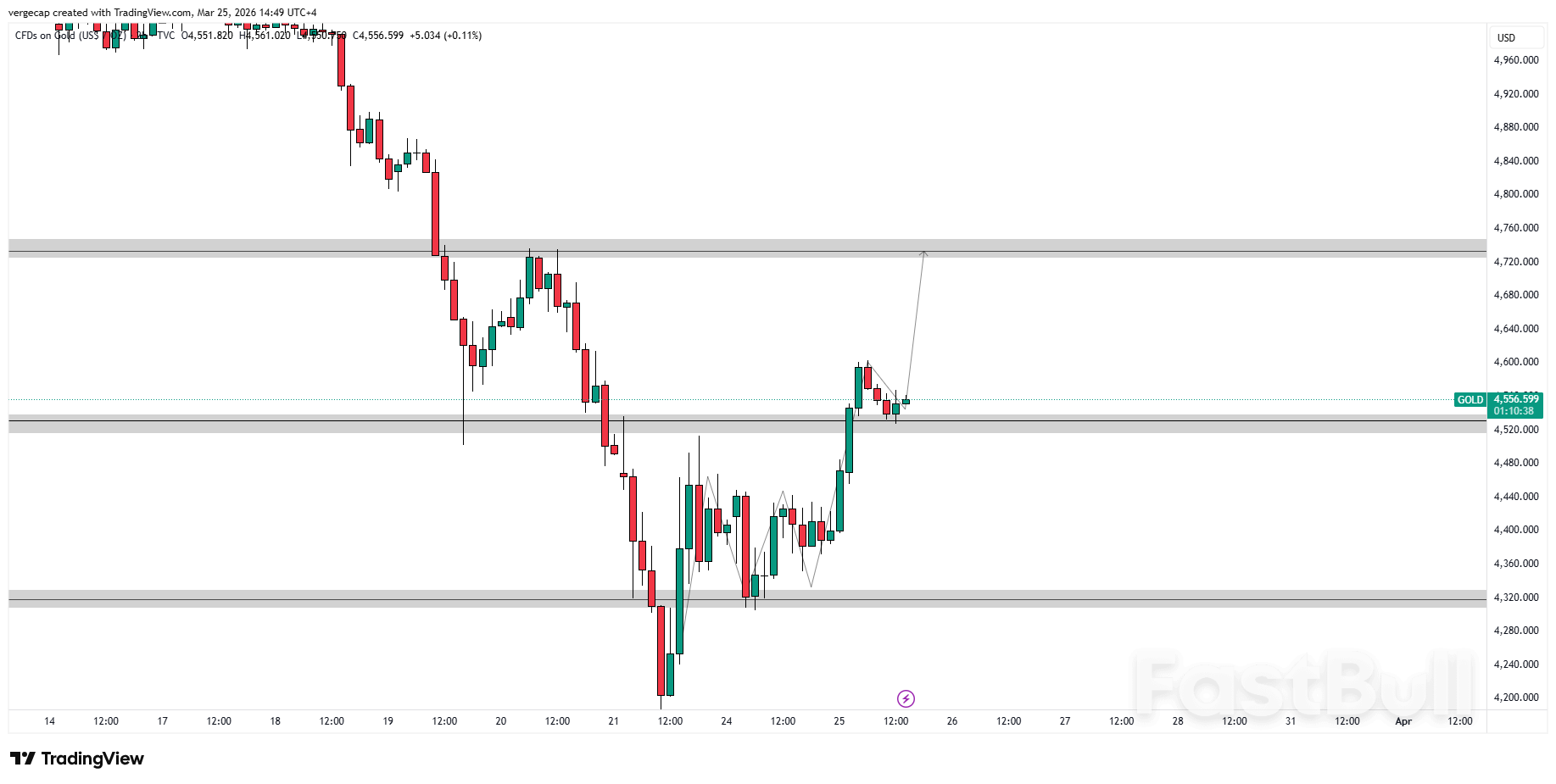
From a technical perspective, gold is attempting to stabilize after a sharp bearish impulse, showing early signs of a corrective recovery within a broader downtrend. On the 4-hour chart, price action experienced an aggressive sell-off from the 4,900 region down toward 4,200, followed by a strong bullish rebound. This rebound, however, now appears to be stalling as price approaches a key confluence resistance zone.
Currently, price is consolidating around the 4,520–4,560 region, which aligns with a previously broken support area that is now acting as resistance. This level has already shown signs of rejection, indicating that sellers remain active. The structure suggests a potential lower high formation, reinforcing the idea that the broader trend remains bearish unless a decisive breakout occurs.
Below, the 4,300–4,320 zone represents a critical support base formed after the recent bottoming structure. This area has held firm and triggered the current recovery, making it a key level to watch. A break below this support would confirm a continuation of the bearish trend and likely open the door for a move back toward the 4,200 lows, with further downside extension possible if momentum accelerates.
On the upside, a sustained break above the 4,600 level is needed to invalidate the immediate bearish bias. Such a move would clear the current resistance zone and expose the next major supply area around 4,700–4,750. This aligns with the projected upside path shown on the chart, suggesting a potential continuation of the corrective rally if buyers regain control.
Price action in the current zone reflects indecision, with smaller-bodied candles forming after a strong impulsive move higher. This typically indicates a pause in momentum rather than a confirmed reversal, but it also highlights the importance of the current resistance zone in determining the next directional move.
Momentum-wise, while indicators are not explicitly shown, the sharp V-shaped recovery suggests a temporary bullish momentum shift. However, the slowing pace of gains near resistance implies weakening follow-through, consistent with a corrective rally rather than a full trend reversal.
TRADE RECOMMENDATION
BUY GOLD
ENTRY PRICE: 4,560
STOP LOSS: 4,400
TAKE PROFIT: 4,720


