The gold market is displaying a classic case of risk-off support clashing with monetary policy headwinds this Friday, leaving XAU/USD stuck in a tight range as investors brace for a pivotal week of US economic data.
The precious metal is currently clinging to a positive bias, marking its third straight day of modest upticks. However, the lack of any significant follow-through buying underscores the deep uncertainty gripping the market. On one hand, the geopolitical landscape is darkening rapidly. US President Donald Trump issued a stark ultimatum to Iran on Thursday, demanding a deal over its nuclear program within a "10 to 15-day" window, warning that failure to comply would result in "really bad things" happening.
The response from Tehran was swift and ominous. In a communication to UN Secretary-General Antonio Guterres, Iran stated it does not seek war but will not tolerate military aggression. In a chilling escalation of rhetoric, Tehran warned that if attacked, "all bases and assets of a hostile force in the region would be legitimate targets." This fiery exchange has significantly raised the prospect of a direct military confrontation and a broader conflagration in the Middle East. Unsurprisingly, this is providing a robust floor under gold, reinforcing its status as the ultimate store of value in times of crisis and fueling the modest safe-haven rally seen today.
Yet, the bullish potential is being severely blunted by the realities of the US economic landscape. The minutes from the January FOMC meeting, released this week, confirmed what hawkish market participants had suspected: the Federal Reserve is in no rush to cut rates. In fact, the discussion among officials included the possibility of raising rates should inflation prove stubborn. This narrative was reinforced by a string of resilient economic data, particularly from the labor market, which continues to defy expectations of a slowdown.
This combination of a robust economy and cautious central bank rhetoric has forced a dramatic repricing in the market. Investors have been forced to scale back bets on aggressive and imminent rate cuts, propelling the US Dollar to its highest level since January 23. A stronger dollar is a powerful headwind for gold, making the greenback-priced commodity more expensive for international buyers and diminishing its investment appeal relative to yield-bearing assets.
This fundamental deadlock explains the market’s hesitancy. As we head into the weekend, traders are opting to de-risk and wait for the big-ticket items on next week’s US calendar. All eyes will be on the Advance reading of Q4 GDP, which will offer a final snapshot of the economy's growth trajectory. However, the real market mover will undoubtedly be the January Personal Consumption Expenditures (PCE) Price Index, the Fed’s preferred inflation gauge.
The PCE report will either confirm the market’s hawkish repricing or force another violent shift in expectations. A hotter-than-expected inflation print could send Treasury yields and the dollar soaring, potentially breaking gold’s recent support and triggering a deeper correction. Conversely, a softer reading could unravel the dollar's recent gains and allow gold’s geopolitical risk premium to truly shine. For now, the yellow metal remains in limbo, a patient spectator awaiting its next major cue.
Technical Analysis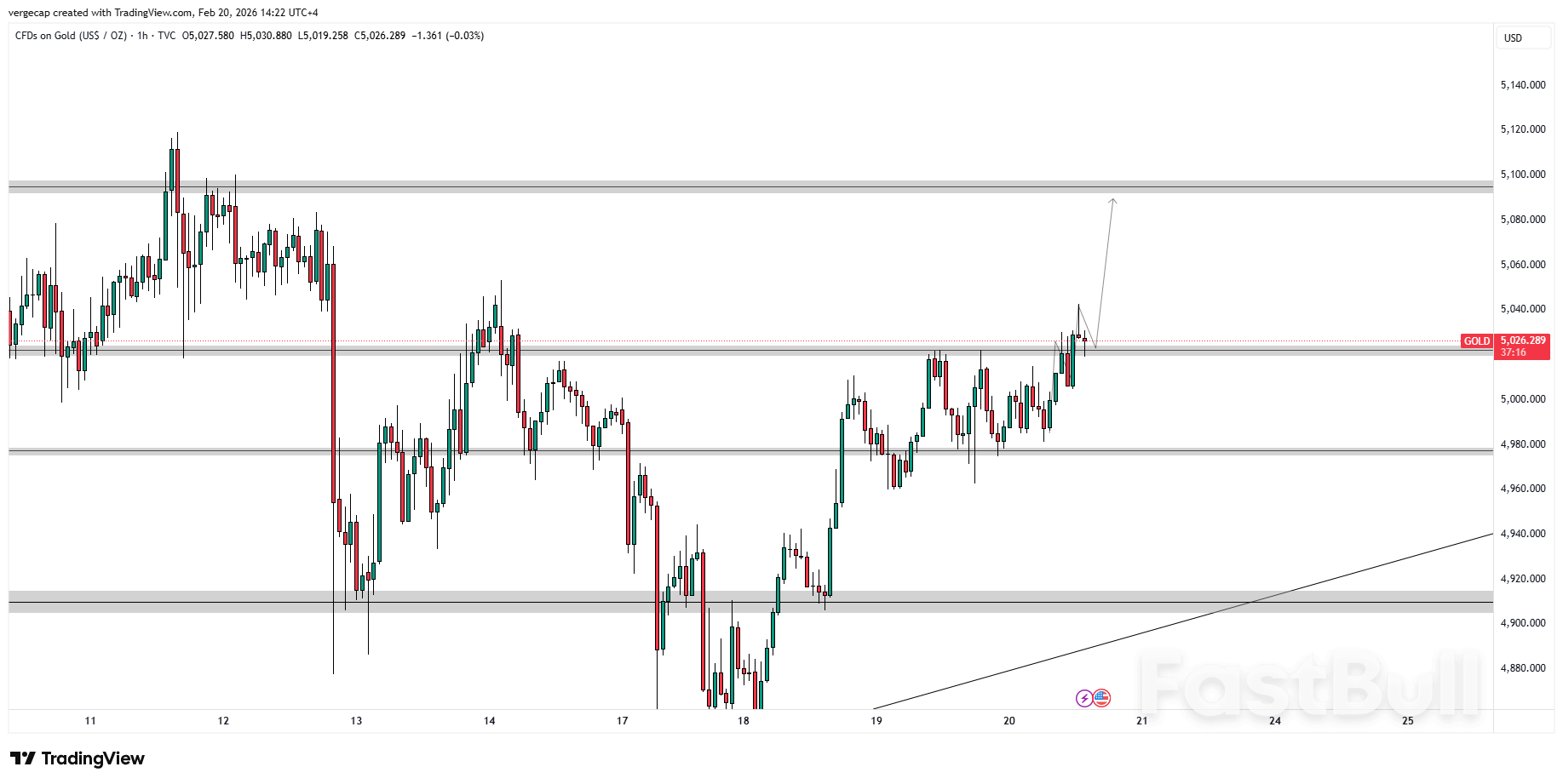
From a technical perspective, gold is transitioning back into a short-term bullish recovery phase following a sharp mid-February selloff. The 1-hour chart shows price rebounding decisively from the $4,880–$4,920 demand zone, where aggressive buying previously emerged. This level now defines the structural base of the current upswing.
Price action has since formed a sequence of higher lows, signaling improving market structure. The recovery has carried gold back above the $4,980–$5,000 consolidation band, which previously acted as resistance and is now being retested as near-term support—an important sign of acceptance by buyers.
Currently, gold is pressing into a key supply zone around $5,020–$5,040, an area that capped upside attempts earlier in the week. This zone represents the immediate structural inflection point. Sustained acceptance above it would confirm a continuation of the bullish leg and shift focus toward the $5,080–$5,100 resistance area, which marks the upper boundary of the broader range visible on the chart.
On the downside, failure to hold above $5,000 would suggest a false breakout and could trigger a pullback toward $4,950, with deeper retracement risk back toward the rising trendline support near $4,920. A break below that level would undermine the recovery structure and reintroduce bearish pressure.
Overall, structure favors continued upside as long as price holds above the $5,000 handle, with momentum suggesting consolidation-to-higher rather than trend exhaustion.
TRADE RECOMMENDATION
BUY GOLD
ENTRY PRICE: 5,030
STOP LOSS: 4,950
TAKE PROFIT: 5,100


