Gold begins the week under pressure, with XAU/USD trading around $4,396, down roughly 0.77%, as investors continue to digest the implications of a much stronger-than-expected US employment report. Renewed expectations of a Federal Reserve rate hike, combined with inflation concerns stemming from elevated energy prices, are creating a difficult backdrop for the non-yielding metal.
Friday's US labor data strengthened the argument for maintaining restrictive monetary policy. Nonfarm Payrolls increased by 162,000 in August, comfortably exceeding expectations for 56,000 new jobs, while the Unemployment Rate remained unchanged at 4.1%. Markets now assign roughly a 58% probability of a rate increase at the September 15-16 Fed meeting.
Despite those pressures, Gold has avoided a more aggressive selloff as the US Dollar struggles to gain traction. The DXY trades near 98.95, around two-week lows, with broad strength in the Japanese Yen weighing heavily on the Greenback. USD/JPY has fallen toward 154.50 and is down approximately 3.3% since the beginning of September.
Meanwhile, renewed US-Iran tensions are influencing Gold primarily through the inflation channel rather than generating a significant safe-haven rally. The situation escalated over the weekend following another exchange of military action, adding uncertainty around Middle Eastern energy supplies.
WTI crude has subsequently remained close to $90 per barrel, near its highest level since July. Persistently expensive energy could feed into broader consumer prices, complicating the inflation outlook and strengthening the case for keeping interest rates elevated for longer. With global bond yields already at historically high levels, that environment increases the opportunity cost of holding Gold.
The next major test will come from US inflation figures. Producer Price Index data are due Thursday, followed by Consumer Price Index figures on Friday. Stronger-than-expected inflation would reinforce expectations for another Fed hike and could extend pressure on XAU/USD. Conversely, softer readings could reduce tightening expectations and give Gold room to recover.
For now, Gold remains caught between hawkish Fed expectations and a weakening US Dollar. The strong employment report has shifted the immediate balance against the metal, but Dollar weakness and persistent geopolitical uncertainty are preventing sellers from establishing complete control.
Technical Analysis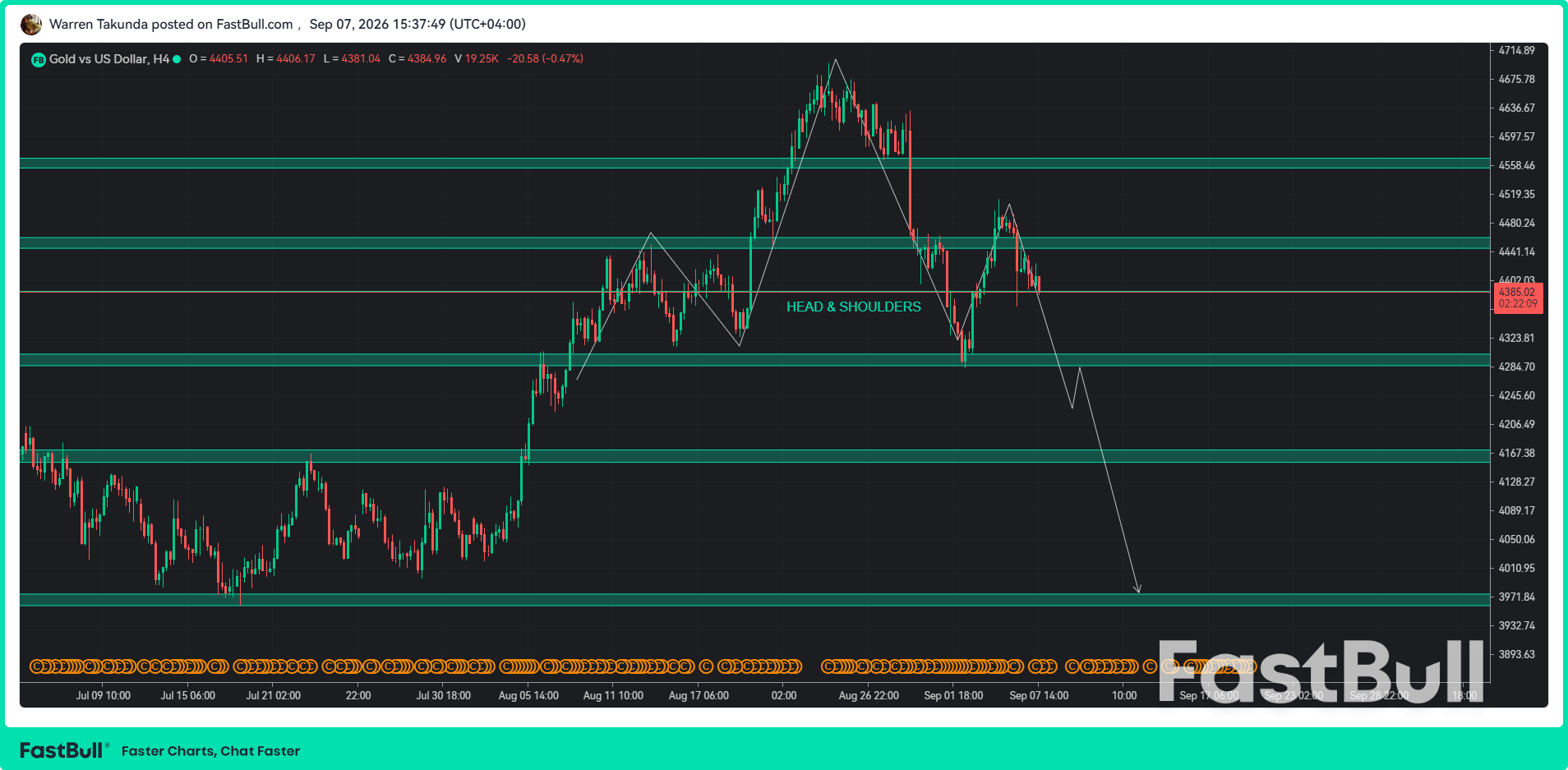
Gold's 4-hour chart is showing a significant deterioration in structure, with price action increasingly resembling a large Head and Shoulders reversal pattern following the rejection from the $4,680 region. XAU/USD is currently trading around $4,385, and the latest decline has brought sellers back into control after the recovery attempt failed around $4,480.
The left shoulder developed around the $4,440–$4,460 region, followed by the rally toward approximately $4,680, which formed the head. Gold subsequently dropped toward $4,290 before recovering to roughly $4,480, creating what appears to be the right shoulder. The inability to challenge the previous peak strengthens the bearish characteristics of the formation.
Attention now turns to the $4,280–$4,300 neckline and support region. This area has already produced a strong reaction once, making it the key technical level separating the current consolidation from a much deeper correction. A decisive 4-hour break beneath $4,280 would effectively confirm the bearish pattern and could trigger another acceleration in selling pressure.
Below the neckline, the first significant area to watch sits around $4,150–$4,170. A failure to attract sustained buying there would expose the psychological $4,000 level, followed by the major $3,960–$3,980 demand zone. This lower region also closely aligns with the broader measured downside suggested by the Head and Shoulders formation.
On the upside, $4,440–$4,460 has returned as immediate resistance. A recovery above this area could delay the bearish scenario and allow another attempt toward $4,480. However, Gold would need to reclaim the stronger $4,550–$4,570 resistance zone to seriously challenge the developing reversal structure.
For now, the combination of a lower right shoulder, rejection from $4,480 and renewed weakness toward the neckline keeps the technical bias bearish. The $4,280 area remains the decisive confirmation level, with a breakdown potentially opening a considerably larger correction toward the $4,000 region.
TRADE RECOMMENDATION
SELL XAU/USD
ENTRY PRICE: 4,385
STOP LOSS: 4,550
TAKE PROFIT: 4,000


