Gold prices are attempting to find their footing in European trading on Friday, clinging to modest intraday gains but struggling to mount a convincing challenge of the psychologically critical $5,000 per ounce level. The bullion market finds itself in a state of suspended animation, caught between resilient labor market data and the looming threat of this afternoon’s US consumer inflation report—a release that many traders believe will determine the Federal Reserve’s trajectory for the first half of 2026.
XAU/USD is currently hovering in the $4,990–$4,995 region, recovering slightly from Thursday’s sharp selloff that briefly knocked prices below the $4,900 handle. That decline, which erased more than $180 from the commodity’s value at its nadir, was triggered by a fundamental repricing of US rate expectations following Wednesday’s stronger-than-expected Nonfarm Payrolls report .
The January jobs data delivered a clear message: the American labor market is not rolling over. With payrolls accelerating unexpectedly and the unemployment rate dipping to 4.3 percent, traders were forced to recalibrate their Fed bets. According to CME Group’s FedWatch Tool, the probability of a rate cut in March has collapsed to just 18 percent, with April now appearing equally unlikely . The market is effectively pricing in a policy stand-pat through the end of Chairman Jerome Powell’s term in May, with the first full quarter-point reduction now fully discounted for the June meeting .
Yet here is where the narrative becomes interesting—and where gold’s resilience starts to make sense. Despite the hawkish repricing, traders are still pricing in at least two rate cuts before year-end 2026 . The bond market is effectively calling the Fed’s bluff, suggesting that while March is dead, the broader easing cycle remains very much alive.
Thursday’s Jobless Claims data added another layer of complexity to the macro picture. The Department of Labor reported 227,000 new applications for unemployment insurance during the week ending February 7—a figure that came in above the 222,000 consensus estimate, though below the prior week’s upwardly revised 232,000 [citation:original data].
More concerning, however, was the continued rise in Continuing Claims, which climbed to 1.862 million during the week ending January 31. This marks the latest in a year-long trend of deteriorating labor market depth—a phenomenon that Dallas Fed President Lorie Logan addressed earlier this week in remarks at the FIA-SIFMA Forum . While Logan noted that “downside risks appear to have meaningfully dissipated,” she also acknowledged that the labor market is exhibiting what she termed a “low hiring, low firing” equilibrium .
This is the paradox confronting Fed officials: headline payroll numbers remain respectable, but beneath the surface, the labor market’s vitality is leaching away. The ratio of job openings to unemployed workers has drifted down, and the quality of employment gains—heavily concentrated in healthcare and other non-cyclical sectors—suggests underlying fragility .
For gold, this nuance matters. The yellow metal has historically thrived in environments where labor market deterioration forces the Fed’s hand, even if inflation remains slightly elevated. Friday’s CPI report will determine whether that dynamic prevails or whether sticky prices force policymakers to maintain their current posture.
Consensus estimates point to both headline and core CPI registering 0.3 percent month-over-month, with the annual core reading expected to dip to 2.5 percent from December’s 2.6 percent . On its face, this represents continued progress toward the Fed’s 2 percent target. But market participants are wary of the so-called “January Effect”—the tendency for corporations to implement annual price hikes at the start of the year, potentially juicing the inflation print beyond expectations .
The stakes could not be higher. A core reading above 2.7 percent would likely be interpreted as confirmation that the “last mile” of disinflation is proving stubbornly resistant, potentially delaying rate cuts well into the second half of the year. Such an outcome would punish gold severely, likely pushing prices below last week’s lows toward the $4,850 region .
Conversely, a print below 2.5 percent would validate the disinflationary thesis and reopen the door for earlier Fed accommodation. Under that scenario, gold’s push above $5,000 would likely accelerate, with $5,140 emerging as the next technical target .
Technical Analysis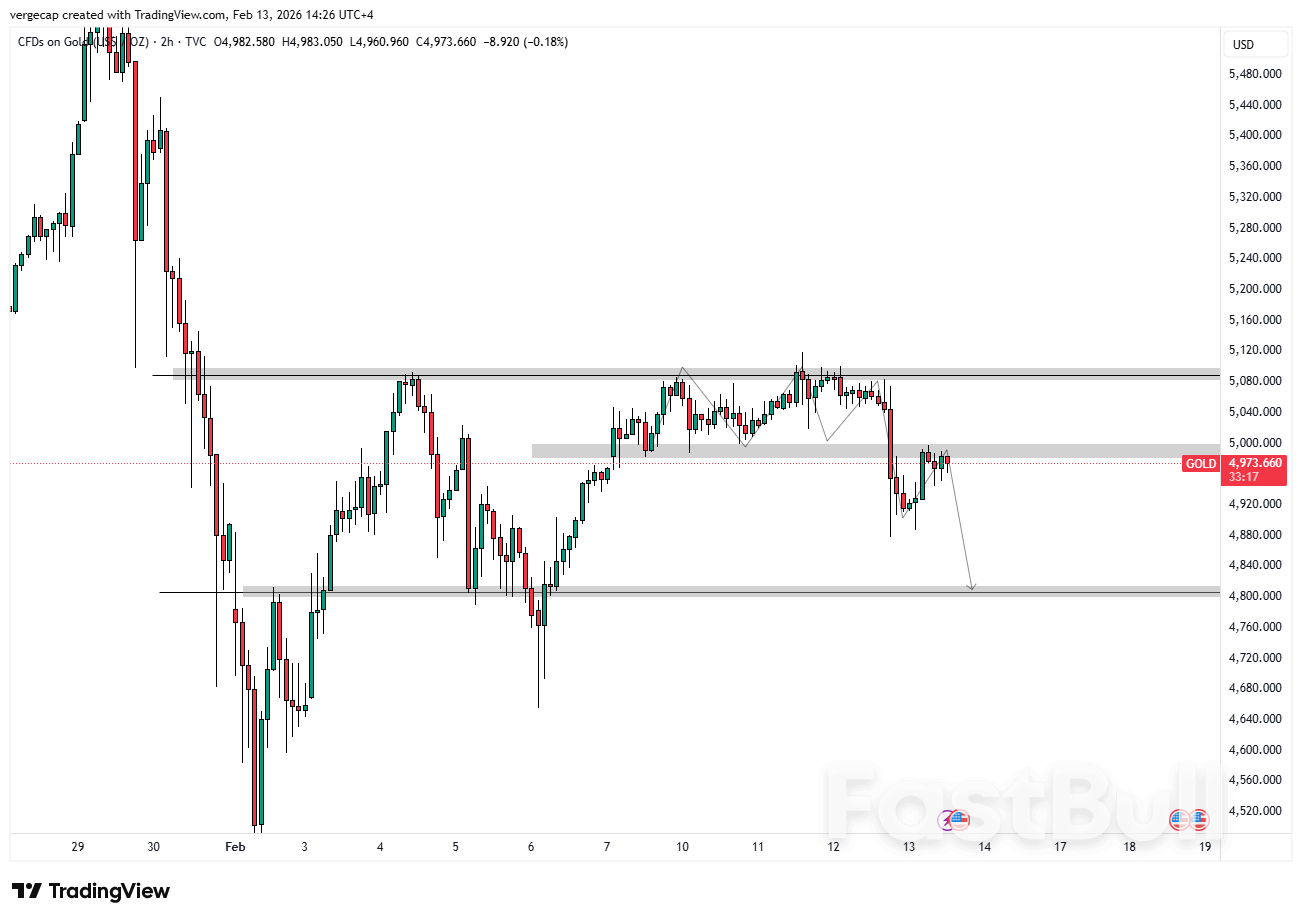
From a technical perspective, gold (XAUUSD – 2-hour chart) is transitioning from a recovery phase into a corrective structure after failing to sustain momentum above a key resistance band. Price action shows that the market recently rejected the 5,080–5,100 supply zone, which has repeatedly capped upside attempts and now stands as a critical near-term resistance cluster.
On the 2-hour timeframe, gold had formed a short-term series of higher lows from the 4,760–4,800 demand base, reflecting a constructive rebound. However, the inability to establish acceptance above 5,080 has resulted in a sharp bearish rejection candle, signaling supply dominance. The recent lower high formation near 5,090 suggests early signs of short-term trend exhaustion and the potential development of a broader range between 4,800 and 5,100.
The 5,000 psychological level is now acting as an intermediate pivot. Price is currently hovering just below this handle, and sustained trading beneath it increases the probability of a deeper pullback. A decisive breakdown below 4,960 would likely accelerate bearish momentum and expose the 4,800–4,820 support zone, which represents prior consolidation and a well-defined demand area. A sustained move below 4,800 would invalidate the recovery structure and shift the broader bias toward a more pronounced corrective phase, potentially opening the door toward 4,700 and below.
On the upside, bulls must reclaim 5,000 and secure a firm break above 5,080–5,100 to reestablish upside control. A sustained push through this supply zone would negate the current lower high structure and likely trigger renewed momentum buying, with 5,150 and 5,200 emerging as the next upside targets.
Price structure currently favors cautious bearish continuation in the near term. The rejection from resistance, combined with the emerging lower high and strong bearish impulse candle, suggests increasing downside pressure. However, unless 4,800 is decisively broken, the broader structure still resembles a range rather than a confirmed downtrend.
TRADE RECOMMENDATION
SELL GOLD
ENTRY PRICE: 4,980
STOP LOSS: 5,110
TAKE PROFIT: 4,810


