Gold prices are clinging to modest gains during European trading on Thursday, finding support just above the psychologically critical $5,000 per ounce level. However, the precious metal is struggling to gather any significant bullish momentum as traders digest a confusing mix of escalating geopolitical tensions and a surprisingly hawkish undertone from the Federal Reserve.
The stalemate in Eastern Europe remains a primary pillar of support for the safe-haven asset. The latest round of US-mediated peace negotiations between Ukrainian and Russian officials concluded in Geneva yesterday with no tangible progress. Sources close to the talks indicate that fundamental disagreements regarding the status of contested territories remain intractable, effectively dashing hopes for an imminent de-escalation.
Simultaneously, the geopolitical risk premium is being further juiced by alarming signals emanating from the Middle East. According to defense intelligence reports circulating in Washington, the US military has elevated its readiness posture and is capable of striking Iranian targets as early as this weekend. While President Trump has yet to sign off on any final authorization for armed conflict, the mere possibility of a sudden escalation in the region is forcing institutional investors to maintain a defensive allocation to bullion.
THE FED'S HAWKISH UNDERCURRENT
Yet, for all the fear in the air, gold’s upside remains conspicuously capped. The culprit, as it has been for much of the year, is the US Dollar and the shifting narrative around interest rates.
The release of the Federal Reserve’s January meeting minutes on Wednesday painted a picture of a deeply divided Federal Open Market Committee (FOMC). While the market has been pricing in aggressive rate cuts for months, the minutes reveal that policymakers are far from unified on the timing.
Several officials suggested that further rate cuts could be warranted if inflation continues its downward trajectory. However, a significant contingent pushed back against this narrative, warning that easing policy too prematurely—with inflation still lingering above target in some sectors—could severely undermine the Fed’s credibility and jeopardize the long-term goal of a 2% inflation anchor.
This hawkish caution was reinforced by robust economic data. Tuesday’s Industrial Production report smashed expectations, posting a gain well above consensus, with manufacturing output surging by the most in nearly a year. This economic resilience gives the Fed ample runway to maintain higher rates for longer, boosting the US Dollar and diminishing the allure of non-yielding assets like gold.
Technical Analysis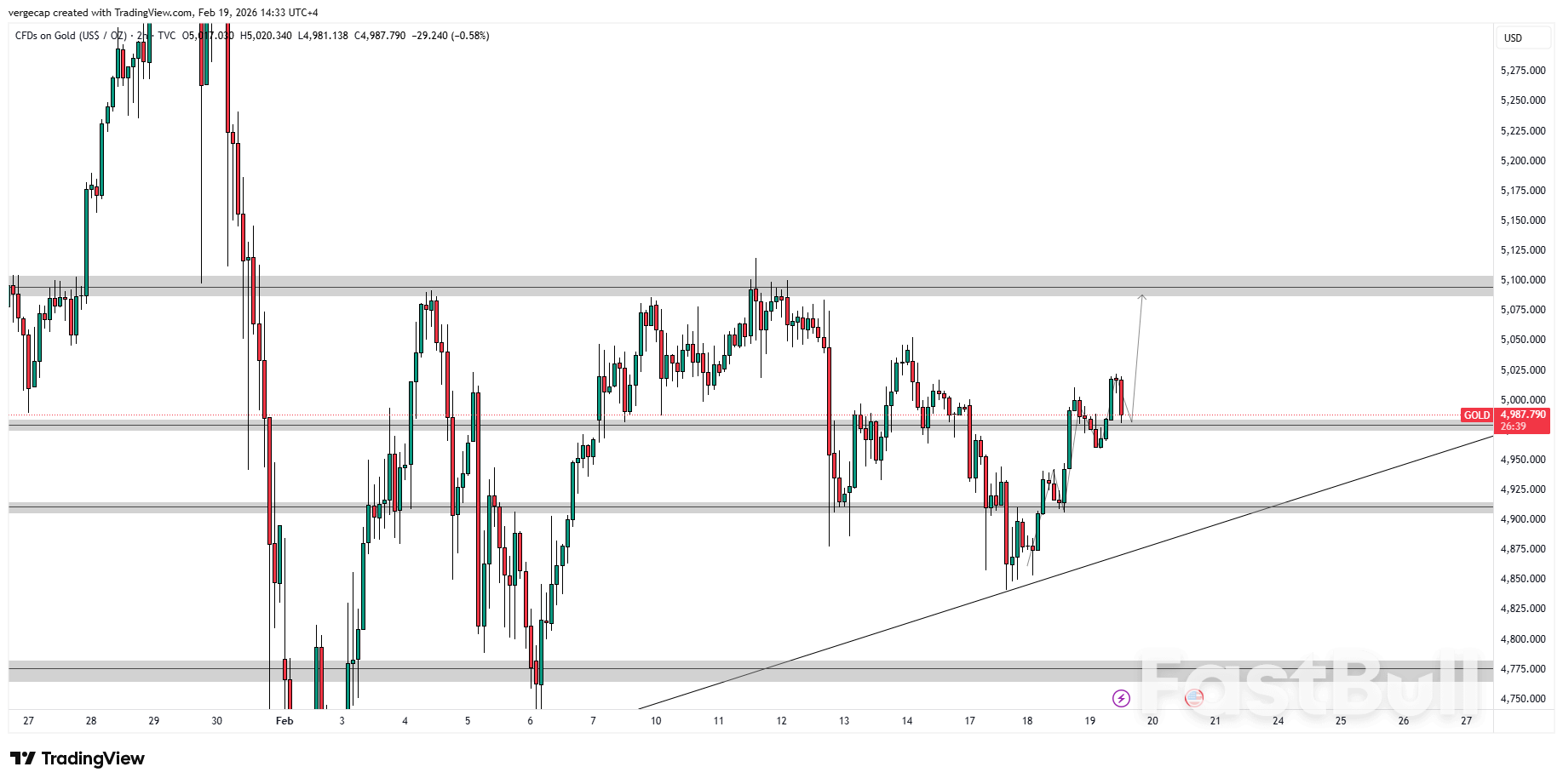
From a technical perspective, gold remains supported within a developing bullish recovery structure, despite recent volatility and repeated tests of key resistance zones. On the 4-hour chart, price action shows gold rebounding from a rising trendline drawn from the early February lows, reinforcing the presence of higher lows and an emerging upward bias. This trendline has acted as a dynamic support, underpinning successive pullbacks and signaling that dip-buying interest remains intact.
Price is currently consolidating around the 4,980–5,000 zone, a pivotal area that has repeatedly acted as both support and resistance. The market is attempting to build acceptance above this level following a sharp bounce from the 4,900–4,920 demand zone, which coincides with a previously defended horizontal support band. The strong bullish reaction from this region suggests demand absorption and a shift away from bearish momentum seen earlier in the month.
Overhead, the 5,080–5,110 resistance zone stands out as the most critical near-term barrier. This area marks prior distribution highs and has repeatedly capped upside attempts, as highlighted by multiple upper wicks and failed breakouts. A sustained 4-hour close above this zone would represent a clear break of structure and likely trigger a renewed impulsive move higher, opening the door toward the 5,200 psychological level and potentially the upper extremes near 5,250.
On the downside, immediate support rests at 4,950–4,970, a short-term consolidation base. A decisive break below this region would expose the rising trendline support near 4,900, which remains the most important level for preserving the bullish recovery narrative. A sustained move below 4,900 would invalidate the higher-low structure and shift the outlook back toward a broader corrective phase, with downside risk extending toward 4,780–4,800, where deeper liquidity previously accumulated.
Momentum indicators favor consolidation rather than reversal. The Relative Strength Index (RSI) has cooled from earlier elevated readings and is hovering in neutral-positive territory, indicating that upside momentum has reset without slipping into bearish conditions. This behavior typically supports continuation rather than trend exhaustion. Meanwhile, the MACD is stabilizing after a recent pullback, suggesting bearish momentum is fading and aligning with the view of a pause before the next directional move.
Overall, gold appears to be coiling beneath major resistance while maintaining a constructive higher-low structure. As long as price holds above the rising trendline and the 4,900 support zone, the technical bias favors an eventual upside breakout rather than a renewed selloff.
TRADE RECOMMENDATION
BUY GOLD
ENTRY PRICE: 4,990
STOP LOSS: 4,900
TAKE PROFIT: 5,120


