Fundamentals
The shocking detainment of Venezuelan President Nicolás Maduro by U.S. authorities over the weekend initially triggered a market reaction that appears to have dissipated, with gold prices retreating for the second consecutive day on Thursday. However, a confluence of geopolitical and macroeconomic factors may temper aggressive short positions in gold, potentially limiting downside risk. U.S. President Donald Trump has issued threats that Colombia and Mexico could face military intervention as part of efforts to combat organized crime networks and regional instability. Additionally, Secretary of State Marco Rubio indicated that President Trump's objective to annex Greenland remains unchanged, with the possibility of pursuing this goal through military means. Ongoing geopolitical tensions stemming from slow progress in the Russia-Ukraine peace negotiations, instability in Iran, and issues surrounding the Gaza Strip continue to elevate geopolitical risk, supporting safe-haven precious metals. Coupled with market expectations that the Federal Reserve will reduce interest rates in March and potentially implement additional easing later this year, these factors may restrain declines in precious metals. The SPDR Gold Trust, the world's largest gold ETF, held steady at 1,067.13 tonnes from the previous trading day. China's foreign exchange reserves reached $3.3578 trillion at the end of December 2025, marking a fifth consecutive month of growth and hitting a decade-high. Meanwhile, the People's Bank of China has increased gold holdings for 14 consecutive months, adding a total of 860,000 ounces in 2025. Most Wall Street institutions, including UBS, remain optimistic about gold's outlook, with UBS upgrading its rating to "overweight." Conversely, Capital Economics forecasts a correction in gold prices by 2026.
In terms of economic indicators, the Institute for Supply Management reported an unexpected rebound in U.S. service sector activity for December, with the Non-Manufacturing Purchasing Managers' Index rising from 52.6 in November to 54.4. However, this positive development was largely offset by two underwhelming U.S. labor market reports. According to data from the Automatic Data Processing Institute, private sector employment increased by 41,000 in December, reversing a decrease of 29,000 in November (revised from an earlier decline of 32,000), surpassing the previous forecast of 47,000. Additionally, the Job Openings and Labor Turnover Survey indicated a decline in job vacancies to 7.146 million in November. Nevertheless, traders appear hesitant to take aggressive directional positions, as market attention remains focused on the upcoming U.S. nonfarm payrolls report due on Friday. This crucial employment data will influence market expectations of Federal Reserve policy paths, potentially boosting the U.S. dollar and injecting renewed momentum into gold prices that lack yield. Meanwhile, the weekly initial unemployment claims figures released on Thursday could present short-term trading opportunities in XAU/USD during North American trading hours. Given these fundamental factors, a cautious approach would involve waiting for a significant follow-through sell-off before considering entries to mitigate further losses.
Technical Analysis
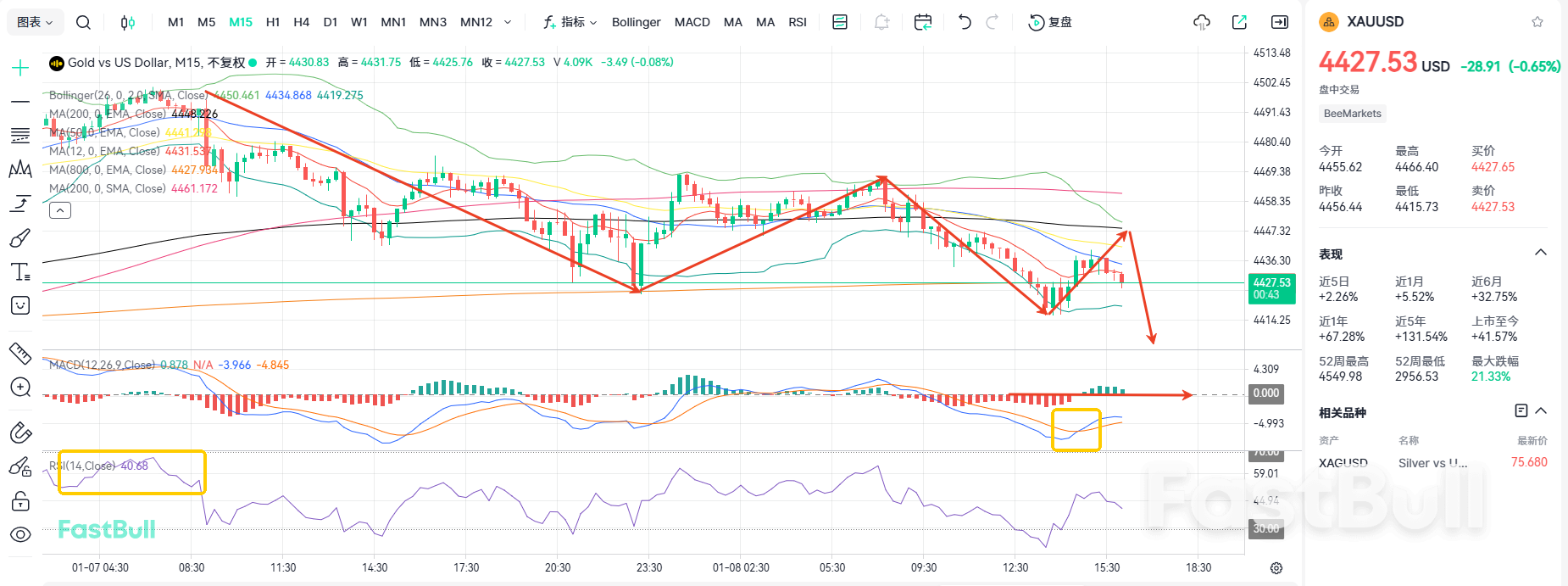
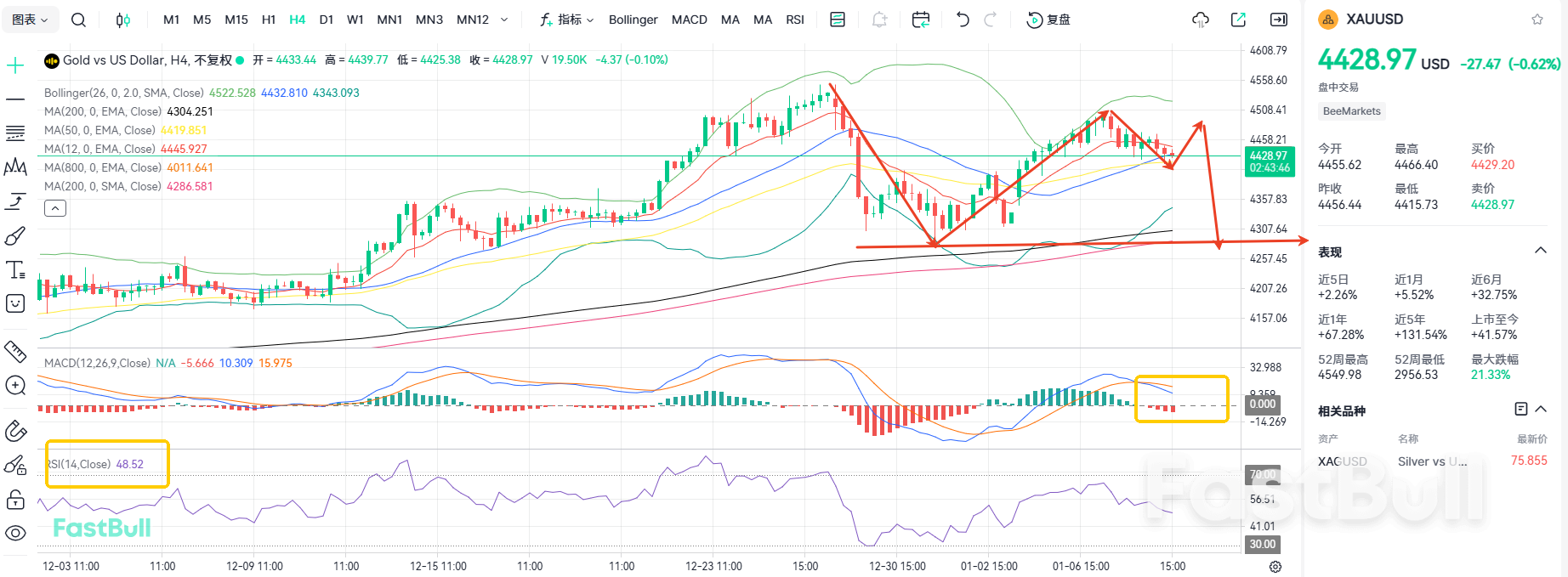
Gold, observed in the 4H timeframe, exhibits narrowing Bollinger Bands and a flat moving average, indicating a potential trend reversal. In the short term, price may challenge the 4485 and 4500 levels; failure to establish new highs suggests a probable decline towards the EMA200 around 4304. The MACD has formed a death cross, with its MACD line and signal line approaching the zero-axis, signaling that corrective consolidation is ongoing. The RSI stands at 48, reflecting a cautious market sentiment. In the 15-minute timeframe, the price oscillates along the middle Bollinger Band and the EMA12 downward, with the MACD forming a golden cross below zero, and its MACD line and signal line retreating towards the zero-axis but remain some distance away, implying that a rebound delay persists. Resistance levels are near the EMA200 and the upper Bollinger Band at approximately 4448. The RSI is at 40, indicating that market participants predominantly hold a bearish outlook. It is recommended to go short at the highs.
Trading Recommendations
Trading Direction: Sell
Entry Price: 4448
Target Price: 4100
Stop Loss: 4600
Support: 4200, 4100, 3800
Resistance: 4530, 4550, 5000


