Gold has done something remarkable over the past few sessions. A 6.5% rally is not routine. It is the kind of repricing that happens when a market-defining event lands with enough force to rearrange the entire macro landscape in hours. The US-Iran peace deal is that event. The stall at $4,300 is the market asking whether the event is actually what it appears to be.
Trump said the deal is signed and details may come before Friday. In normal diplomatic circumstances a signed agreement generates immediate sustained conviction. In the context of a conflict that has produced ceasefire extensions, contradictory statements, IRGC counterclaims, and US military strikes called self-defense over the past three months, the market has learned to treat announcements as the beginning of the verification process rather than the end of uncertainty. $4,300 is where the headline ends and the questions begin.
The Strait of Hormuz is the most important variable in that verification process. Three months of closure drove global inflation to levels that forced central banks worldwide to abandon easing cycles and pivot toward tightening. That inflationary pressure is embedded in every CPI reading, every producer price survey, and every central bank communication since March. If the deal delivers genuine Hormuz reopening, energy costs fall, inflation moderates, and the central banks that were forced hawkish by a supply shock they could not control suddenly have room to pause. That is the scenario gold's 6.5% rally was pricing. The stall reflects uncertainty about whether it is actually being delivered.
The nuclear dimension adds complexity. Reports suggest Iran's nuclear program was deferred to a later negotiating stage rather than resolved in the current agreement. Re-escalation risk has not been completely eliminated, and any investor who has watched this conflict produce surprise military strikes and vessel seizures is entitled to maintain skepticism about any arrangement that leaves the hardest question unanswered.
This week's central bank decisions are the secondary catalyst that matters. A Fed that signals comfort pausing given the prospect of reduced energy inflation would be genuinely bullish for gold. A Fed that maintains hawkish language pending Hormuz confirmation would cap gold near current levels. The monetary policy pivot that peace makes possible is the mechanism through which gold's traditional inflation hedge role gets restored, because the contradiction of the past three months, high inflation forcing rate hikes that suppressed gold, finally resolves in the metal's favor if rates stop rising.
Technical Analysis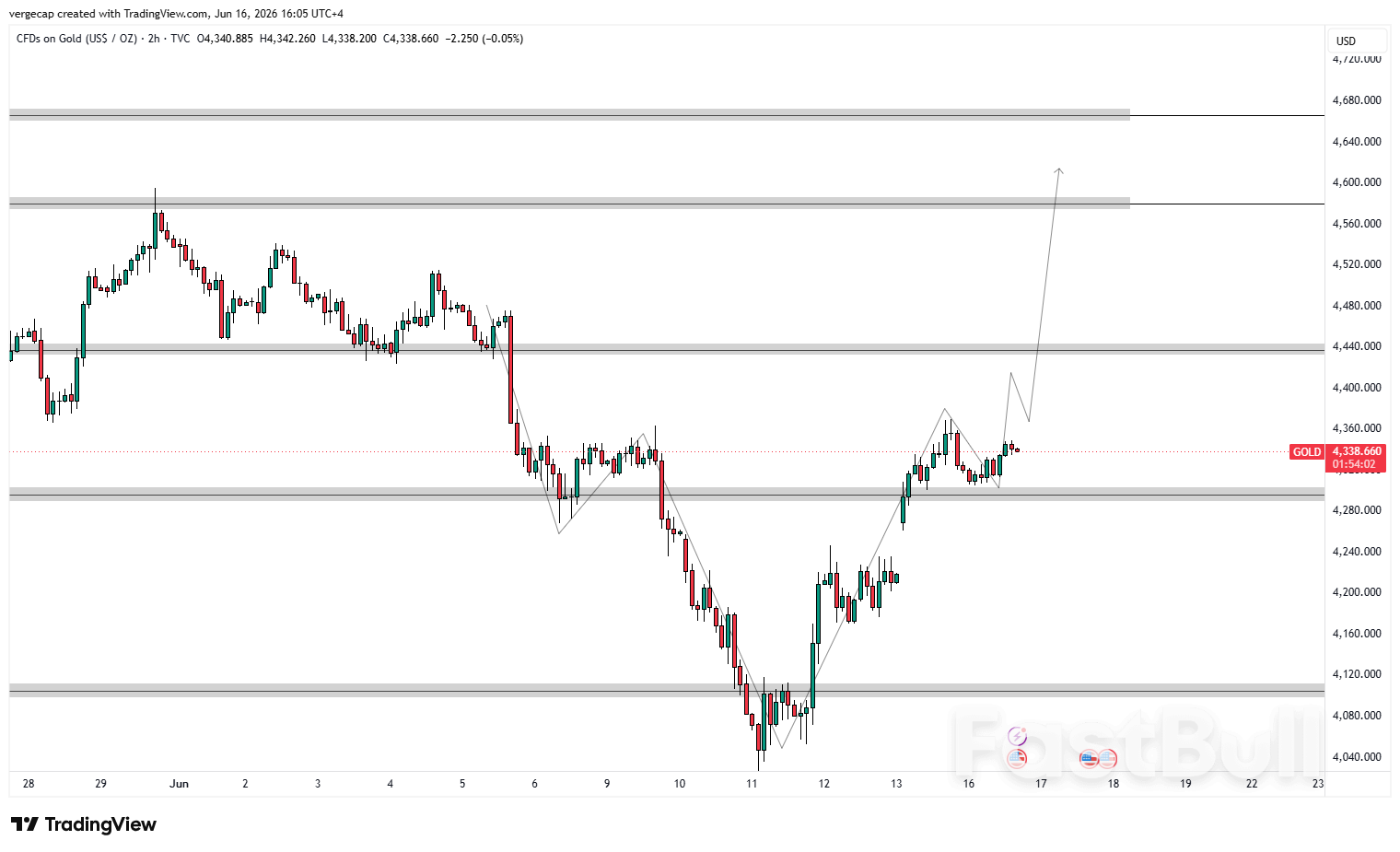
The gold chart over the past three weeks is one of the most dramatic price action sequences visible on any major asset right now, and understanding what it means for the immediate and medium-term outlook requires reading the full narrative rather than just the current candle.
Gold peaked near $4,580 to $4,600 in late May and early June before experiencing a sharp and aggressive decline that carried price all the way to the $4,060 to $4,080 lows by June 11, a drawdown of approximately $500 in less than a week. The velocity of that decline, visible in the consecutive large bearish candles between June 5 and June 11, was not a gradual correction. It was a capitulation move driven by macro repricing around central bank expectations and conflict de-escalation reducing the safe-haven premium that had built up in gold during the Hormuz closure. The June 11 lows near $4,060 to $4,080 represent a significant structural floor where buyers absorbed the entirety of that selling pressure and staged an equally aggressive recovery.
That recovery from $4,060 to the current $4,338 area has been the defining bullish event of the past week. Price moved approximately $280 in just a few sessions, with the most powerful single-candle move occurring on June 12 when the market repriced rapidly on peace deal confirmation news. The recovery has since entered a consolidation phase between the $4,300 to $4,310 support reference and the $4,360 to $4,380 resistance band overhead, and this consolidation is where the most important near-term technical decision is being made.
The dotted horizontal reference near $4,340 to $4,360 is the immediate battleground. Price has tested this zone from below multiple times across the past two sessions, producing modest recoveries that stall before clearing the level with conviction. A sustained 2-hour close above $4,360 would confirm that the consolidation is resolving in favor of the bulls and would trigger the next leg of the projected advance toward the $4,440 to $4,460 horizontal resistance band, which provided multiple support and resistance pivot points during the late May trading range.
The projected path on the chart extends beyond $4,440 toward the $4,580 to $4,600 major resistance zone, which represents the pre-decline highs and the most significant supply area on the visible chart. Reaching that target requires clearing $4,360 first, then $4,440 to $4,460, and sustaining momentum through each level. The step-pattern nature of the projected advance shown on the chart is realistic given the density of horizontal reference points overhead.
The $4,280 to $4,300 zone is the critical support floor for the current recovery structure. A sustained close below $4,280 would signal that the bounce from the $4,060 lows is failing and would risk a retest of the $4,120 to $4,140 area before any fresh bullish attempt becomes viable. The $4,060 lows are the absolute reference for the medium-term bullish thesis, and their breach would demand a complete reassessment of the peace deal repricing narrative.
TRADE RECOMMENDATION
BUY XAU/USD (GOLD)
ENTRY PRICE: $4,340
STOP LOSS: $4,200
TAKE PROFIT: $4,600


