Gold (XAU/USD) is demonstrating a characteristically resilient performance in European trade on Friday, clinging to an intraday advance as a cocktail of competing fundamental drivers—shifting risk sentiment, nuanced Federal Reserve policy expectations, and simmering geopolitical unease—creates a complex backdrop for the ultimate safe-haven asset. While the precious metal has yet to convincingly breach the psychologically significant $4,900 per ounce barrier, its ability to maintain a positive bias amidst mixed cues underscores the market's current search for stability.
The primary fuel for today’s bid appears to be a tangible, if not yet dramatic, deterioration in the global risk appetite. Equity markets, which had been buoyant for much of the week, are showing signs of fatigue and hesitation. This subtle but important turnaround is driving incremental but meaningful capital flows toward traditional harbors of safety. Gold, with its centuries-old legacy as a store of value outside the conventional financial system, is a direct beneficiary. This dynamic is a classic reminder that in times of uncertainty, even perceived or nascent uncertainty, liquidity seeks the bedrock of bullion.
Compounding this supportive environment is a fresh wave of weakness in the US Dollar. The Dollar Index (DXY) is edging lower, relinquishing some of its recent gains. Given that gold is predominantly priced in dollars, this depreciation reduces the cost of acquisition for holders of other currencies, broadening the pool of potential buyers and providing a tangible mechanical lift to XAU/USD. This dollar softness, however, exists within a broader and more consequential debate: the future path of US monetary policy.
Recent data points from the US labor market have introduced a nuanced wrinkle into the Federal Reserve narrative. Signs of emerging weakness, while not catastrophic, have bolstered market speculation that the central bank may need to enact a more aggressive easing cycle in 2026. For a non-yielding asset like gold, lower interest rates diminish the opportunity cost of holding it, making it more attractive relative to interest-bearing securities. This expectation is providing a fundamental tailwind beneath current prices.
Yet, hovering over all these financial calculations is the dense fog of geopolitics. The impending resumption of US-Iran nuclear talks looms large on the horizon, an event fraught with potential for both breakthrough and breakdown. The White House, in comments that perfectly encapsulate the current diplomatic tightrope, stated that diplomacy remains President Donald Trump's "first choice," while simultaneously and unequivocally warning that a full arsenal of military options remains "at his disposal." For gold markets, this is a potent formula. It injects a premium of risk into the equation—a premium that directly supports prices by reminding investors that the transition from tense negotiation to open conflict can be perilously swift.
However, it would be a mischaracterization to paint the outlook as unambiguously bullish. A significant countervailing force is capping unchecked optimism. The growing consensus on Wall Street is that Kevin Warsh, the incoming Federal Reserve Chair, will steer the committee toward a less dovish, potentially more hawkish, policy stance than his predecessor. Warsh’s historical writings and policy leanings suggest a heightened sensitivity to inflation risks and a potential reluctance to sustain the Fed’s balance sheet at its current bloated size. For gold, which thrives in environments of loose monetary policy and negative real yields, the prospect of a Warsh-led Fed introduces a formidable ceiling. This expectation is fostering a climate of caution among bullish traders, who are likely to hesitate before committing to significant new long positions at these elevated levels.
Technical Analysis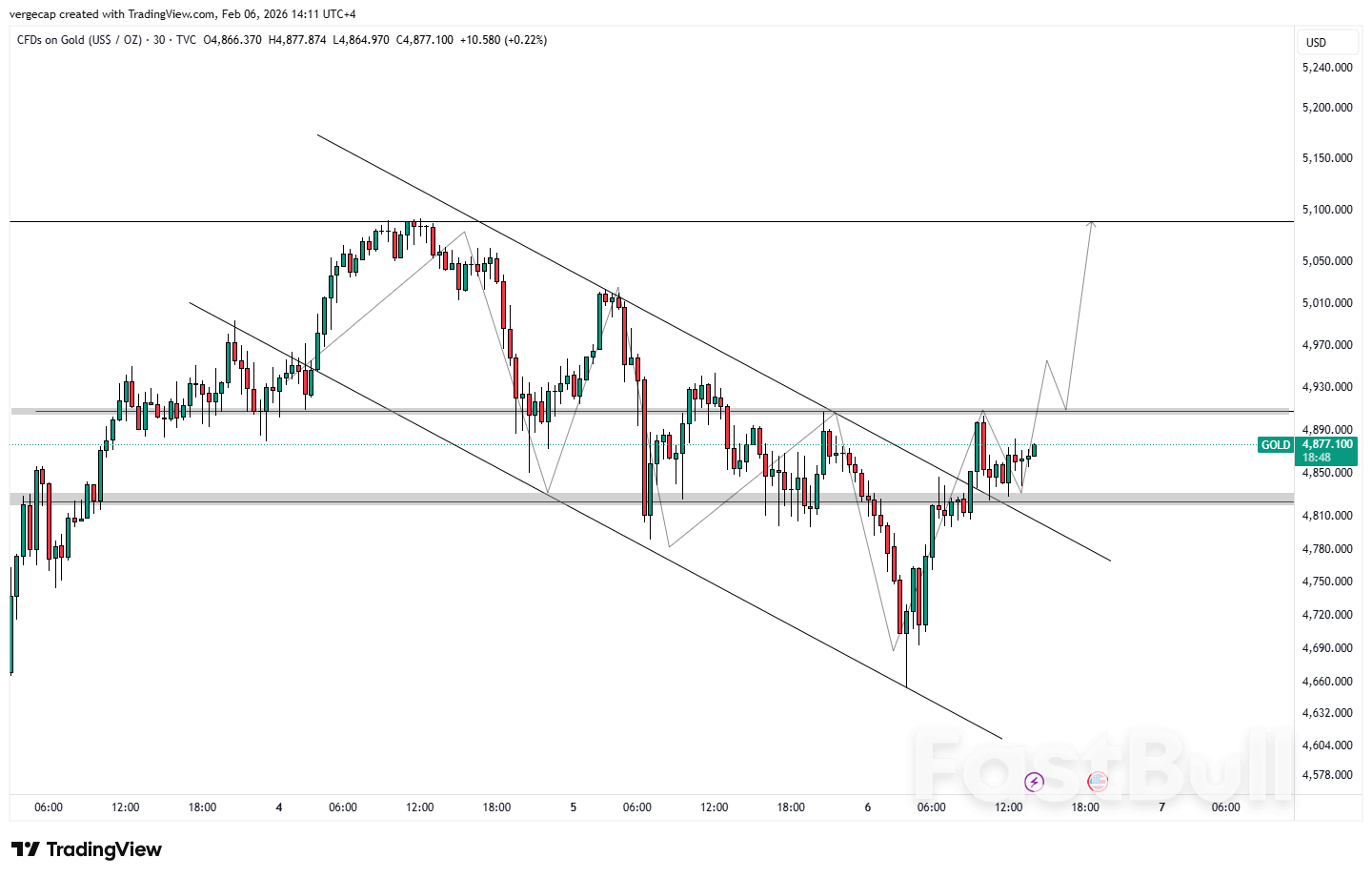
From a technical perspective, Gold (XAU/USD) is attempting to transition from a corrective downtrend into a potential bullish reversal structure. On the 30-minute chart, price action had been contained within a well-defined descending channel, characterized by lower highs and lower lows. However, recent price behavior shows bullion rebounding strongly from the lower boundary of that channel and now pressing against the upper trendline resistance, signaling that bearish momentum is beginning to fade.
Price is currently testing a key horizontal resistance zone around $4,900–$4,930, which has acted as both support and resistance multiple times during the recent consolidation phase. This area represents a pivotal inflection point. A sustained break and close above this region would effectively confirm a channel breakout, shifting the short-term structure from corrective to bullish and exposing higher resistance levels.
Below current price, immediate support is seen near $4,840–$4,850, aligning with the mid-range consolidation base and recent higher low. This level now serves as the first line of defense for bulls. A move back below this zone would suggest the breakout attempt has failed, potentially dragging price back toward the $4,780 region, which sits near the lower boundary of the descending channel. A deeper drop beneath $4,750 would invalidate the developing recovery structure and reassert broader bearish control.
On the upside, a confirmed break above $4,930 would open the path toward the $5,000 psychological level, a round-number barrier likely to attract both profit-taking and breakout momentum flows. Beyond that, the chart projection indicates scope for an extension toward the $5,080–$5,100 zone, where previous swing highs and projected resistance converge.
The recent sequence of higher lows following the sharp rebound suggests improving short-term momentum. Price compression beneath resistance, combined with fading downside follow-through, points to accumulation rather than distribution. This typically precedes a volatility expansion move, with the bias tilting upward if resistance gives way.
Overall, the technical setup favors a bullish breakout scenario, provided Gold secures a firm move above the $4,900–$4,930 barrier.
TRADE RECOMMENDATION
BUY GOLD
ENTRY PRICE: $4,775
STOP LOSS: $4,700
TAKE PROFIT: $5,050


