Fundamentals
Tensions in the Middle East persist as the U.S. and Iran reject mediation proposals from Oman and Egypt, maintaining entrenched positions in ceasefire negotiations. The U.S. military conducted strikes on military targets at Iran's oil export hub of Hormuz Island, with no damage reported to critical oil infrastructure. The strategic island handles approximately 90% of Iran's crude oil loading for export, and Iranian authorities have warned of retaliatory measures against U.S. and Israeli oil facilities in the region should such infrastructure face attacks. Concurrently, the U.S. Central Command has requested the Pentagon to deploy additional destroyers and Marine Corps assets to the Middle East. Sources indicate ongoing diplomatic efforts involving coordination with South Korea, Japan, and France for a joint naval escort program, though operational challenges remain significant with implementation continuing. In energy markets, the International Energy Agency announced a prioritization of initial surplus crude oil releases to Asian markets. Japan confirmed a March 16 release of 80 million barrels from strategic reserves—the largest since 1978—though logistical constraints will delay availability of such supplies to European and U.S. markets beyond late March. Against a backdrop of ongoing uncertainty regarding the reopening of crucial shipping lanes, the temporal disconnect between supply responses and immediate demand pressures has intensified market concerns about short-term supply disruptions, amplifying oil price volatility. On the financial front, as of March 13, holdings in the SPDR Gold Trust, the world's largest gold exchange-traded fund, stood at 1,071.56 tons, a 1.76-ton decline week-over-week, signaling cautious investor sentiment following recent highs in precious metal prices. The institutional commodities strategy head at Saxo Bank, Ole Hansen, remains optimistic about gold’s long-term upside potential. He highlighted that current conditions both intensify inflationary pressures and hamper economic growth. While prematurely asserting no rate cuts will occur by 2026—with Fed Chairmanship dynamics potentially influenced by Trump-related policy priorities—the central bank is evidently caught between conflicting policy objectives. Even if temporary pauses in central bank gold purchases materialize, structural concerns regarding expanding fiscal deficits, geopolitical risks, and fiat currency credibility will likely sustain gold’s appeal. FXTM’s senior market analyst Lukman Otunuga noted that gold’s pre-Fed meeting test of the US$5,000 per ounce support level aligns with market expectations. Near-term risks for the precious metal remain to the downside, as the market currently prices about 20% probability for a single 2026 rate cut against oil prices sustaining triple-digit levels. Short-term gold trends will remain sensitive to U.S. dollar strength, with the upcoming policy decision potentially offering clearer directional cues for multi-year positioning. While consensus anticipates policy rate preservation during this meeting, persistent energy costs could force reassessment of forward guidance. Hawkish clarification from policymakers might exert renewed downward pressure on gold prices.
According to macroeconomic indicators, the latest revised data from the U.S. Department of Commerce shows that the annualized rate of real GDP growth in the fourth quarter of last year was 0.7%, a sharp downward revision from the initial estimate of 1.4% — a decline that is nearly halved. This significant adjustment has drawn widespread attention in Wall Street, indicating weakening growth momentum as the U.S. economy approaches 2026. Meanwhile, the core PCE price index for January rose 3.1% year-over-year, registering the highest increase since March of last year; concurrent job vacancies expanded from 6.55 million in December to 6.95 million in January, offsetting a decline in layoff numbers. Collectively, these metrics portray a textbook stagflation scenario: decelerating growth paired with persistent inflationary pressures, which severely limits the Federal Reserve's policy flexibility and elevates economic uncertainty and complexity in outlook. In regard to Federal Reserve policy expectations, prolonged high oil prices have amplified upward inflationary pressures, diminishing market anticipations of rate cuts. Analysis indicates rising energy costs are intensifying stagflation risks for the U.S. economy, while the coexistence of a weakening labor market and persistent inflation complicates macroprudential management. A growing contingent of investors suggests the Fed may sustain current interest rates over an extended timeframe, with rate easing likely delayed beyond current forecasts. Concurrently, Sino-American economic and trade teams initiated pivotal talks in Paris under the backdrop of the U.S. 301 investigation targeting China. Discussions focused on agricultural products, critical minerals, and trade administration frameworks, according to official notices describing the dialogue as "open and constructive." Chinese representatives emphasized unwavering defense of national rights and interests, along with rejection of unilateralist and protectionist policies. Global markets urgently scrutinize the implications of these negotiations, perceiving them as foundational groundwork preceding the U.S. leadership's planned mid-March visit to China. The proceedings will likely shape the immediate trajectory of U.S.-China economic relations, which remain at a critical juncture between "frozen détente" and escalation.
Technical Analysis
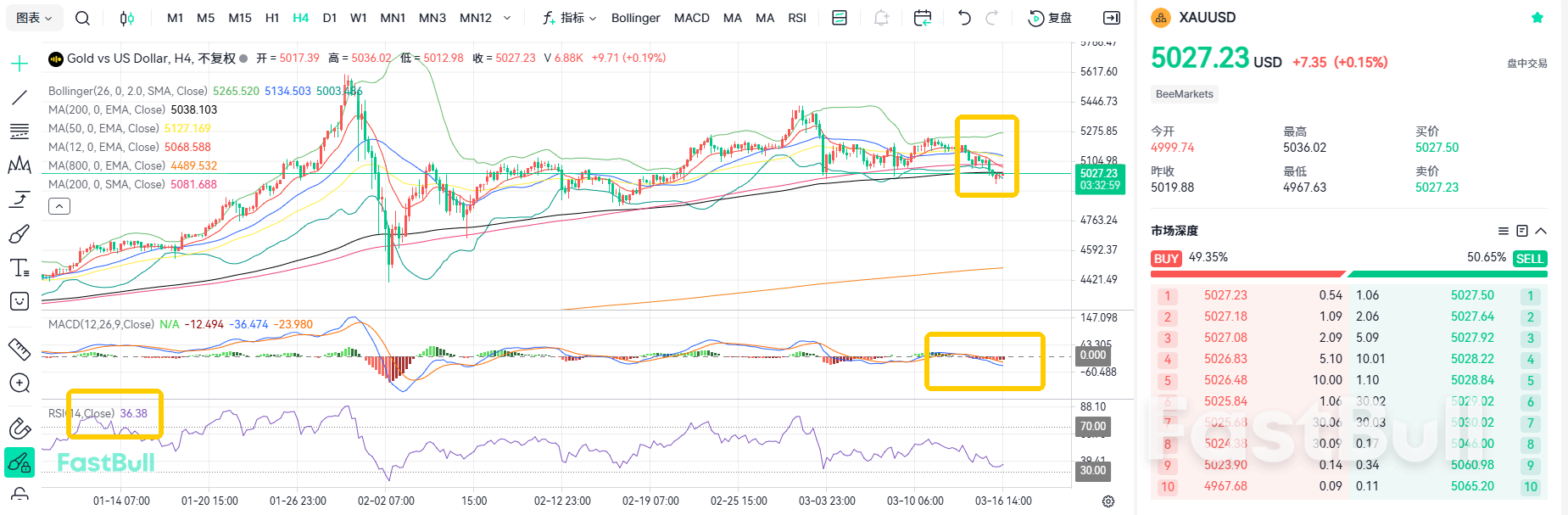
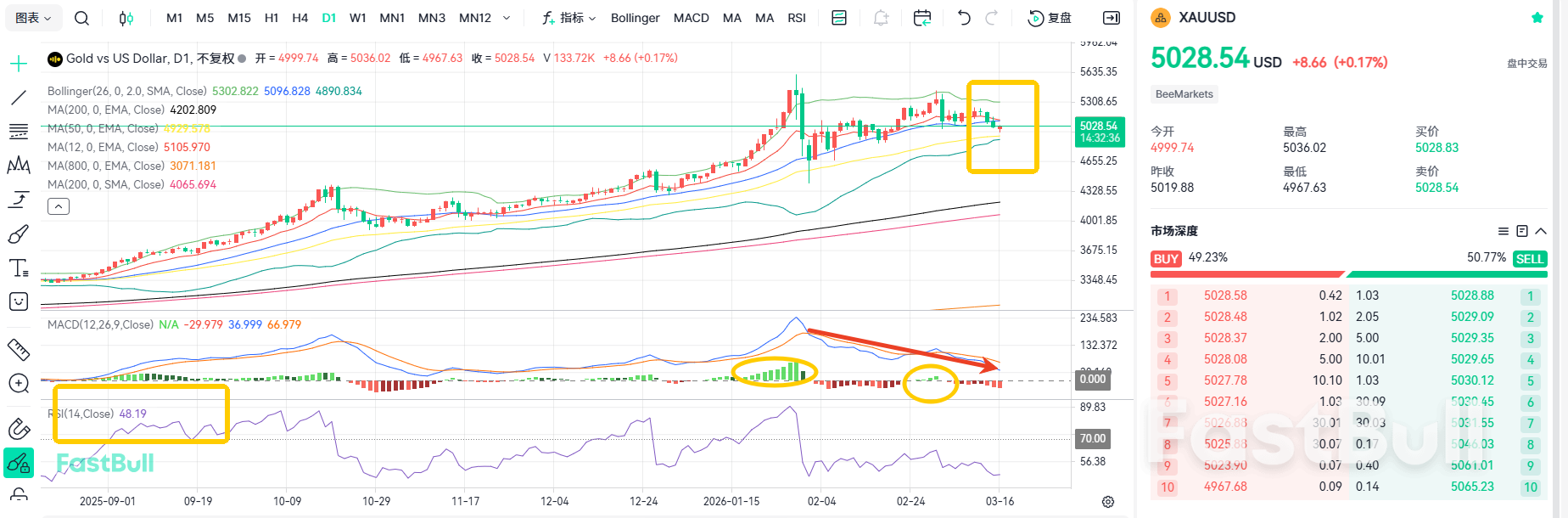
In the 4H timeframe, the Bollinger Bands are widening in a downward direction, with moving averages indicating a bearish divergence as the market remains in a declining phase. Price action is currently oscillating between the EMA12 and the Bollinger lower band: failure to sustain above 5000 could drive the price toward 4900, while holding above 5000 may create opportunities to test 5500 and 5600 resistance levels. The MACD has established a death cross with both the MACD line and signal line returning below the zero line, while RSI stands at 36, confirming a dominant bearish bias with decisive selling pressure. In the 1D timeframe, a candlestick pattern with a strong upper shadow shows price encountering resistance at the Bollinger upper band. This is followed by a large bearish candle closing below the EMA12 and Bollinger middle band, suggesting the consolidation phase is incomplete. MACD again signals a death cross, with upward momentum dissipating in a potential top divergence formation. The RSI at 48 indicates a shift in market sentiment from neutral to bearish. The strategy prioritizes taking short positions as prices rise.
Trading Recommendations
Trading Direction: Sell
Entry Price: 5050
Target Price: 4300
Stop Loss: 5500
Support: 4500, 4300, 4100
Resistance: 5400, 5500, 5600


