Fundamentals
The U.S. Department of Labor reported that initial jobless claims fell to 227,000 for the week ending February 7th. This figure surpassed the initial estimate of 222,000 but fell short of the revised 232,000 claims from the previous week. Furthermore, continuing claims rose to 1.862 million for the week ending January 31st, underscoring persistent labor market weakness observed over the past year. This data has bolstered the U.S. dollar and stimulated demand for gold. A shift in global risk sentiment, evidenced by a general downturn in equity markets, has also contributed to a flight towards gold as a safe-haven asset. However, it remains uncertain whether the XAUUSD can sustain its upward momentum, or if bullish investors will await the crucial U.S. Consumer Price Index (CPI) report before initiating new positions. Holdings in the SPDR Gold Trust, the world's largest gold ETF, decreased by 5.14 tons from the previous trading day to 1076.18 tons. This indicates that some medium-to-long-term investors are reducing their positions ahead of inflation data, suggesting cautious short-term sentiment. From a technical and trading behavior perspective, recent volatility in the gold market, coupled with a lack of incremental buying pressure at key levels, has led to a technical negative feedback loop after prices breached important psychological thresholds, amplifying downward movement. Geopolitically, U.S. President Trump publicly stated that the U.S. "must" reach an agreement with Iran on the nuclear issue, or the situation would become "very serious." He clarified that Israeli Prime Minister Netanyahu did not request a suspension of related negotiations, nor were discussions held on this matter. Trump further emphasized that if Iran refuses to reach an agreement, "it will be a different situation," warning that events could rapidly unfold within the next month. Israeli Prime Minister Netanyahu expressed optimism that Trump could reach a "good deal" with Iran. These statements reflect a U.S. policy balancing strategic withdrawal from the Middle East with nuclear non-proliferation efforts. Geopolitical uncertainties persist, providing a logical basis for continued safe-haven demand.
U.S. Treasury Secretary Bessent reached a critical compromise with Senate Republicans during a closed-door session regarding the investigative parameters for Federal Reserve Chair Powell. He agreed that the Senate Banking Committee, rather than the Department of Justice, would assume oversight of the inquiry. This ostensibly technical transfer of jurisdiction represents a calculated political concession by the Trump administration, designed to smooth the path for the new Fed Chair nominee. Essentially, it's a quid pro quo, exchanging a procedural maneuver for tacit approval of the investigation's continuation, substituting internal institutional processes for external judicial pressure. This reflects a highly intricate phase of negotiation and probing in the ongoing power struggle over the Federal Reserve's independence. Although public statements indicate a softening stance, a definitive resolution to the deadlock remains multifaceted. Regardless of the ultimate outcome, this political transaction concerning investigative jurisdiction has established a new benchmark for the pattern of political pressure the Federal Reserve may face in the future. Its institutional legacy will continue to shape the fundamental ecosystem of U.S. monetary policy decision-making long after Powell's departure and the installation of his successor. The U.S. housing market exhibits more pronounced weakness. Existing home sales experienced a substantial decline in January, marking the largest monthly drop in nearly four years, primarily attributed to elevated mortgage rates and adverse winter weather conditions. Despite improvements in housing affordability metrics, with wage growth outpacing home price appreciation, persistent shortages in entry-level housing inventory and elevated borrowing costs continue to constrain the market. Economists generally anticipate that the short-term weakness in the housing sector may be partly transient. However, as the Federal Reserve's room for interest rate cuts narrows, the risk of financing costs trending upward again remains, potentially exerting continued pressure on existing home sales later in the year.
Technical Analysis
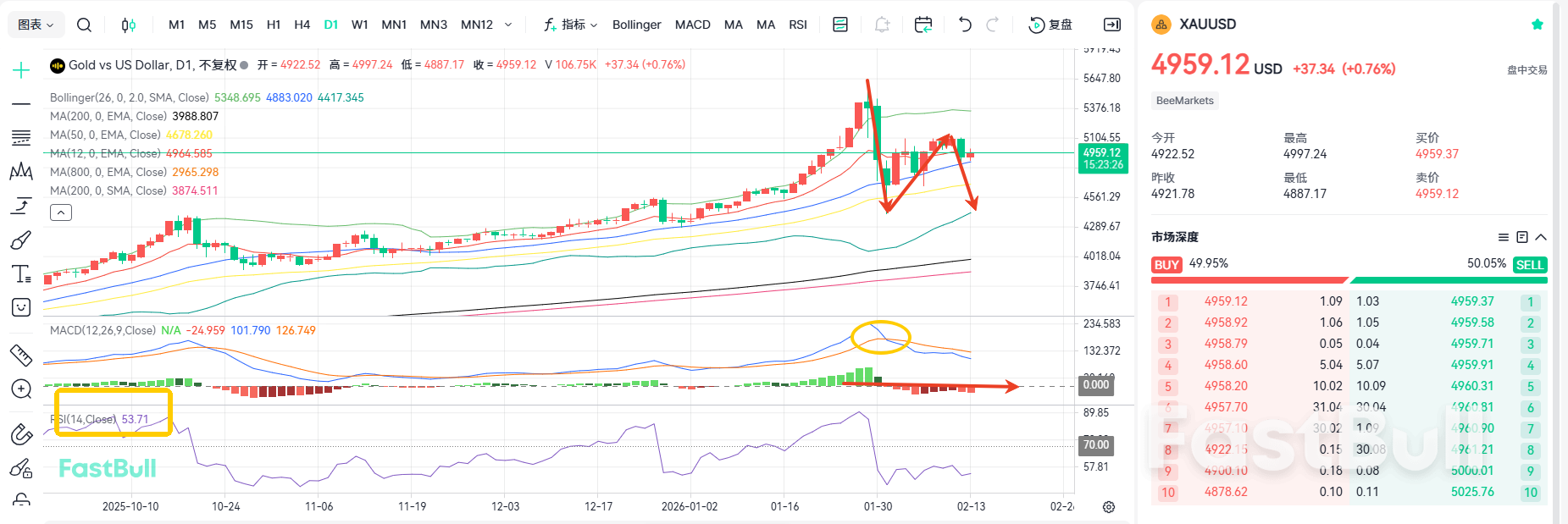
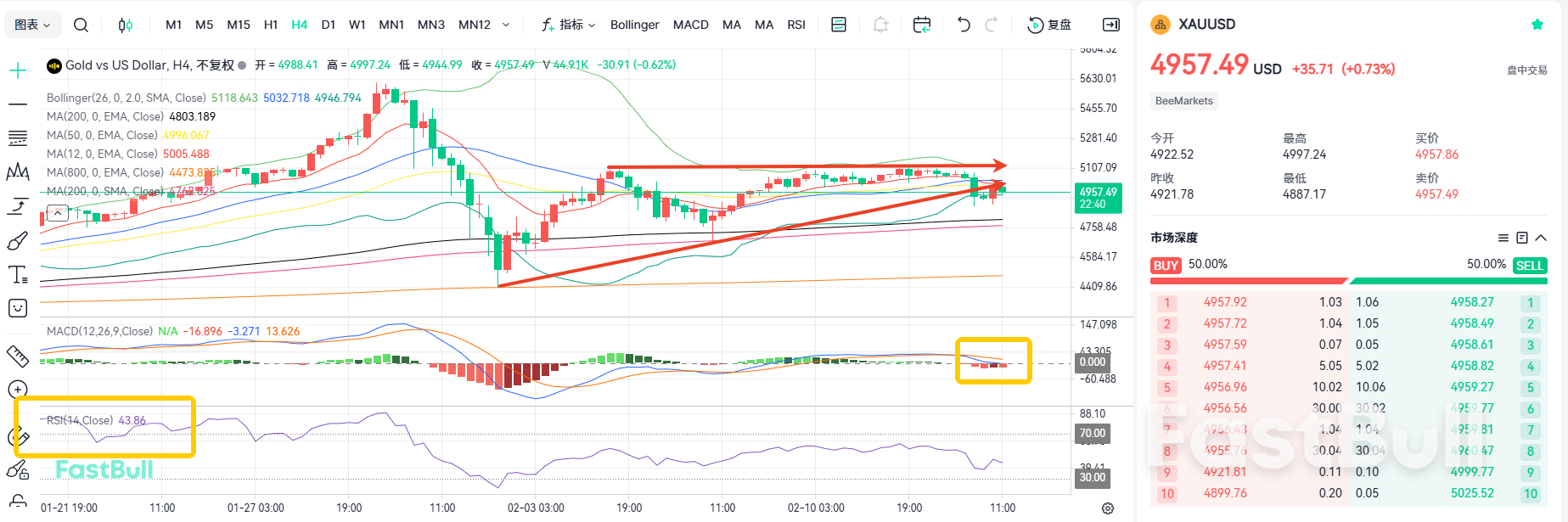
In the 4H timeframe, gold is once again facing resistance at the middle Bollinger Band, signaling a return to bearish territory. It's highly probable that the price will decline towards the EMA200 and the previous low, with target levels identified at 4803 and 4655, respectively. Following a MACD death cross, the MACD line and signal line are converging near the zero line, indicating a potential shift in momentum. The RSI reading of 43 suggests a predominantly sell-oriented sentiment among market participants. In the 1D timeframe, the Bollinger Bands are constricting, and the moving averages are flattening. After the formation of a bearish evening star pattern, the price has continued to decline with significant bearish candles, implying that the short-term downtrend is not yet complete and current movements may be corrective bounces. The MACD has formed a death cross at the highs, with the MACD line and signal line converging towards the zero line. Given the current distance, this suggests the downward trend is ongoing. Key support levels are situated at 4100 and 3900. The RSI at 53 indicates a prevailing optimistic sentiment in the market. Our trading strategy recommends a short position initially, followed by a long position.
 Trading Recommendations
Trading Direction: Sell
Entry Price: 4975
Target Price: 4300
Stop Loss: 5100
Support: 4500, 4200, 4100
Resistance: 5000, 5100, 5200


