The unthinkable has happened. Gold, the millennia-old store of value that was supposed to shine brightest during geopolitical catastrophe, has been utterly defeated by the very chaos it traditionally thrives upon. The precious metal slumped for a fourth consecutive session on Monday, breaching the critical psychological barrier of $5,000 per troy ounce to trade at $4,995.21 during the European morning. It is a stunning reversal of fortune for a market that began the year with record-breaking momentum, now caught in the perfect crossfire of war-induced inflation and an increasingly cornered Federal Reserve .
The narrative driving markets this quarter has been violently rewritten. While missiles fly over the Middle East and the Strait of Hormuz sits eerily silent, the "safe-haven" trade has been supplanted by a singular, ugly reality: the return of 1970s-style stagflation fears. The non-yielding metal is being crushed under the weight of soaring energy costs, which have effectively slammed the door shut on hopes for imminent US interest rate cuts .
The immediate catalyst for the selloff is the escalating US-Israeli campaign against Iran. Over the weekend, strikes targeted Iran’s primary oil export hub on Kharg Island. Although former President Donald Trump attempted to downplay the damage to oil infrastructure, the retaliatory response from Tehran was swift and severe, striking targets in Israel and energy assets across the Arabian Peninsula. With the conflict now entering its third week and no diplomatic off-ramp in sight, global financial markets are bracing for a prolonged siege .
Yet, paradoxically, it is the remedy for this conflict—rather than the conflict itself—that is strangling gold. Brent crude remains stubbornly anchored above $100 a barrel, a level that injects inflationary adrenaline directly into the veins of the global economy. This has forced a radical repricing of central bank policy. Just a month ago, markets were pricing in multiple rate cuts from the Fed. Today, as we head into the Federal Open Market Committee (FOMC) meeting on Wednesday, the CME FedWatch tool shows virtually zero probability of a move. Traders now fear that policymakers in Washington will be forced to maintain a hawkish stance, keeping real yields elevated to combat the energy-driven price shock .
Gold is being overshadowed by a stronger USD, rising yields, and the uncertainty surrounding Federal Reserve policy. They added that a vicious cycle of liquidation is also underway, with traders selling bullion to meet margin calls in other asset classes battered by the volatility .
The market dynamics on Monday illustrated the tug-of-war sentiment. After dipping below $5,000, the metal saw a slight technical recovery, paring some losses as the US dollar index softened slightly. A weaker dollar typically provides a bid for commodities priced in the greenback, and OCBC strategist Christopher Wong suggested that near-term price action would likely remain "choppy" as markets attempt to reassess the trajectory of real yields against a backdrop of escalating military risks .
But any relief may be short-lived. While headlines of war usually send investors fleeing into gold, the current calculus is different. The market is staring at the "Strait of Hormuz" dilemma. With 20% of the world's oil supply passing through this chokepoint, now effectively closed, the inflationary impulse is immediate and violent. This dynamic forces the Fed’s hand, making yield-bearing assets like US Treasuries more attractive than gold .
Adding to the volatility are mixed political signals. There are reports that the Trump administration is negotiating with seven nations—including the UK, France, China, and Japan—to form a naval coalition to secure the Strait of Hormuz and guarantee the flow of oil. Such a move could theoretically deflate the energy risk premium. However, Trump himself threatened further strikes on Kharg Island over the weekend, stating he was "not ready" to cut a deal. Meanwhile, US Energy Secretary Chris Wright attempted to calm markets with a prediction that the conflict would end within "the next few weeks," though such forecasts have been met with skepticism given Tehran's insistence that it has not requested a ceasefire .
The broader metals complex reflected the uncertainty. Spot silver suffered heavy losses, dropping over 2% in volatile trade, while platinum managed a modest gain .
Looking ahead, the path of least resistance for gold appears lower in the immediate term. The $5,000 level, once seen as a launchpad to record highs, is now acting as resistance. Traders will be glued to the Fed's "dot plot" and Chair Jerome Powell's press conference on Wednesday. Any signal that the Fed is willing to look through this energy spike would be a boon for gold. However, if the central bank emphasizes the need to quash inflation at all costs—even at the risk of slowing growth—bullion could be heading for a test of the $4,950 support level in the sessions ahead .
Technical Analysis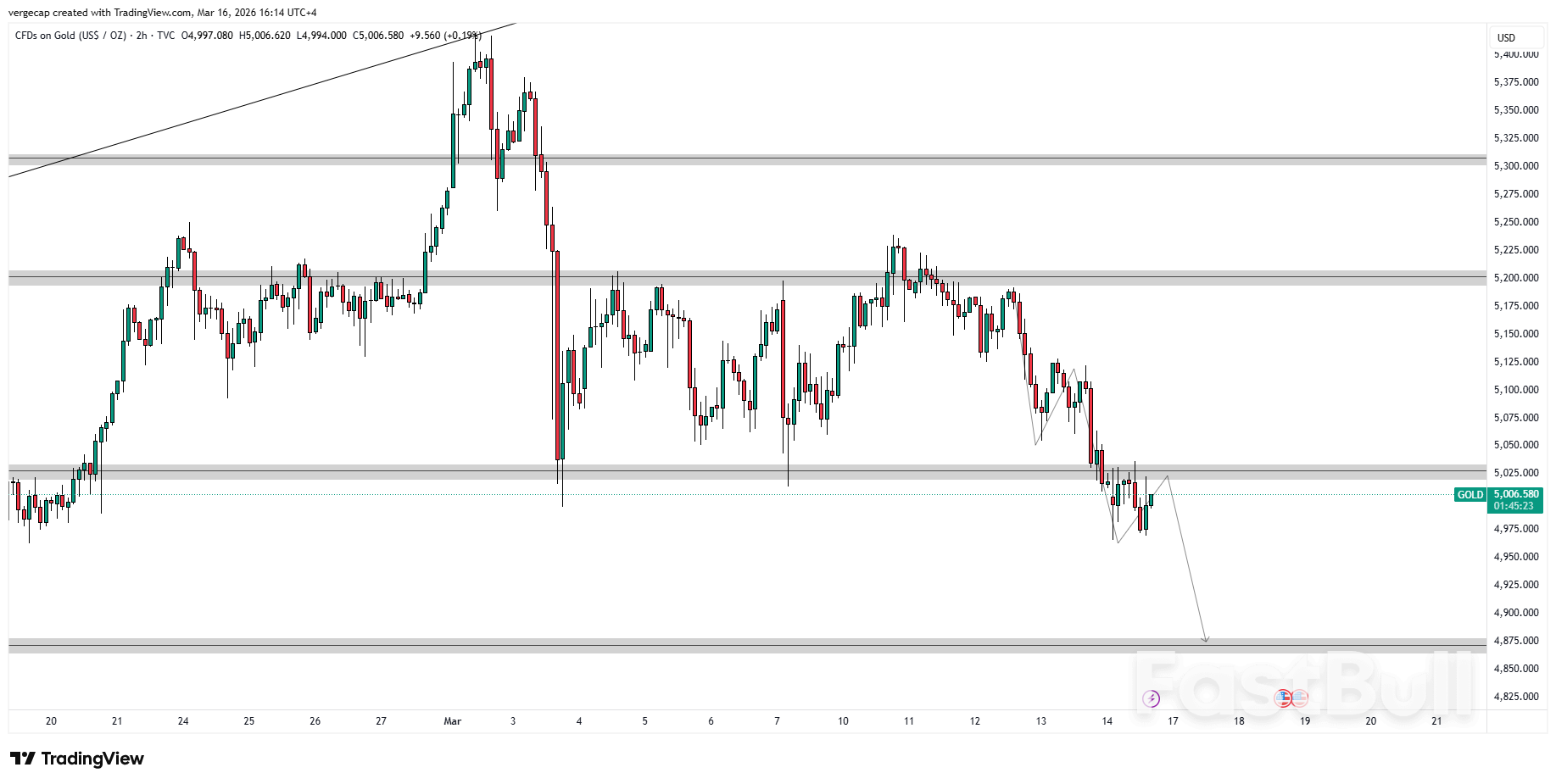
From a technical perspective, gold remains entrenched in a well-defined bearish structure. On the 2-hour chart, prices continue to form a sequence of lower highs and lower lows, reflecting persistent selling pressure following the sharp rejection from the $5,380–$5,400 resistance region earlier in March. That rejection marked a decisive shift in momentum, triggering an aggressive downside move that has since defined the prevailing trend.
Currently, gold is trading near the $5,006 level, hovering around a key horizontal support zone near $5,020 that has historically acted as an important demand area. However, recent price action suggests that this support is under significant pressure, with multiple attempts to stabilize being met with continued selling interest. The inability of buyers to generate a meaningful rebound from this level indicates that the market remains vulnerable to further downside.
The $5,020 region now represents a critical technical pivot. A decisive break below this support, particularly if accompanied by sustained trading beneath the psychological $5,000 level, would mark a notable deterioration in the short-term market structure and likely accelerate bearish momentum. Such a move would confirm a continuation of the broader downward trend and expose the $4,880–$4,900 support zone, which represents the next major demand area visible on the chart.
This region is particularly significant as it previously served as a structural base during earlier consolidation phases, making it a logical downside target if bearish momentum persists. A sustained break below that area would signal a deeper correction within the broader trend and could open the door for an extended move toward the $4,850 handle.
On the upside, bullish traders would first need to reclaim the $5,080–$5,100 region, which previously acted as support but has now transitioned into near-term resistance following the recent breakdown. A sustained move above this zone could allow gold to stage a corrective rebound toward the $5,200 resistance area, where the market previously encountered repeated supply pressure. However, unless price can reclaim and hold above these levels, rallies are likely to be viewed as temporary retracements within the prevailing bearish trend.
Price behavior currently suggests corrective consolidation rather than trend reversal. The recent bounce from the $4,970–$4,980 region appears limited in scope, with the market struggling to regain upside traction. As long as gold remains capped below the $5,080–$5,100 resistance corridor, sellers are likely to maintain control of the broader structure.
Overall, the technical outlook continues to favor bearish continuation, with the market likely to extend losses if the key $5,020 support level fails to hold and downside momentum accelerates.
TRADE RECOMMENDATION
SELL GOLD
ENTRY PRICE: 5,020
STOP LOSS: 5,120
TAKE PROFIT: 4,880


