Gold is holding near $4,700 on Thursday — but holding is not the same as recovering, and the distinction has never mattered more. XAU/USD is under sustained pressure from three directions simultaneously, and the metal's resilience near current levels feels less like genuine strength and more like the calm before a breakdown that the fundamental environment is actively building toward.
The Dollar is surging, posting fresh weekly highs near 98.70 on the Dollar Index — and a stronger Dollar mechanically pressures dollar-denominated gold by raising the effective purchase cost for international buyers. The Dollar's strength is not merely technical. It is fundamentally driven by a Federal Reserve that has been forced off its rate-cutting trajectory by the same geopolitical crisis that should theoretically be lifting gold's safe-haven appeal.
That is the paradox crushing gold right now. The Strait of Hormuz closure is driving WTI crude toward $95.80 — three consecutive days of gains — which is generating inflationary pressure that is keeping the Fed firmly on hold. The CME FedWatch tool shows a 76.8% probability of rates staying in the 3.50%–3.75% range through December. Rate cut expectations — one of gold's most powerful fundamental supports — have been effectively eliminated for 2026.
A Fed on hold means real rates stay high. High real rates mean the opportunity cost of holding non-yielding gold remains elevated. And elevated opportunity costs mean institutional capital stays in Treasuries and money markets rather than rotating into the metal. The geopolitical crisis that generates gold's safe-haven demand is simultaneously generating the monetary policy environment that undermines it. That contradiction explains everything about gold's rangebound, pressured price action this week.
Technical Analysis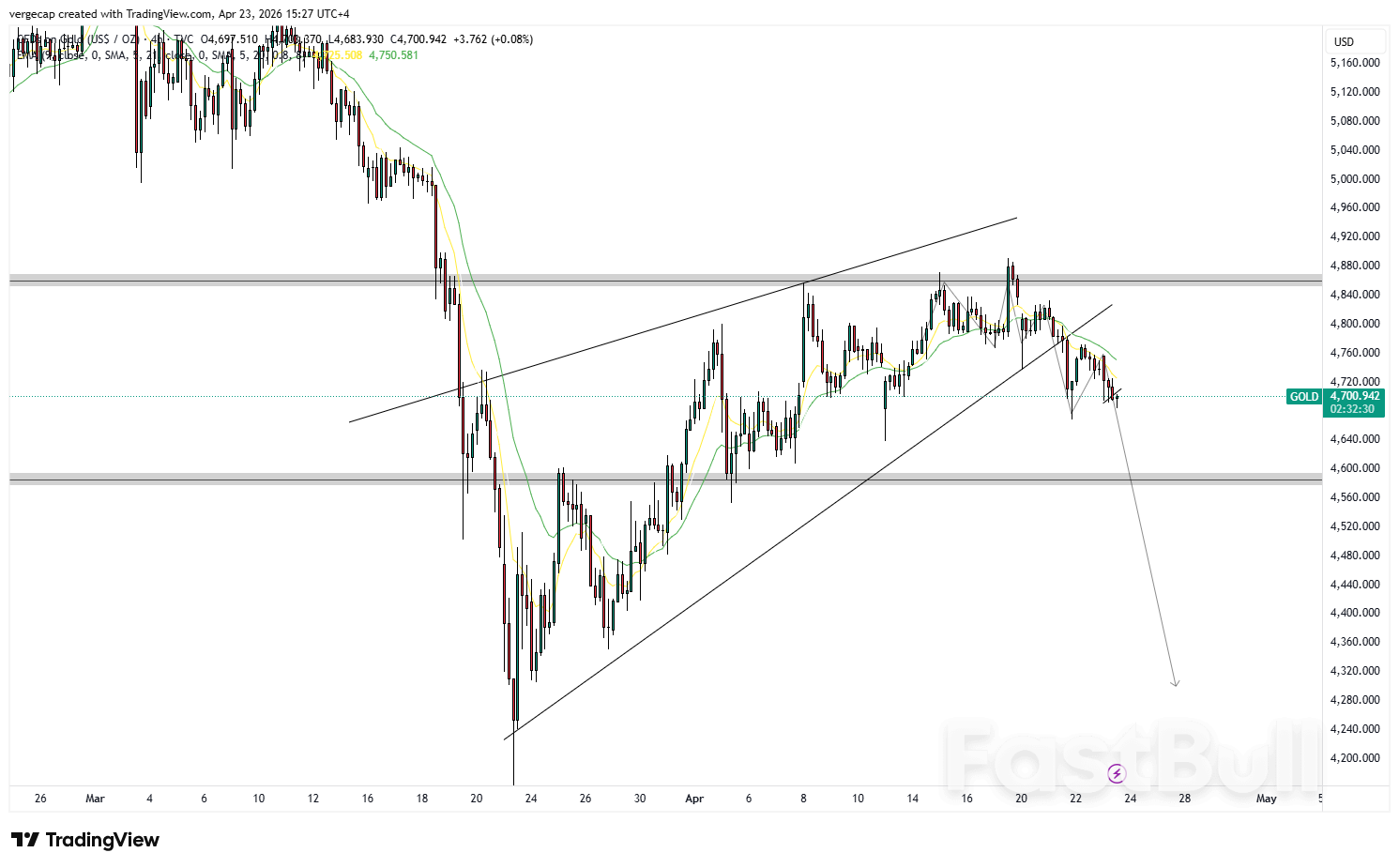
From a technical perspective, Gold has undergone a decisive and structurally significant breakdown on the 4-hour chart, with price violating the lower boundary of the ascending channel that had guided the recovery from the late March lows near $4,200. The breakdown is confirmed, clean, and accompanied by large bearish candle bodies that signal genuine institutional conviction rather than routine technical noise. Price currently trades at $4,700.942, and the projected path on the chart is unambiguous in its bearish implications.
The ascending channel that defined Gold's recovery from the March 19–20 lows was one of the more orderly and well-respected bullish structures on the 4-hour timeframe — consistently validated on both boundaries and producing multiple reliable bounce points from the lower trendline support. The channel guided price from the $4,200 region all the way to the $4,880 major resistance ceiling — a recovery of nearly $680 — before exhaustion set in. The failure to sustain above $4,880 across multiple attempts in mid-to-late April was the first structural warning. The subsequent break of the channel's lower boundary is the confirmation that the recovery has run its course.
The 9-period EMA at $4,755.508 and the 21-period SMA at $4,750.581 have both flipped above current price and are converging as overhead resistance — a classic bearish inversion from the supportive alignment that characterised the rally phase. This configuration, where price trades beneath both declining moving averages following a channel breakdown, is one of the most reliable continuation signals on an intraday chart. Each attempted recovery toward the $4,720–$4,730 area that fails to reclaim the moving averages should be treated as a shorting opportunity rather than a reversal signal.
The $4,700 psychological level — currently the most watched reference on this chart — is the immediate battleground. Price is pressing against this level with a persistence that reflects both the significance of the round number as a psychological support and the genuine selling pressure that has been building since the channel breakdown. A sustained 4-hour close below $4,700 would be the technical confirmation that bears are firmly in control and would trigger the next leg lower toward the $4,600 major horizontal support band — a prominent gray zone visible on the chart that arrested the mid-March decline and represents the most substantial structural support below current price.
The $4,600 level is not merely a technical reference — it is the line whose breach would signal a genuinely serious trend deterioration and validate the full measured move projection visible on the chart, which extends the breakdown toward the $4,300–$4,320 area. That target represents a complete retracement of the channel advance and aligns with the significant price activity recorded in the week of March 19–24 that formed the base of the recovery. The projected path drawn on the chart points precisely toward this zone, and given the fundamental headwinds — a surging Dollar, eliminated rate cut expectations, and oil-driven inflation cementing the higher-for-longer narrative — the move is both technically justified and fundamentally supported.
On the upside, the broken channel floor — now resistance near $4,760–$4,780 — combined with the converging moving averages creates a formidable overhead supply zone. A recovery above $4,800 on a closing basis would be the minimum technical requirement to suggest the bearish thesis is losing momentum. The $4,880 major resistance ceiling would need to be reclaimed convincingly to neutralise the breakdown entirely — a scenario that requires a fundamental catalyst of sufficient magnitude to reverse the current Dollar and rate expectations dynamic.
TRADE RECOMMENDATION
SELL XAU/USD (GOLD)
ENTRY PRICE: $4,720
STOP LOSS: $4,800
TAKE PROFIT: $4,320


