The British Pound remained under heavy pressure against the US Dollar on Thursday, with GBP/USD extending losses for a third consecutive session as investors reacted to escalating political uncertainty in the United Kingdom and growing expectations that the Federal Reserve may maintain restrictive monetary policy for longer than previously anticipated.
The pair traded near 1.3482 during the European and North American sessions, down roughly 0.30% on the day, as Sterling struggled to recover from a wave of selling pressure triggered by both domestic political concerns and broad-based US Dollar strength.
Market sentiment toward the Pound deteriorated sharply following renewed speculation surrounding the future of UK Prime Minister Keir Starmer after the Labour Party’s disappointing performance in recent local elections. Political tensions intensified further after UK Health Secretary Wes Streeting unexpectedly resigned from the government on Thursday, fueling speculation over a potential leadership challenge within Labour ranks.
Streeting had increasingly been viewed by political observers and investors as one of the strongest candidates to eventually replace Starmer. His departure has amplified concerns about political fragmentation within the ruling party at a time when markets are already closely monitoring the UK’s fiscal outlook and economic stability.
Prime Minister Starmer attempted to calm concerns by rejecting calls to step aside, insisting that his administration remains committed to a long-term agenda. “We can’t let a leadership contest plunge us into chaos,” Starmer told ministers, describing his government as a “10-year project.” Despite those comments, investors remain cautious that an internal power struggle could weaken policy coordination and complicate fiscal management at a delicate moment for the British economy.
In my view, the political uncertainty now emerging in the UK is becoming a significant headwind for Sterling. Currency markets are increasingly sensitive to signs of fiscal instability, particularly after the sharp volatility seen in UK assets during previous periods of political turmoil. Investors appear concerned that prolonged leadership uncertainty could undermine confidence in the government’s ability to manage rising borrowing costs and slowing economic momentum.
Those concerns have already been reflected in the UK bond market. Long-dated gilt yields surged earlier this week to levels not seen in decades as investors demanded higher premiums for holding British government debt. The 30-year gilt yield briefly climbed toward 5.8%, its highest level since 1998, while the benchmark 10-year yield rose above 5.1%, reaching levels last seen during the global financial crisis in 2008.
Although yields eased slightly on Thursday, partly because some investors viewed Streeting as one of the more fiscally disciplined figures within Labour, the broader market tone remains fragile. Elevated borrowing costs continue to raise concerns about the sustainability of the UK’s fiscal position, especially if political uncertainty intensifies further.
At the same time, external factors continue to favor the US Dollar. Ongoing geopolitical tensions in the Middle East and stalled negotiations between the United States and Iran have reinforced demand for safe-haven assets, boosting the Greenback across major currency pairs. The US Dollar Index climbed toward 98.73, its highest level in roughly two weeks, reflecting renewed investor demand for the currency.
Rising Oil prices linked to disruptions in the Middle East are also fueling global inflation concerns. Higher energy costs continue to complicate the outlook for central banks worldwide, with traders increasingly expecting policymakers to keep interest rates elevated to prevent inflation from becoming entrenched.
In the United Kingdom, markets are currently pricing in at least two additional Bank of England rate hikes before year-end. However, the deteriorating political backdrop could make the central bank’s policy path significantly more complicated if financial market stress intensifies.
Meanwhile, recent US economic data has further reinforced the Dollar’s bullish momentum. US Retail Sales rose 0.5% month-on-month in April, matching market forecasts, while the closely watched Retail Sales Control Group — which feeds directly into GDP calculations — also increased 0.5%. Although consumer spending growth slowed from March’s stronger reading, the data still pointed to a resilient US economy capable of withstanding elevated borrowing costs.
The latest inflation figures from the United States also underscored the impact of rising energy prices on broader consumer costs, strengthening expectations that the Federal Reserve may need to maintain a hawkish stance for longer. Traders are increasingly considering the possibility of another Fed rate hike before the end of the year, a sharp shift from earlier expectations for monetary easing.
For now, the combination of political instability in the UK, rising gilt yields, resilient US economic data, and growing Fed hawkishness continues to tilt momentum firmly in favor of the US Dollar, leaving Sterling vulnerable to further downside pressure in the near term.
Technical Analysis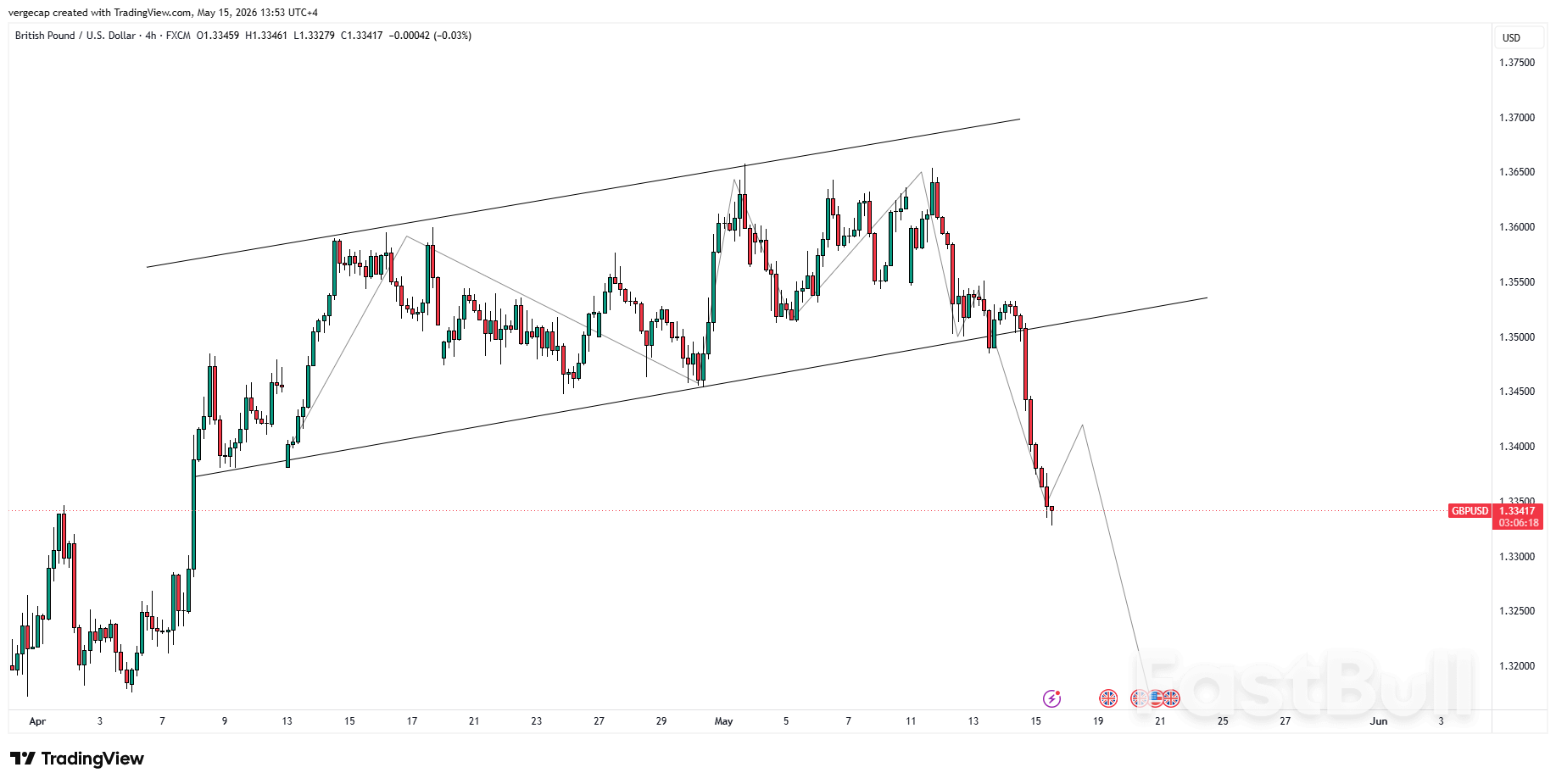
From a technical perspective, GBP/USD has shifted decisively into a bearish structure after breaking down from a well-defined ascending channel that had supported the broader uptrend since early April. On the 4-hour chart, the pair sliced aggressively below the lower boundary of the channel near the 1.3510–1.3500 region, confirming a bearish breakout and signaling a notable deterioration in short-term market structure.
The sharp rejection from the 1.3640–1.3650 area formed a lower high near the upper boundary of the channel, highlighting fading bullish momentum and increasing selling pressure. Since then, Cable has posted a sequence of strong bearish candles, accelerating losses toward the 1.3340 region. The breakdown below former channel support suggests that what had previously acted as a dynamic buying zone has now turned into immediate resistance.
Price action also confirms the emergence of a bearish continuation pattern, with sellers maintaining firm control following the channel breach. The inability of bulls to reclaim the 1.3500 psychological handle reinforces the downside bias and increases the likelihood of further weakness in the sessions ahead. In my view, the recent breakdown reflects a broader shift in sentiment as traders rotate back into the US Dollar amid rising Treasury yields and expectations that the Federal Reserve could maintain a restrictive policy stance for longer.
Technically, the next major downside support comes in around the 1.3300 psychological level, which is currently providing temporary stabilization. However, a decisive break below this region could accelerate bearish momentum toward 1.3200, with further downside exposure opening the path toward the 1.3150 area, where previous consolidation and breakout activity occurred in early April.
On the upside, any recovery attempt is likely to face strong resistance near 1.3450 initially, followed by the broken channel support around 1.3500–1.3520. A sustained move back above that zone would be required to invalidate the current bearish outlook and restore confidence in a broader bullish recovery. Beyond that, the 1.3600 region remains the key upside barrier bulls would need to reclaim before momentum shifts back in favor of Sterling.
Momentum indicators strongly favor sellers. The Relative Strength Index (RSI) has likely fallen toward the low-40s, reflecting increasing bearish momentum while still remaining above oversold territory. This suggests there is still room for additional downside before exhaustion conditions emerge. Meanwhile, the Moving Average Convergence Divergence (MACD) appears to have crossed firmly below the signal line and remains beneath the zero axis, reinforcing the bearish trend and signaling continued downside pressure in the near term.
Overall, the technical landscape suggests GBP/USD remains vulnerable to further declines unless buyers can quickly reclaim the broken trendline structure. The combination of bearish price action, channel breakdown, and strengthening US Dollar fundamentals continues to favor sellers over the short term.
TRADE RECOMMENDATION
SELL GBP/USD
ENTRY PRICE: 1.3400
STOP LOSS: 1.3455
TAKE PROFIT: 1.3200


