The British Pound is walking a tightrope to start the trading week, caught between the gravitational pull of domestic economic fragility and a sudden, albeit modest, reprieve in the U.S. Dollar. Sterling edged 0.4% higher against the greenback on Monday, hovering near the $1.3270 mark during the European session. However, beneath this veneer of resilience lies a currency deeply unsettled, with traders bracing for a pivotal week dominated by central bank decisions on both sides of the Atlantic.
The immediate focus for Cable traders is the Bank of England’s policy announcement slated for Thursday. While the money markets have fully priced in a hold at the current rate of 3.75%, the real volatility hinges on the vote split and the forward guidance accompanying the decision. The consensus points to a 7-2 majority in favor of maintaining the status quo, but this projection masks a burgeoning dilemma for the Old Lady of Threadneedle Street: the return of imported inflation.
Just as the UK economy began to show tentative signs that its own inflation crisis was slowly coming to heel, geopolitical tensions in the Middle East have thrown a wrench into the works. The recent closure of the strategic Strait of Hormuz amid escalating conflicts has sent shockwaves through the energy market. The resultant spike in global oil prices presents a direct and immediate threat to the BoE’s projections. The UK, still wrestling with a Consumer Price Index that stubbornly sits at 3%—a full percentage point above the central bank’s comfort zone despite a recent downtick—is uniquely vulnerable to energy shocks. This external pressure complicates the BoE’s messaging. Do they signal a prolonged hold to combat potential secondary effects from higher fuel prices, or do they acknowledge that a supply-side shock is outside their monetary toolkit?
Thursday’s announcement will be preceded by the release of critical labor market data for the three months ending in January. The forecasts paint a picture of a cooling jobs sector. The ILO Unemployment Rate is expected to remain static at 5.2%, but the real focal point will be wage growth. Average Earnings Excluding Bonuses are projected to decelerate to 4% Year-on-Year, down from the previous 4.2%. This moderation in wage pressures is the silver lining the BoE desperately needs. If pay packets are shrinking in real terms (or growing slower than inflation), it reduces the risk of a wage-price spiral. Should the data come in softer than expected, it could embolden the dovish members of the Monetary Policy Committee, potentially narrowing that 7-2 majority and capping Sterling’s upside.
The primary driver behind Monday’s uptick in GBP/USD appears less about sterling strength and more about dollar fatigue. The Greenback, which had been on a blistering four-day winning streak, finally took a breather. The US Dollar Index (DXY) corrected back toward the psychological 100.00 level, retreating from a fresh nine-month high of 100.54 reached on Friday. This pullback suggests that the rampant pre-Fed buying may have been slightly overextended.
However, this reprieve for the Pound may be short-lived. All eyes are now on the Federal Reserve’s own policy decision on Wednesday. The market expects the Fed to keep rates anchored in the 3.50%-3.75% range. The critical factor for the dollar will be the tone of Chair Powell’s press conference. If the Fed signals that resilient U.S. economic data warrants keeping rates higher for longer—especially as the BoE is forced to consider cuts—the resulting rate differential could send the DXY screaming back toward recent highs, crushing the current sterling rally.
Technical Analysis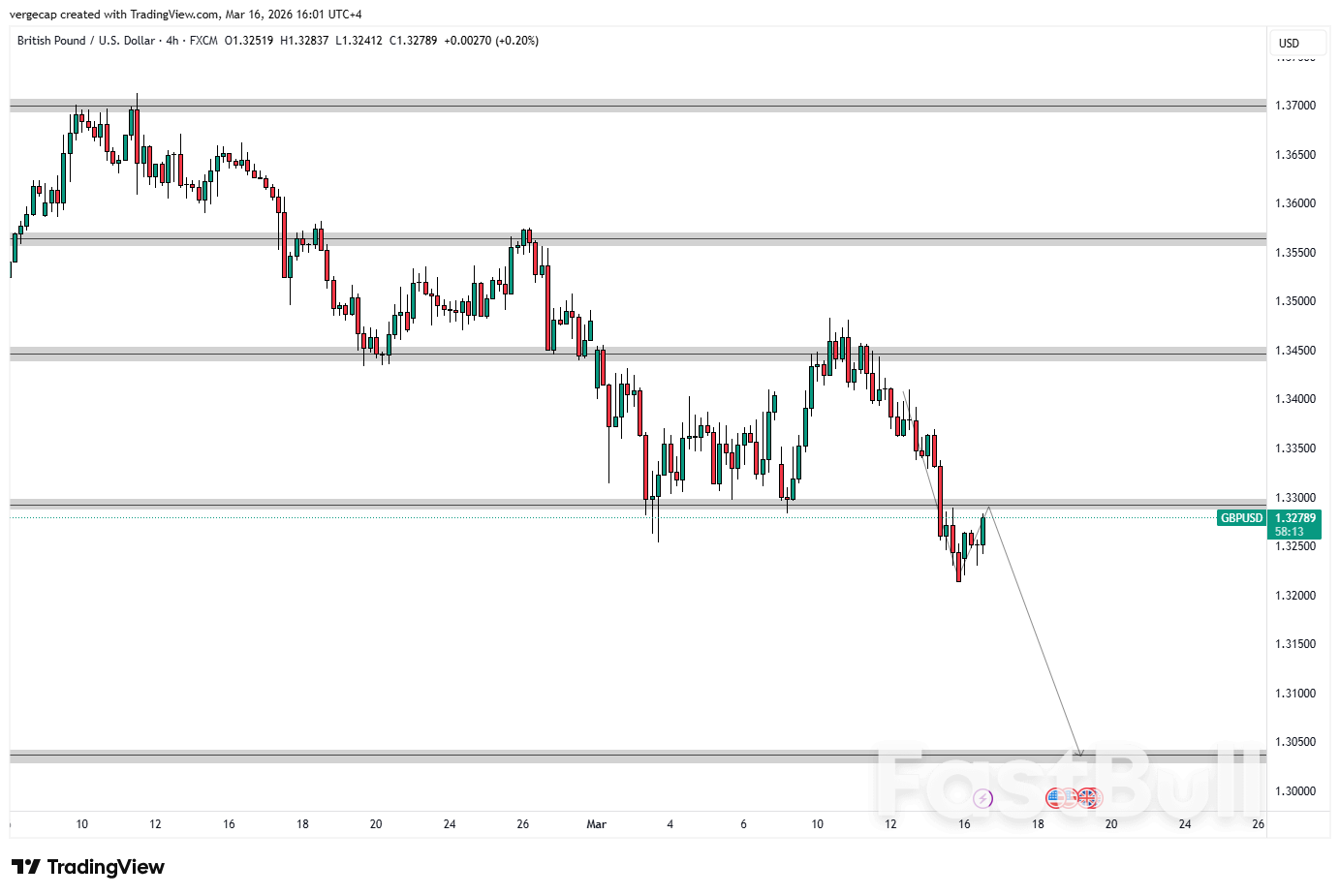
From a technical perspective, GBP/USD remains entrenched in a well-defined bearish structure. On the 4-hour chart, the pair continues to print lower highs and lower lows, reflecting persistent selling pressure that has dominated price action since mid-February. The broader structure shows a series of failed recovery attempts, with each rebound being capped by previous support zones that have now transitioned into resistance.
Currently, price is trading near the 1.3280 region, which corresponds with a previously established horizontal support zone around 1.3290–1.3300 that has recently been breached. This breakdown is technically significant as the level had previously acted as a consolidation base earlier in March. The failure to hold above this support suggests that bearish momentum remains firmly intact and that the recent minor rebound represents a corrective pullback rather than the beginning of a sustained recovery.
The next immediate resistance lies near the 1.3450 region, where the market previously experienced repeated rejection. This level marks an important structural barrier that now reinforces the prevailing bearish bias. A sustained move above 1.3450 would be required to challenge the current downtrend and potentially trigger a broader corrective rebound toward 1.3550, another historically significant supply zone. However, given the current market structure, such a scenario appears less likely in the near term unless buyers regain control with strong bullish momentum.
On the downside, the 1.3290–1.3300 zone now acts as initial resistance following the recent breakdown, and continued rejection below this area could accelerate selling pressure. If bears maintain control, the next major downside target emerges near the 1.3050 support zone, which represents a key historical demand area visible on the chart. A sustained move toward this region would confirm the continuation of the broader bearish trend and could attract additional momentum selling.
Price action also suggests that the current recovery attempt lacks strong conviction. The recent bounce from the 1.3220–1.3230 region appears corrective in nature, with the market struggling to establish a meaningful bullish structure. As long as GBP/USD remains capped below the 1.3300–1.3450 resistance corridor, rallies are likely to be viewed as selling opportunities within the prevailing downtrend.
Overall, the technical structure continues to favor bearish continuation, with the market likely to extend losses if sellers successfully defend nearby resistance levels and maintain pressure below the recently broken support zone.
TRADE RECOMMENDATION
SELL GBP/USD
ENTRY PRICE: 1.3290
STOP LOSS: 1.3350
TAKE PROFIT: 1.3050


