The British Pound is carving out modest but meaningful gains against the US Dollar on Friday, with GBP/USD edging up toward the 1.3444 handle during the European session as a confluence of geopolitical optimism and pre-data positioning drives cautious risk appetite across currency markets.
Sterling's advance has been broad-based against most of its major peers, though it trails against other European currencies where regional flows are also benefitting from the same peace-driven sentiment shift. The move, while not dramatic in pip terms, carries significant narrative weight — and in my view, it reflects a market that is quietly but deliberately repricing geopolitical risk downward for the first time in months.
The catalyst driving the Pound's outperformance is the most consequential geopolitical development in years: growing signals that Russia and Ukraine may be inching toward a negotiated settlement after more than four years of devastating conflict that has reshaped European security architecture, global energy markets, and the macroeconomic calculus of virtually every central bank in the developed world.
A Bloomberg report citing a senior adviser to Ukrainian President Volodymyr Zelenskyy indicated that Kyiv believes it is now close to reaching a peace agreement with Moscow. The significance of this statement cannot be overstated. Zelenskyy's inner circle has historically maintained maximalist positions, and any softening — particularly one surfacing through a credible news channel — suggests the diplomatic groundwork is more advanced than public discourse has let on.
Adding further weight to the narrative, the Kremlin on Friday issued a notably conciliatory statement of its own, declaring that peace with Ukraine could be achieved today if President Zelenskyy makes the decision. A senior Russian official went further, clarifying that Russia is seeking peace — not merely a ceasefire — a distinction that, if genuine, implies a willingness to engage on the structural political questions that have historically been the most intractable barriers to any lasting resolution.
From where I stand, the market is right to respond positively to these developments, but appropriate caution is warranted. We have seen false dawns in this conflict before. Diplomatic signals have a way of evaporating as quickly as they appear, particularly when domestic political pressures on both sides remain intense. Nevertheless, the directional shift in rhetoric from both Kyiv and Moscow represents the most synchronised signal of potential de-escalation we have seen, and risk assets — the Pound included — are pricing in a non-trivial probability that something substantive is taking shape behind closed doors.
Theoretically, any durable easing in the Russia-Ukraine conflict would deliver a meaningful tailwind to European risk assets and commodity-sensitive currencies, ease pressure on energy prices, and give central banks in the region — including the Bank of England — greater flexibility in managing their monetary policy trajectories without the overhang of geopolitical supply shocks distorting their inflation forecasts.
Compounding the already complex weekend risk calendar, investors are also closely monitoring a scheduled round of talks between the United States and Iran, which will take place over the weekend in Pakistan. The two nations are expected to engage on terms outlined in Iran's 10-point peace plan, which proposes a framework for a permanent ceasefire in the Middle East.
For currency and commodity markets, the stakes are enormous. The Middle East conflict has been a primary driver of the surge in global oil prices that has complicated monetary policy across the world, pushed inflation higher just as central banks were beginning to declare victory, and fundamentally altered the near-term growth outlook for energy-importing economies — including the United Kingdom. Any credible progress in these talks over the weekend could trigger a meaningful pullback in crude prices come Monday, which would have cascading disinflationary implications that markets have not yet priced in.
I believe these talks will be closely watched not just by oil traders, but by every fixed income and currency desk on the planet. The stakes for the inflation trajectory — and therefore for rate expectations globally — could not be higher.
As significant as the geopolitical backdrop is, the most immediate market-moving event of the day arrives at 12:30 GMT with the release of the US Consumer Price Index for March. This is, without question, the data print of the week — and arguably one of the most consequential inflation readings in recent months.
Consensus expectations are stark. Headline CPI is forecast to have accelerated sharply to 3.3% year-on-year in March, up from 2.4% in February — an eye-catching jump that would represent a significant reversal of the disinflation progress the Federal Reserve had been cautiously celebrating in recent quarters. On a monthly basis, headline inflation is projected to have risen by 0.9%, a dramatic acceleration from the 0.3% reading recorded in February.
If these numbers print anywhere close to expectations, the implications for the US Dollar, Federal Reserve rate expectations, and risk sentiment are profound. A 3.3% year-on-year CPI reading driven by elevated energy costs would effectively slam the door shut on any near-term Fed rate cut narrative, reinforce the case for a prolonged hold — or even raise the spectre of renewed tightening if energy prices remain elevated — and deliver a sharp jolt to equity and fixed income markets that have been reluctantly adjusting to a higher-for-longer rate environment.
For GBP/USD specifically, a hot CPI print would almost certainly cap the Pound's current advance. The Dollar would likely strengthen broadly as rate differentials reassert themselves, with the Fed forced into an uncomfortably hawkish posture just as the Bank of England navigates its own stagflationary dilemma.
Conversely, a softer-than-expected reading — perhaps reflecting some early demand destruction from the energy price shock — could provide Sterling with the fuel it needs to sustain and extend its current gains, potentially opening the door to a test of the 1.3500 psychological level.
This is a Friday that encapsulates everything that has made 2026 such a treacherous environment for traders and policymakers alike. Geopolitical headlines and hard economic data are colliding in real time, and the market must simultaneously process the probability of peace in Eastern Europe, diplomatic progress in the Middle East, and an inflation print that could reshape central bank expectations for the rest of the year.
Sterling's move higher feels justified on risk-sentiment grounds for now, but I would be reluctant to chase it aggressively ahead of the CPI release. The risk is asymmetric: a hot inflation number could erase today's gains quickly, while a soft reading would validate the move and create a cleaner entry opportunity on a breakout basis.
For now, the Pound's resilience is a story of geopolitical hope meeting a market hungry for good news — but the cold reality of inflation data will have the final word before the weekend begins.
Technical Analysis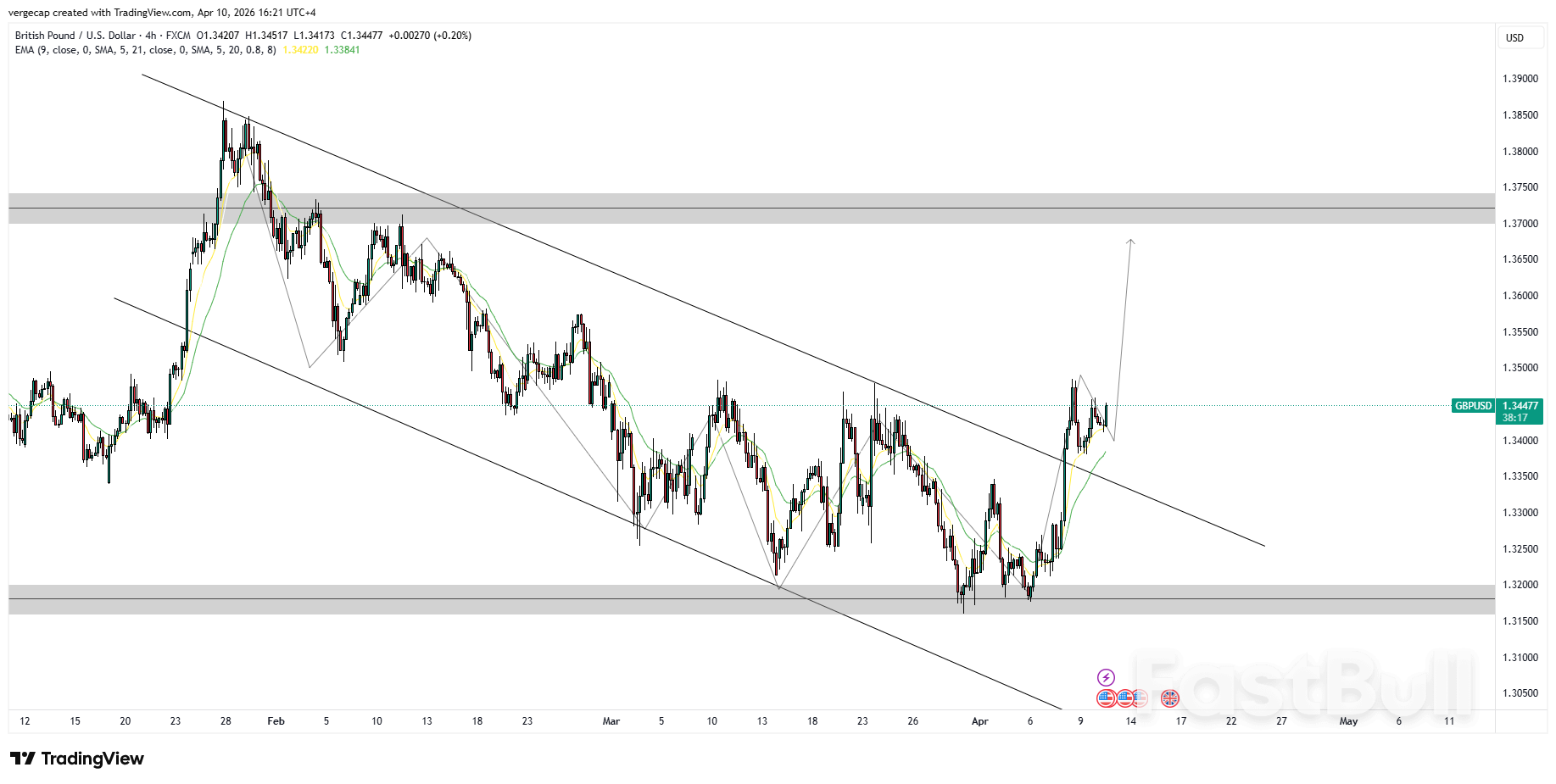
GBP/USD — 4-Hour Technical Analysis | April 10, 2026
From a technical perspective, GBP/USD has delivered one of the most significant structural developments seen on the 4-hour chart in months — a decisive breakout above the upper boundary of a well-defined descending channel that has dominated price action since the late January peak near 1.3890. This channel, which guided the pair steadily lower through February, March, and into early April, compressing price from multi-month highs all the way down to the 1.3190–1.3210 major support floor, has now been convincingly violated to the upside. The breakout is not a marginal or tentative one — price surged through the descending trendline with authority in the April 8–9 sessions, confirming that the corrective phase that defined the first quarter of 2026 has run its course.
The 9-period EMA, currently tracking at 1.3422, and the 21-period SMA, sitting at 1.3384, have both turned upward and are now positioned beneath price in a bullish alignment — the first time this configuration has been cleanly established since the pair was trading near the January highs. This moving average structure is a meaningful confirmation signal. During the entirety of the descending channel phase, price consistently traded below these averages or used them as dynamic resistance on recovery attempts. Their transition to support beneath a rising price underscores the shift in momentum from bearish to bullish.
Price is currently consolidating around the 1.3440–1.3450 area, which corresponds to a near-term pivot level marked by a dotted horizontal reference on the chart. This level deserves close attention. A clean hold above 1.3440 on any near-term pullback — with the 9 EMA and 21 SMA providing a rising dynamic floor — would represent healthy consolidation within the new bullish structure and set the stage for the next leg higher. A dip back toward the 21 SMA near 1.3384 should not in itself be interpreted as a failure of the breakout, provided price does not close back below the broken channel boundary, now acting as support in the 1.3320–1.3350 region.
The primary upside target is clearly defined by the 1.3750–1.3760 major resistance band, a zone that capped the pair decisively during the February period and represents the most significant supply area between current price and the January highs. A sustained push through this level — which aligns with the projected move arrow drawn on the chart — would complete a full recovery of the descending channel's entire range and open the door toward a retest of the 1.3880–1.3900 region where the broader correction originated.
On the downside, the 1.3190–1.3210 major support band — the floor that held throughout the most aggressive selling of late March and early April — remains the definitive invalidation level for the bullish thesis. A breakdown below this zone would represent a catastrophic failure of the recovery structure and signal that the corrective move has resumed with potentially greater intensity. Between current price and that floor, the 1.3300 area and the channel boundary near 1.3320–1.3350 offer intermediate layers of support that should absorb any near-term selling pressure.
The measured move derived from the width of the descending channel, projected from the breakout point, points toward the 1.3700–1.3750 zone as a technically derived first target — consistent with the resistance band and the chart's own projected arrow. This gives bullish traders a well-defined risk-reward framework with clear entry, stop, and target parameters.
The overall picture is one of trend reversal in progress. The descending channel has been broken, the moving averages have turned supportive, and the structure of higher lows is beginning to form. The near-term consolidation near 1.3440 is constructive rather than concerning, and any dip that holds above the broken channel line should be treated as a buying opportunity rather than a warning signal.
TRADE RECOMMENDATION
BUY GBP/USD
ENTRY PRICE: 1.3445
STOP LOSS: 1.3300
TAKE PROFIT: 1.3750


