The British Pound struggled to maintain gains against the Japanese Yen on Thursday, with GBP/JPY retreating back below the 213.30 region after another failed attempt to clear resistance near 213.70. The cross initially pushed higher during the Asian session following stronger-than-expected UK economic data, but renewed caution surrounding potential Japanese currency intervention kept traders from aggressively selling the Yen.
Preliminary figures released earlier in the day showed that the United Kingdom economy expanded by 0.6% in the first quarter, accelerating sharply from the previous quarter’s 0.2% growth pace. Monthly Gross Domestic Product data also surprised to the upside, rising 0.3% against expectations for a 0.2% contraction. The figures helped ease fears that geopolitical instability tied to the ongoing Middle East conflict would significantly weaken British economic activity.
In my view, the stronger UK data reinforces expectations that the British economy remains more resilient than previously anticipated, particularly as consumer spending and service-sector activity continue to hold up despite elevated borrowing costs. That resilience has offered underlying support to Sterling in recent weeks, especially against lower-yielding currencies such as the Japanese Yen.
However, upside momentum in GBP/JPY remains limited as traders continue to tread carefully around the Yen. Market participants remain highly sensitive to the possibility of another intervention from Japanese authorities after several suspected operations in recent weeks aimed at slowing the Yen’s depreciation.
Support for Tokyo’s stance was reinforced earlier this week after US Treasury Secretary Scott Bessent acknowledged concerns over excessive currency volatility during meetings with Japanese Prime Minister Sanae Takaichi. The remarks were viewed by markets as a signal that Washington may tolerate further action from Japanese authorities if speculative moves intensify again.
The broader macro backdrop also continues to favor a cautious approach toward Yen selling. While the Bank of Japan remains significantly more dovish than other major central banks, policymakers have recently opened the door to additional tightening if inflation and wage growth remain firm. That has prevented traders from building aggressive bearish Yen positions despite the pair’s broader bullish trend.
At the same time, global risk sentiment remains fragile as geopolitical tensions in the Middle East continue to cloud the outlook for energy prices and inflation. Rising Oil prices have increased uncertainty across currency markets, with investors wary that any further escalation could trigger renewed safe-haven flows into the Yen.
From a broader perspective, GBP/JPY still appears supported by the divergence between UK and Japanese monetary policy expectations. The Bank of England remains cautious about easing policy too quickly due to sticky inflation pressures, while the Bank of Japan is expected to normalize rates only gradually. Even so, the threat of intervention and shifting global risk sentiment are likely to keep volatility elevated in the near term.
For now, traders appear reluctant to push GBP/JPY decisively above the 214.00 psychological barrier until there is greater clarity on both Japanese policy intentions and broader geopolitical developments.
Technical Analysis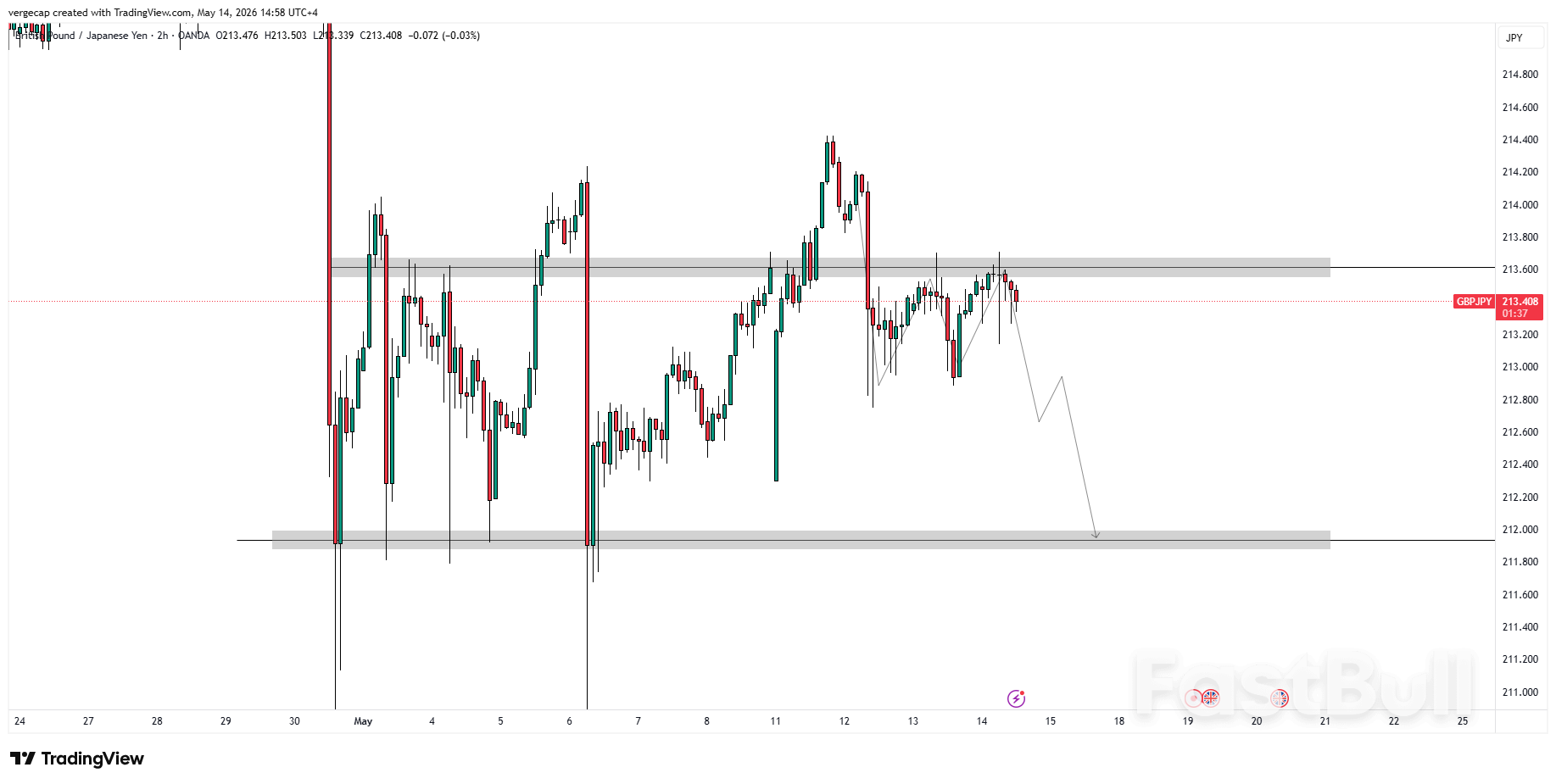
GBP/JPY is beginning to exhibit signs of mounting bearish pressure within a broader sideways market structure on the 2-hour timeframe. Price action continues to struggle beneath the 213.60–213.70 resistance region, an area that has repeatedly capped upward advances and acted as a firm supply zone in recent sessions. Multiple rejection candles around this level indicate persistent selling interest, preventing buyers from establishing sustained bullish momentum.
The pair is currently hovering near 213.40 following another failed breakout attempt, with short-term momentum gradually tilting to the downside. Recent price behavior suggests weakening buying strength, while the projected path on the chart points toward a potential decline into the major support region around 211.90–212.00. This demand area has previously provided strong buying support during several pullbacks, making it a key target if bearish momentum continues to build.
Structurally, GBP/JPY remains confined within a broad consolidation range bounded by support near 211.90 and resistance around 213.70. However, repeated rejection from the upper boundary of the range increases the likelihood of a rotation lower toward the bottom of the structure. Unless bulls manage to force a decisive breakout above resistance, the short-term outlook remains biased toward further downside correction.
Near-term resistance is clearly positioned at 213.60–213.70, where previous highs and rejection points continue to attract sellers. A sustained break above this barrier would invalidate the immediate bearish scenario and potentially open the door for a continuation rally toward the 214.30–214.50 region. Such a move would indicate renewed bullish momentum and a possible resumption of the broader upward trend.
On the downside, initial support is located around 212.80, followed by the more important demand zone between 211.90 and 212.00. A clean breakdown beneath this support area would significantly weaken the current market structure and expose the pair to deeper losses toward the 211.00 psychological level. A move of that magnitude would likely confirm a broader bearish shift rather than a temporary corrective decline.
Momentum studies also point to fading bullish strength. Price is beginning to form lower highs beneath resistance while upside continuation remains limited, signaling a gradual loss of buying momentum. The Relative Strength Index (RSI) appears to be easing back toward neutral territory after failing to maintain strength near overbought levels, suggesting that bullish pressure is cooling without yet entering deeply bearish conditions.
At the same time, the Moving Average Convergence Divergence (MACD) is flattening and starting to rotate lower, reflecting slowing upside momentum and reinforcing expectations for continued short-term consolidation or downside movement. Although the bearish momentum is not yet aggressive, current conditions suggest sellers are slowly gaining control while the pair remains below resistance.
Overall, the technical outlook favors a corrective bearish move as long as GBP/JPY continues trading beneath the 213.70 supply zone. Repeated failures at resistance, weakening momentum signals, and the projected downside trajectory collectively support expectations for a move toward lower support levels before any meaningful bullish continuation develops.
TRADE RECOMMENDATION
SELL GBP/JPY
ENTRY PRICE: 213.40
STOP LOSS: 214.00
TAKE PROFIT : 211.00


