The British pound retreated against the Japanese yen on Wednesday, easing from fresh long-term highs above the 212.00 mark reached earlier in the week, as renewed geopolitical tensions in Asia and a shift toward risk aversion lifted demand for the safe-haven Japanese currency. GBP/JPY slipped back below 211.00, with traders opting to lock in profits following the pair’s strong multi-week rally and reassess exposure amid deteriorating regional sentiment.
The move came as relations between China and Japan took a more confrontational turn. On Tuesday, Beijing announced a ban on exports of dual-use goods to Japan, materials that can be employed for both civilian and military purposes. The decision is widely viewed as a direct response to comments made by Japanese Prime Minister Sanae Takaichi regarding Taiwan, which have further strained diplomatic ties between Asia’s two largest economies after China.
Takaichi stated in November that a hypothetical Chinese military action against Taiwan could prompt a response from Japan, remarks that were met with strong condemnation from Beijing. The episode reopened long-standing geopolitical fault lines in the region, raising concerns among investors about potential disruptions to trade, supply chains, and broader regional stability. Markets responded by scaling back risk exposure, a move that traditionally favors the Japanese yen given its long-standing role as a safe-haven and funding currency.
Adding to the yen’s strength were comments from Bank of Japan Governor Kazuho Ueda, who reiterated earlier this week that the central bank remains committed to further monetary tightening. While the pace of normalization is expected to remain cautious, Ueda’s remarks reinforced expectations that Japan is gradually moving away from decades of ultra-loose monetary policy. This narrative has become increasingly supportive for the yen, particularly during periods when global risk appetite fades.
In contrast, sterling struggled to find support from domestic fundamentals. In the UK, December’s final S&P Global Services PMI was revised lower to 51.4 from a preliminary reading of 52.1, pointing to softer momentum in the country’s dominant services sector. Although the index remains in expansionary territory, the downward revision underscores concerns that economic growth is losing traction as higher interest rates and tighter financial conditions weigh on activity.
Despite the near-term decline, the broader trend in GBP/JPY remains decisively bullish. The pair is still trading nearly six percent above its early-November lows, reflecting persistent structural pressures on the yen. Chief among these are ongoing concerns about Japan’s fiscal position. In December, Prime Minister Takaichi’s cabinet approved an additional $118 billion budget to fund a new stimulus package, a move that is expected to exacerbate strains on public finances already burdened by one of the highest debt-to-GDP ratios in the developed world.
While fiscal stimulus may offer short-term economic support, it also reinforces longer-term doubts about sustainability, limiting the yen’s ability to mount a sustained recovery during periods of calm market conditions. As a result, rallies in the Japanese currency have so far been largely reactive, driven by external shocks rather than a durable shift in fundamentals.
From a market perspective, the current pullback in GBP/JPY appears corrective rather than indicative of a broader trend reversal. Geopolitical risk and central bank rhetoric have provided temporary relief for the yen, but unless tensions escalate further or the Bank of Japan delivers a more aggressive tightening path, the structural yield advantage enjoyed by sterling is likely to keep the longer-term bias tilted to the upside.
Technical Analysis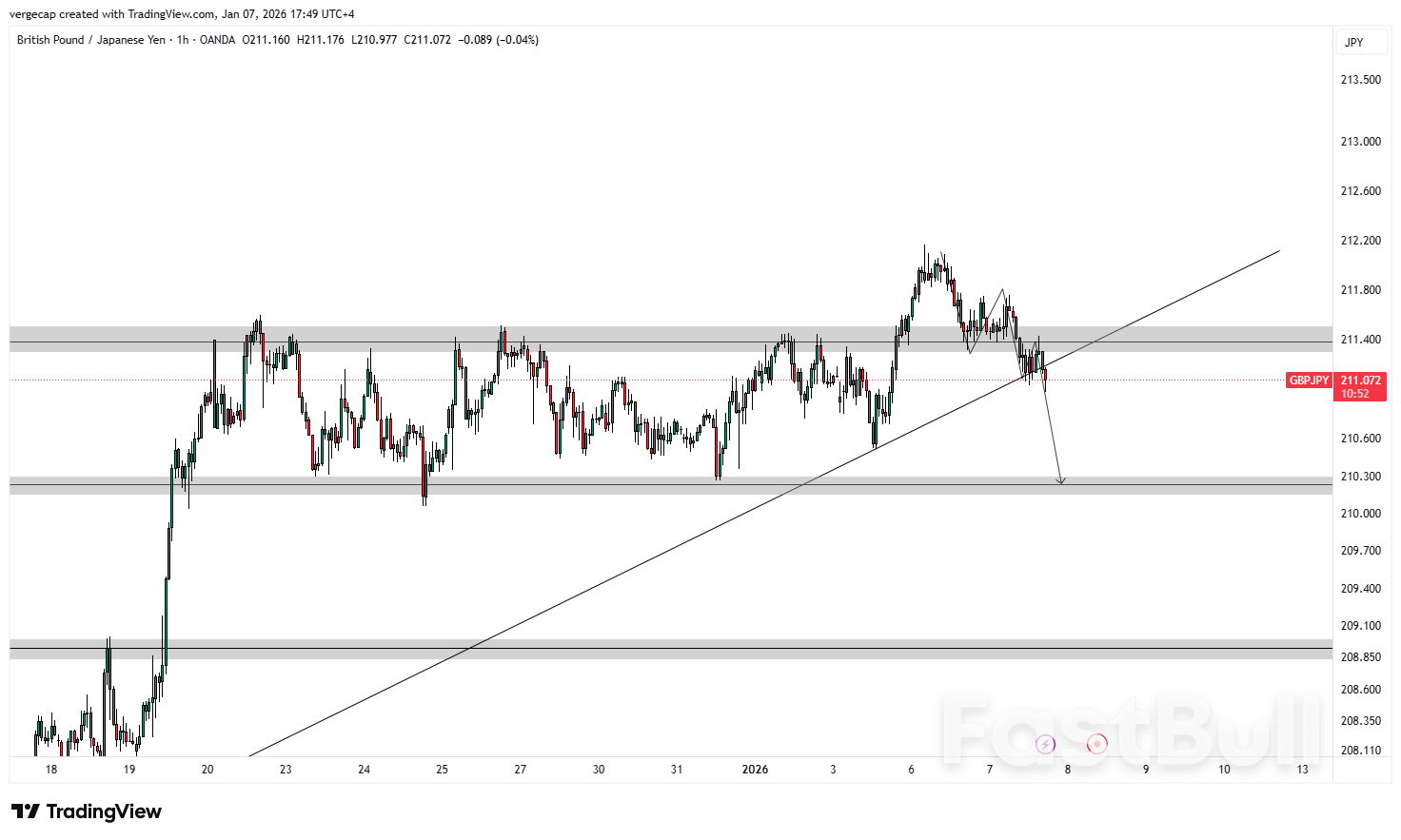
From a technical standpoint, short-term price action supports the view of a corrective move. On the hourly chart, GBP/JPY has reacted sharply from the 211.37 area, a key overlap support zone that has now acted as resistance. The rejection from this level suggests that bearish momentum has room to extend in the near term. The move lower remains technically valid as long as price holds below the 211.98 region, which represents a recent swing high and a critical resistance level. On the downside, the 210.54 area stands out as an important pullback support, where buying interest could re-emerge in line with the broader bullish trend. Momentum indicators on lower timeframes continue to favor further consolidation or modest downside before the next directional move takes shape.
TRADE RECOMMENDATION
SELL GBPJPY
ENTRY PRICE: 211.00
STOP LOSS: 212.00
TAKE PROFIT: 209.00


