GBP/JPY extends its decline after failing to sustain gains near the 213.00 region, dropping sharply to around 211.30 during the European session on Monday. The currency cross comes under heavy selling pressure as a powerful Yen resurgence overwhelms an already-fragile Sterling.
The pair's sharp slide on the 4-hour chart was primarily triggered by a forceful intervention warning from Japanese authorities. Japan's Vice Finance Minister for International Affairs, Atsushi Mimura, issued his strongest warning yet to currency speculators after the Yen crossed a critical threshold, stating that growing concern exists over speculative activity not only in crude oil futures markets but also in the foreign exchange market, and that decisive action may soon be necessary. His comments immediately jolted the Yen higher across all majors, with GBP/JPY catching the full force of the reversal.
The Japanese Yen had earlier weakened past the closely watched 160 per dollar level — its lowest since July 2024, when Tokyo last intervened directly in currency markets — pressured by surging oil prices tied to the Middle East conflict, as higher import costs threatened to derail Japan's economic recovery. However, the Yen subsequently edged away from that critical level after BoJ Governor Kazuo Ueda reinforced the intervention rhetoric, stating that currency movements are a factor with a significant impact on the Japanese economy and prices. The one-two punch from both the Ministry of Finance and the Bank of Japan proved sufficient to reverse speculative Yen short positions sharply.
On the Sterling side, the Pound offered little resistance to the selloff. Risk aversion remained elevated as US-Iran tensions continued to dominate market sentiment, with President Trump claiming Iran seeks a deal while Iranian state media rejected negotiations and instead pushed for unilateral guarantees — including potential fees for ships passing through the Strait of Hormuz. Brent crude has been nearing $105 per barrel, poised for its largest monthly gain since 1990.
Domestically, the UK economy remains in a stagflationary bind that limits the Pound's ability to recover. The Bank of England's MPC held Bank Rate unchanged at 3.75% on 19 March in a unanimous vote — the first unanimous decision since September 2021 — amid concerns that Middle East-driven energy price rises will push CPI inflation to between 3% and 3.5% over the next couple of quarters. The unemployment rate has also climbed to 5.2%, its highest in a decade, while GDP grew by just 0.1% in Q4 2025.
UK economic momentum continues to soften, with signs that demand and hiring are losing traction, and Pantheon Macroeconomics expects the Bank of England to remain cautious with a growing bias towards easing later in the year — a prospect that caps any meaningful GBP upside. Notably, the UK's February CPI report showed headline inflation stuck at 3.0%, but this data predates the full force of the Middle East energy shock, meaning the worst of the inflationary impact is yet to be reflected in the figures.
The path of least resistance for GBP/JPY remains tilted to the downside in the near term. A combination of aggressive Japanese verbal intervention, BoJ resolve on currency stability, a stagflation-constrained Bank of England, and persistent geopolitical risk from the Iran conflict creates a fundamental backdrop that continues to favour the Yen. Traders will closely watch for any escalation in Japan's intervention language, further oil price moves, and whether the next scheduled BoE meeting on 30 April delivers a surprise rate hike — a scenario that could provide the only meaningful fundamental support for Sterling.
Technical Analysis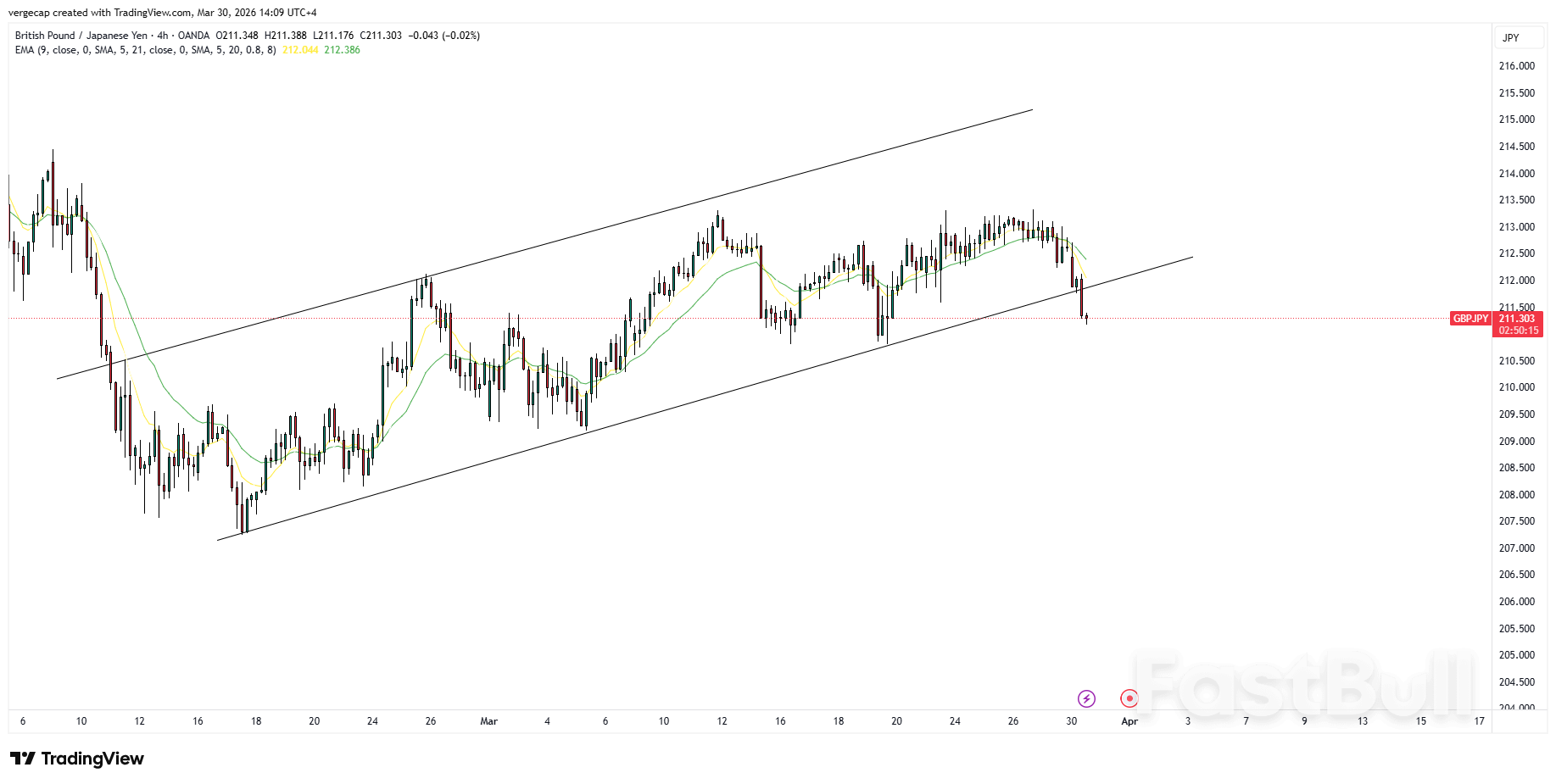
From a technical perspective, GBP/JPY has undergone a meaningful structural deterioration on the 4-hour chart. After trading within a well-defined ascending channel since mid-February 2026, the pair has now staged a decisive breakdown below the channel's lower boundary — a development that fundamentally shifts the near-term bias from bullish to bearish. The break is not a minor wick or temporary deviation; price has closed convincingly below the channel floor near the 211.50 level, confirming that the ascending structure that had been guiding price higher over recent weeks has been violated.
The moving averages reinforce the bearish case. Both the 9-period EMA and the 21-period SMA, currently converging around 212.03–212.38, have crossed above the current price and are now acting as dynamic resistance rather than support. This inversion — where price trades beneath its short and medium-term averages while both are beginning to roll over — is a classic sign of momentum shifting to the downside. Any attempted recovery that fails to reclaim and sustain above 212.00 should be treated as a corrective bounce within a developing bearish sequence rather than a genuine trend reversal.
The breakdown zone between 211.50 and 212.00 now becomes the critical resistance region. A recovery attempt into this area that produces a lower high — particularly around the 211.80–212.10 area — would represent a textbook retest of broken support and a potential high-probability entry for fresh shorts. Confirmation through a bearish rejection candle in this zone would add significant weight to the sell thesis.
On the downside, the projected extension of the channel breakdown points toward the 209.50–210.00 area as the first meaningful target, where prior consolidation activity from early-to-mid March 2026 offers a natural area for price to pause. Below that, a sustained failure at 209.50 opens up a deeper move toward the 208.00–208.50 zone — consistent with the measured move projection drawn on the chart — which also aligns with a previous swing low from mid-February. A broader deterioration beyond 208.00 would bring the 207.00–207.50 region into focus, marking a more complete corrective cycle from the March highs.
The velocity of the current selloff — illustrated by the sharp bearish candle that pierced the channel floor — suggests the market is not simply consolidating. The aggressive nature of the move points to stop-loss triggering and momentum-driven selling, which historically tends to produce follow-through rather than immediate stabilization.
TRADE RECOMMENDATION
SELL GBP/JPY
ENTRY PRICE: 211.250
STOP LOSS: 212.80
TAKE PROFIT: 208.50


