The British Pound is extending its dominance over the Japanese Yen for the fourth consecutive trading session on Thursday, with GBP/JPY finding renewed buying interest on dips into the lower 212.00 region and bulls keeping their sights firmly locked on the March highs around 213.30. The pair's sustained upward trajectory tells a compelling story — not just about the relative strength of Sterling, but about how brutally the ongoing war in the Middle East is reshaping the currency hierarchy across Asia and beyond.
Since hostilities escalated in the region and crude oil prices surged aggressively toward and above the psychologically critical $100 per barrel level, the Japanese Yen has found itself in an increasingly uncomfortable position. Japan, as one of the world's largest importers of crude oil, sits squarely in the crosshairs of any energy price shock of this magnitude. The arithmetic is straightforward and deeply painful for Tokyo: higher oil prices mean a dramatically wider import bill, a deteriorating current account position, and a drag on economic growth that no amount of monetary policy adjustment can fully offset in the near term. For currency markets, this translates directly into persistent and structural headwinds for the Yen — headwinds that have proven far more powerful than the brief spurts of safe-haven demand that a conflict of this nature might otherwise generate for Japan's currency.
This is the central paradox that has defined Yen trading since the Iran war began. In a conventional geopolitical crisis, traders typically pile into the Yen as a refuge asset. But this conflict is not conventional in its implications for Japan. The energy price shock is of sufficient severity that the economic damage narrative is overwhelming the safe-haven narrative, leaving Yen bulls with precious little to work with on a sustained basis.
Against this backdrop, the British Pound has demonstrated a degree of resilience that deserves genuine credit. The United Kingdom, while not immune to the inflationary consequences of higher energy prices, is far less exposed to crude oil import dependency than Japan, and the Bank of England's unanimous decision in March to hold rates at 3.75% — with a clearly communicated hawkish bias — has provided the pound with a meaningful policy support pillar. Markets are now pricing in the possibility that the BoE's next move could actually be a rate hike rather than a cut, a dramatic shift in expectations that has kept Sterling well-bid against funding currencies like the Yen.
The pullbacks in GBP/JPY into the lower 212.00s have been shallow, orderly, and consistently met with buying interest — the hallmark of a pair that is trending with conviction rather than merely bouncing. Each dip has found support, each recovery has nudged the ceiling slightly higher, and the pattern of higher lows that has emerged over the past four sessions is exactly the kind of structure that trend-following participants seek out.
The most intriguing development this week came courtesy of Japan's Labour Cash Earnings data, which printed stronger than expected and briefly injected some genuine optimism into the Yen's corner. The data stoked speculation that the Bank of Japan could be forced to bring forward its timeline for the next interest rate hike — a prospect that carries real significance for a currency whose weakness has been largely built on the foundation of ultra-loose monetary policy and a historically wide interest rate differential against its G10 peers.
Former BoJ board member Seiji Adachi added fuel to this fire on Tuesday, publicly endorsing the idea that a near-term rate hike was a credible and appropriate policy response given the current wage and inflation dynamics in Japan. His comments sent the Yen bouncing sharply higher from its session lows on Wednesday, briefly threatening to disrupt GBP/JPY's four-day winning streak.
But the rally was short-lived — and that tells you everything you need to know about the current state of Yen sentiment. Within hours, the modest recovery had faded entirely, and GBP/JPY was back pressing higher. The message from the market was unambiguous: a potential BoJ rate hike, however real the prospect may be, cannot compete with the immediate and visceral impact of $100-plus oil on Japan's economic outlook. Until there is either a ceasefire in the Middle East that credibly reduces energy price pressure, or a clear and imminent BoJ policy action rather than mere speculation about one, the Yen's structural disadvantage is unlikely to be resolved.
Technical Analysis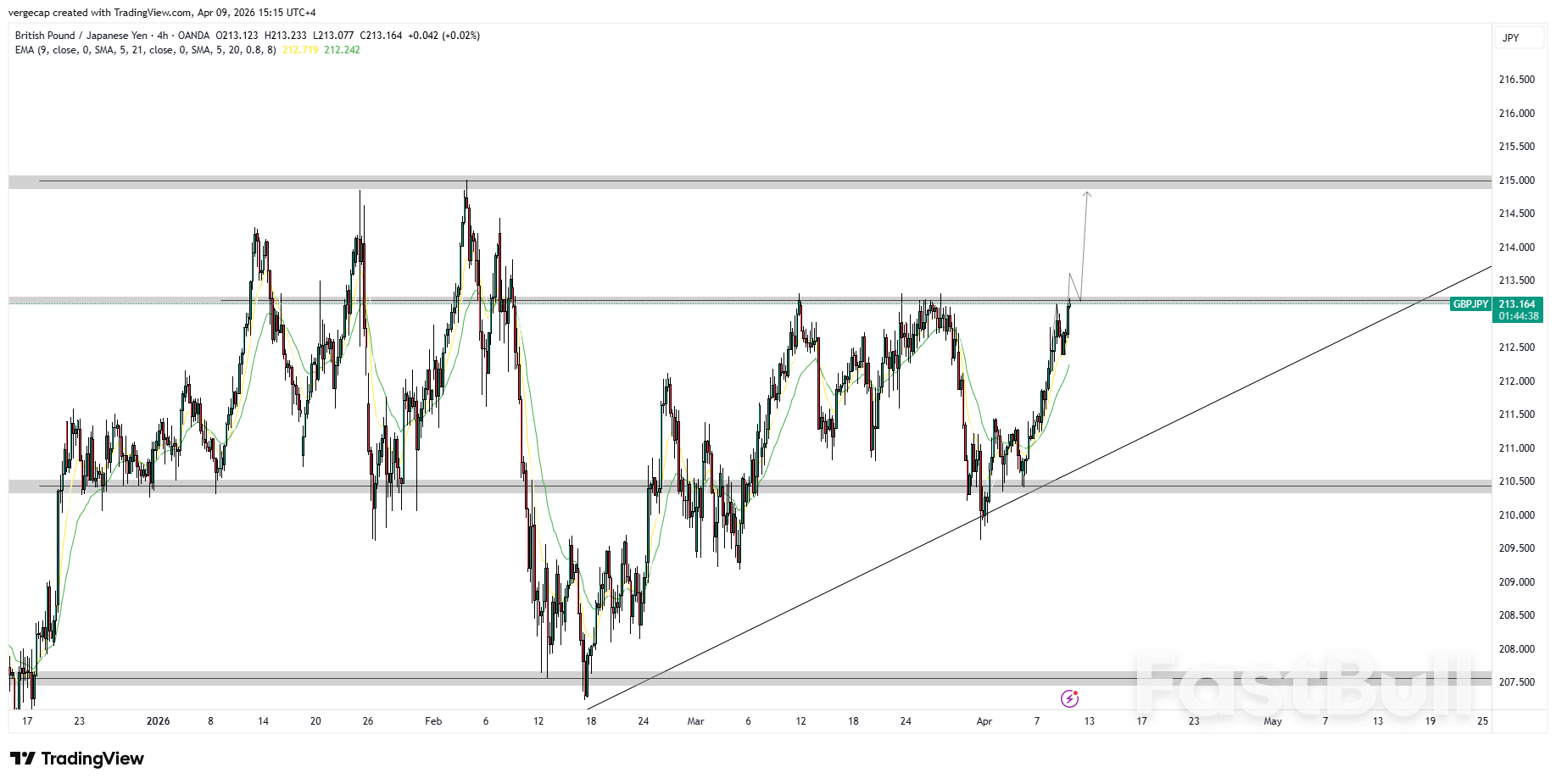
GBP/JPY is positioned at one of the most consequential decision points on its 4-hour chart, trading around 213.16 and pressing directly against the well-established horizontal resistance band between 213.30 and 213.50 — a ceiling that has rejected price on no fewer than four separate occasions since mid-January 2026. The significance of this level cannot be overstated. It has defined the upper boundary of the pair's multi-month range, capping rallies in late January, mid-February, and again in late February before the pair's sharp collapse toward 207.50. The fact that bulls have driven price back to this exact zone for a fresh test, after recovering the entirety of that steep decline, speaks volumes about the underlying demand that has been building throughout March and into early April.
Supporting the bullish case is a well-defined ascending trendline that has been developing since the February 18 low near 207.50. This trendline has cleanly connected a series of higher lows — through the mid-March lows around 209.50, the late March base near 210.00, and the early April lows around 210.50 — and currently slopes upward through the 211.00–211.50 region. The integrity of this trendline over such an extended period and across multiple tests elevates its technical significance considerably. It represents the structural backbone of the current bullish recovery phase, and as long as it remains unbroken on a closing basis, the broader upward bias remains intact.
The moving averages reinforce this constructive picture. The 9-period EMA, currently at 212.72, and the 21-period SMA at 212.24, are both tracking higher beneath price in a clean bullish stack formation. This alignment — with price above both averages, and the faster EMA above the slower SMA — is the textbook configuration of a trending market in an upward phase. The 21 SMA in particular has been acting as a reliable dynamic support during intraday pullbacks over recent sessions, with dips into the 212.00–212.25 area consistently finding buyers. Any corrective move that holds above the 21 SMA would represent a continuation signal rather than a reversal warning.
The immediate and critical test now is whether bulls can deliver a sustained 4-hour close above the 213.30–213.50 resistance band. Given the number of times this zone has rejected advances, a clean break through it would carry outsized technical significance — triggering stop-loss orders from trapped shorts, activating breakout strategies from momentum participants, and potentially attracting fresh trend-following interest. The measured move projection drawn on the chart targets the 215.00 major resistance ceiling following a confirmed breakout, a level that aligns with the broader horizontal supply zone visible at the top of the chart's range. A sustained push toward 215.00 would represent a full recovery of the February selloff and mark a significant shift in the medium-term structure of this pair.
On the downside, the ascending trendline near 211.00–211.50 represents the first meaningful support layer below the current price. A pullback toward this zone that produces a clear bullish reaction — particularly a hammer or engulfing candle on the 4-hour timeframe — would constitute a high-probability continuation setup within the broader uptrend. Below the trendline, the 210.50 horizontal support band becomes relevant, a level that has served as both support and resistance multiple times throughout March. A decisive close beneath 210.50 would damage the recovery structure and bring the 208.00–208.50 zone back into view. The ultimate line in the sand for bulls remains the 207.50 swing low — a break of which would signal a complete breakdown of the current bullish thesis.
The confluence of the ascending trendline, the bullish EMA/SMA alignment, and the four-day streak of higher lows creates a technically compelling case for an upside resolution at the 213.30–213.50 resistance. The structure has been built methodically and with discipline — each pullback shallower than the last, each recovery more confident. This is the behavior of a pair that is accumulating energy for a breakout, not one that is rolling over.
TRADE RECOMMENDATION
BUY GBP/JPY
ENTRY PRICE: 213.30
STOP LOSS: 211.30
TAKE PROFIT: 215.00


